

Flowers that start with C form one of the richest groups in the entire alphabet, spanning nearly every climate and continent. This guide gathers 100 real flowers, from the elegant Camellia to the tiny Cupid’s Dart. Each entry includes a checked botanical name, native range, bloom time, and toxicity note. Whether you garden, arrange bouquets, or just love plant names, this list has something new on nearly every line.
- Quick Answer: Top Flowers That Start With C
- Master Alphabetical List of Flowers That Start With C
- Full Comparison Table of Flowers That Start With C
- Garden Favorites Among Flowers That Start With C
- Indoor Plants Among Flowers That Start With C
- Florist Favorites Among Flowers That Start With C
- Rare Flowers That Start With C
- Flowers That Start With C and Need Caution
- Color-Based Groupings of Flowers That Start With C
- Life-Cycle Groupings of Flowers That Start With C
- Botanical Name Crosswalk for Flowers That Start With C
- Flower Meanings and Symbolism
- Decision Guide: Which Flower That Starts With C Should You Choose?
- Conclusion
- Frequently Asked Questions
This article is built for several kinds of readers at once. A home gardener can use it to fill a bed with dependable, colorful choices. A florist can use it to find fresh C-letter stems for a bouquet. A parent or pet owner can use it to spot risky plants like Carolina Jessamine or Christmas Rose. A curious plant lover can simply enjoy how wide this one letter’s range turns out to be.
The flowers below are organized in several useful ways. A master alphabetical list comes first, followed by a full comparison table covering all 100 entries. After that come category sections for garden favorites, indoor plants, florist picks, rare finds, and toxic plants, each with real photo captions built in. Color groups and life-cycle groups follow near the end, before a full FAQ section.
Every flower named here has a real, verified botanical name. Native range and toxicity notes appear throughout, so you can plan safely around kids or pets. Image captions follow many individual flower descriptions, making it easy to slot in a photo later. By the end, you should be able to pick flowers that start with C for almost any garden goal.
Quick Answer: Top Flowers That Start With C
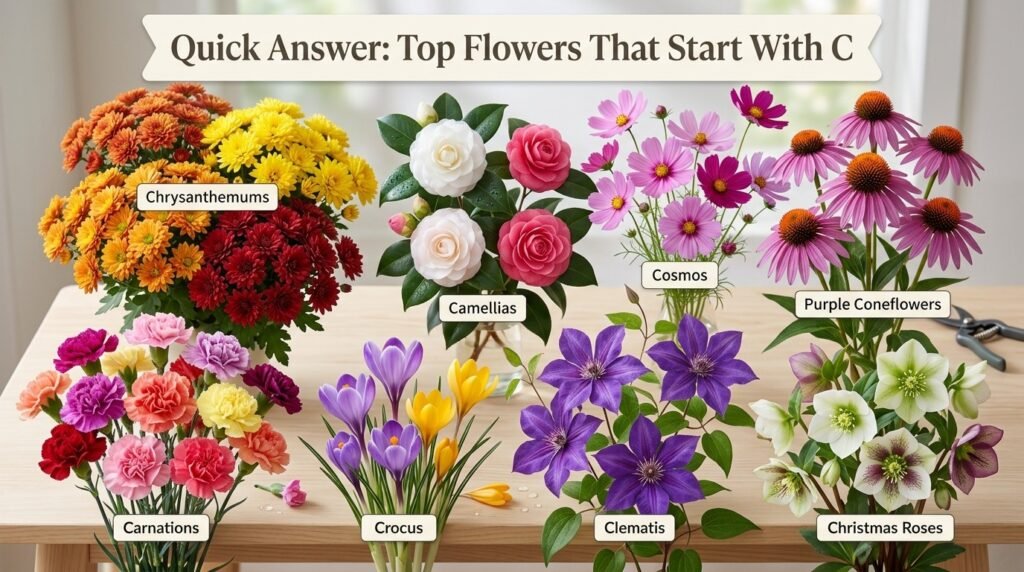
If you only remember a few names, start here. Camellia is a winter-blooming classic, prized for glossy leaves and rose-like flowers. Chrysanthemum defines fall gardens with dense mounds of color in nearly every shade. Cosmos brings airy, fast summer blooms that pollinators visit constantly. Purple Coneflower is a native perennial favorite, tough enough for almost any sunny bed. Carnation remains one of the longest-lasting cut flowers sold in florist shops. Crocus pushes through late winter snow, often the very first bloom of the year. Clematis climbs a trellis fast, covering it in large, showy flowers each summer. Christmas Rose rounds out the list as a striking winter bloomer, though every part of it is toxic.
Master Alphabetical List of Flowers That Start With C
Some flowers here start with C in their common name, like Camellia or Cosmos. Others start with C only through a botanical or genus name, like Cerinthe or Calceolaria. Both types appear below, since most searches for this topic mix common and botanical names.
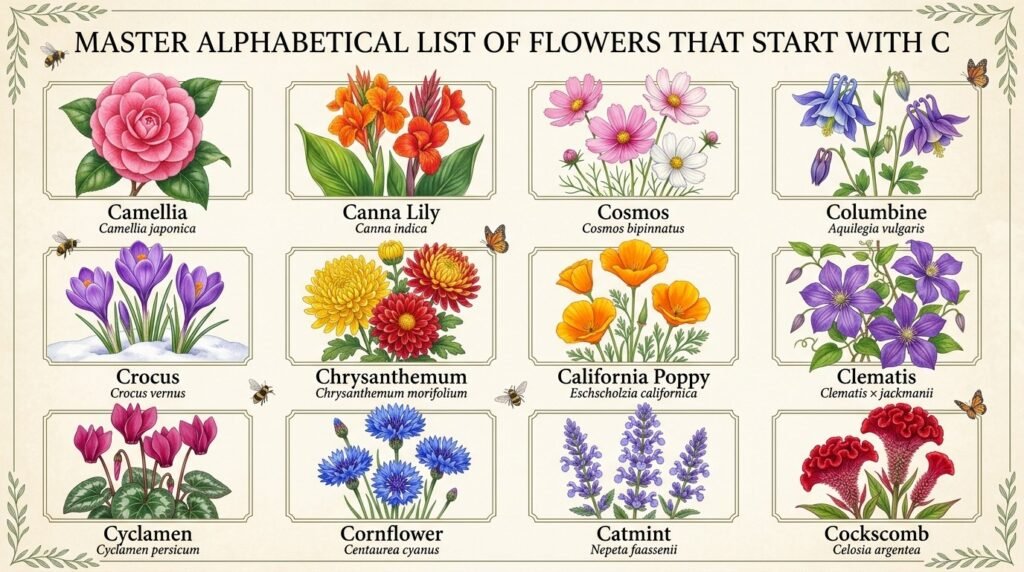
- Camellia (Camellia japonica)
- Candytuft (Iberis sempervirens)
- Canna Lily (Canna indica)
- Carnation (Dianthus caryophyllus)
- Catmint (Nepeta faassenii)
- Cattleya Orchid (Cattleya labiata)
- Cockscomb (Celosia argentea)
- Chrysanthemum (Chrysanthemum morifolium)
- Clematis (Clematis × jackmanii)
- Columbine (Aquilegia vulgaris)
- Purple Coneflower (Echinacea purpurea)
- Coral Bells (Heuchera sanguinea)
- Cosmos (Cosmos bipinnatus)
- Crocus (Crocus vernus)
- Crown Imperial (Fritillaria imperialis)
- Cyclamen (Cyclamen persicum)
- California Poppy (Eschscholzia californica)
- Calendula (Calendula officinalis)
- Calibrachoa (Calibrachoa × hybrida)
- Red Campion (Silene dioica)
- Canterbury Bells (Campanula medium)
- Cape Daisy (Osteospermum ecklonis)
- Cape Primrose (Streptocarpus saxorum)
- Cardinal Flower (Lobelia cardinalis)
- Carolina Jessamine (Gelsemium sempervirens)
- Carpathian Bellflower (Campanula carpatica)
- Catchfly (Silene armeria)
- Celandine (Chelidonium majus)
- Celandine Poppy (Stylophorum diphyllum)
- Chamomile (Matricaria chamomilla)
- Checkered Lily (Fritillaria meleagris)
- Cherry Blossom (Prunus serrulata)
- China Aster (Callistephus chinensis)
- China Pink (Dianthus chinensis)
- Chincherinchee (Ornithogalum thyrsoides)
- Chinese Lantern (Physalis alkekengi)
- Chocolate Cosmos (Cosmos atrosanguineus)
- Christmas Rose (Helleborus niger)
- Cigar Flower (Cuphea ignea)
- Cineraria (Pericallis × hybrida)
- Cinquefoil (Potentilla fruticosa)
- Clarkia (Clarkia amoena)
- Red Clover (Trifolium pratense)
- Confederate Jasmine (Trachelospermum jasminoides)
- Copper Iris (Iris fulva)
- Coral Vine (Antigonon leptopus)
- Corn Cockle (Agrostemma githago)
- Corn Poppy (Papaver rhoeas)
- Cornflower (Centaurea cyanus)
- Cowslip (Primula veris)
- Crape Myrtle (Lagerstroemia indica)
- Creeping Phlox (Phlox subulata)
- Creeping Zinnia (Sanvitalia procumbens)
- Crested Iris (Iris cristata)
- Crimson Clover (Trifolium incarnatum)
- Crocosmia (Crocosmia × crocosmiiflora)
- Crown Vetch (Securigera varia)
- Cup and Saucer Vine (Cobaea scandens)
- Cupid’s Dart (Catananche caerulea)
- Cushion Spurge (Euphorbia polychroma)
- Cypress Vine (Ipomoea quamoclit)
- Calceolaria (Calceolaria herbeohybrida)
- Cardoon (Cynara cardunculus)
- Carline Thistle (Carlina acaulis)
- Ceanothus (Ceanothus thyrsiflorus)
- Cephalaria (Cephalaria gigantea)
- Cerinthe (Cerinthe major)
- Chinese Forget-Me-Not (Cynoglossum amabile)
- Chinese Hibiscus (Hibiscus rosa-sinensis)
- Chinese Trumpet Vine (Campsis grandiflora)
- Chocolate Flower (Berlandiera lyrata)
- Christmas Cactus (Schlumbergera truncata)
- Rock Rose (Cistus × purpureus)
- Cliff Rose (Purshia stansburiana)
- Climbing Hydrangea (Hydrangea anomala subsp. petiolaris)
- Comfrey (Symphytum officinale)
- Common Mallow (Malva sylvestris)
- Coral Honeysuckle (Lonicera sempervirens)
- Corydalis (Corydalis lutea)
- Cotton Lavender (Santolina chamaecyparissus)
- Cranesbill (Geranium sanguineum)
- Coreopsis (Coreopsis grandiflora)
- Clove Currant (Ribes odoratum)
- Cape Honeysuckle (Tecoma capensis)
- Cape Fuchsia (Phygelius capensis)
- Cape Jasmine (Gardenia jasminoides)
- Carolina Allspice (Calycanthus floridus)
- Century Plant (Agave americana)
- Chalice Vine (Solandra maxima)
- Chinese Witch Hazel (Hamamelis mollis)
- Coral Bean (Erythrina herbacea)
- Cranberry Hibiscus (Hibiscus acetosella)
- Crossvine (Bignonia capreolata)
- Culver’s Root (Veronicastrum virginicum)
- Cheddar Pink (Dianthus gratianopolitanus)
- Cardinal Climber (Ipomoea × multifida)
- Cushion Aster (Aster dumosus)
- Cypress Spurge (Euphorbia cyparissias)
- Candle Bush (Senna alata)
That is a full 100 flowers, one of the largest lists in this entire alphabet series. Notice how many entries come from just a few large genera, including Campanula, Dianthus, and Fritillaria, since each branches into several distinct common names.
Full Comparison Table of Flowers That Start With C
The table below lines up six key facts for each of the 100 flowers on this list. Native range shows where a plant grows wild, which helps you judge if your climate will suit it. Bloom season and USDA zone guide planting timing, while the toxicity column flags any risk to people or pets. Use this table as a fast reference before reading the fuller category sections below.
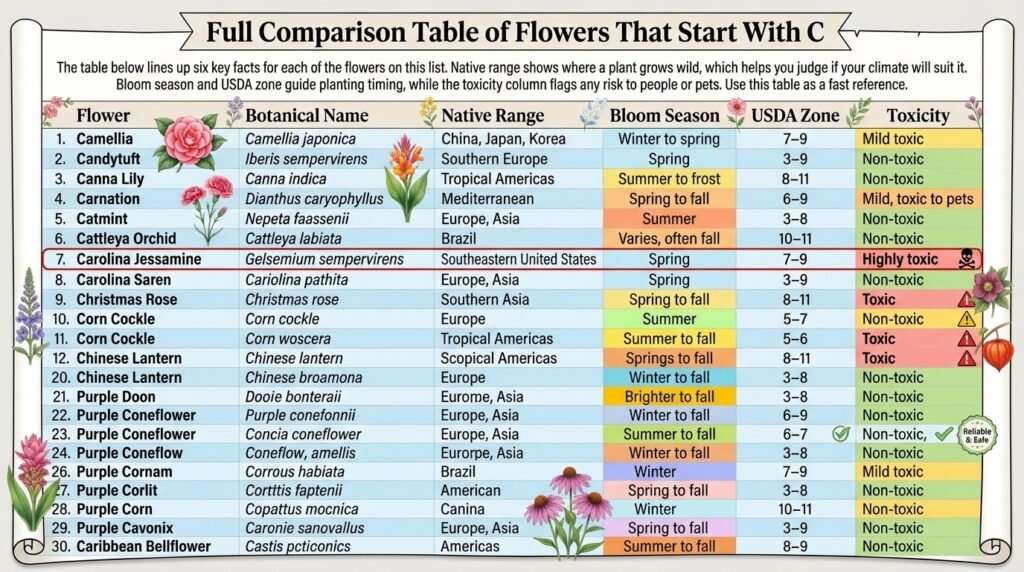
| Flower | Botanical Name | Native Range | Bloom Season | USDA Zone | Toxicity |
| Camellia | Camellia japonica | China, Japan, Korea | Winter to spring | 7–9 | Mild toxic |
| Candytuft | Iberis sempervirens | Southern Europe | Spring | 3–9 | Non-toxic |
| Canna Lily | Canna indica | Tropical Americas | Summer to frost | 8–11 | Non-toxic |
| Carnation | Dianthus caryophyllus | Mediterranean | Spring to fall | 6–9 | Mild, toxic to pets |
| Catmint | Nepeta faassenii | Europe, Asia | Summer | 3–8 | Non-toxic |
| Cattleya Orchid | Cattleya labiata | Brazil | Varies, often fall | 10–11 | Non-toxic |
| Cockscomb | Celosia argentea | Africa, Asia, tropical Americas | Summer to frost | 2–11, annual | Non-toxic |
| Chrysanthemum | Chrysanthemum morifolium | East Asia | Fall | 5–9 | Mild toxic |
| Clematis | Clematis × jackmanii | Garden hybrid | Summer | 4–9 | Toxic sap |
| Columbine | Aquilegia vulgaris | Europe | Late spring | 3–9 | Mild, toxic seeds |
| Purple Coneflower | Echinacea purpurea | North America | Summer | 3–9 | Non-toxic |
| Coral Bells | Heuchera sanguinea | Southwestern United States, Mexico | Late spring to summer | 4–9 | Non-toxic |
| Cosmos | Cosmos bipinnatus | Mexico | Summer to frost | 2–11, annual | Non-toxic |
| Crocus | Crocus vernus | Europe | Early spring | 3–8 | Mild toxic |
| Crown Imperial | Fritillaria imperialis | Middle East, Himalayas | Spring | 5–9 | Mild toxic |
| Cyclamen | Cyclamen persicum | Mediterranean, Middle East | Fall to spring | 9–11, houseplant | Toxic |
| California Poppy | Eschscholzia californica | Western United States | Spring to summer | 6–10 | Mild toxic |
| Calendula | Calendula officinalis | Mediterranean | Spring to frost | 2–11, annual | Non-toxic, edible |
| Calibrachoa | Calibrachoa × hybrida | South America | Spring to frost | 9–11, annual | Non-toxic |
| Red Campion | Silene dioica | Europe | Summer | 4–8 | Mild toxic |
| Canterbury Bells | Campanula medium | Southern Europe | Late spring to summer | 5–8, biennial | Non-toxic |
| Cape Daisy | Osteospermum ecklonis | South Africa | Spring to fall | 9–11, annual | Non-toxic |
| Cape Primrose | Streptocarpus saxorum | South Africa | Year-round indoors | 10–11 | Non-toxic |
| Cardinal Flower | Lobelia cardinalis | North America | Late summer | 3–9 | Toxic |
| Carolina Jessamine | Gelsemium sempervirens | Southeastern United States | Spring | 7–9 | Highly toxic |
| Carpathian Bellflower | Campanula carpatica | Carpathian Mountains | Summer | 3–8 | Non-toxic |
| Catchfly | Silene armeria | Europe | Summer | 5–8 | Mild toxic |
| Celandine | Chelidonium majus | Europe, Asia | Spring to summer | 3–8 | Toxic |
| Celandine Poppy | Stylophorum diphyllum | Eastern United States | Spring | 4–8 | Toxic sap |
| Chamomile | Matricaria chamomilla | Europe, Asia | Summer | 2–11, annual | Non-toxic |
| Checkered Lily | Fritillaria meleagris | Europe | Spring | 3–8 | Mild toxic |
| Cherry Blossom | Prunus serrulata | Japan | Spring | 5–8 | Toxic seeds |
| China Aster | Callistephus chinensis | China | Summer to fall | 2–11, annual | Non-toxic |
| China Pink | Dianthus chinensis | China, Korea, Mongolia | Summer | 3–9 | Mild, toxic to pets |
| Chincherinchee | Ornithogalum thyrsoides | South Africa | Spring to summer | 8–10 | Toxic |
| Chinese Lantern | Physalis alkekengi | Asia | Summer to fall | 3–9 | Toxic |
| Chocolate Cosmos | Cosmos atrosanguineus | Mexico | Summer to fall | 7–9 | Non-toxic |
| Christmas Rose | Helleborus niger | Central Europe | Winter | 3–8 | Toxic |
| Cigar Flower | Cuphea ignea | Mexico, West Indies | Summer to frost | 10–11, annual | Non-toxic |
| Cineraria | Pericallis × hybrida | Canary Islands | Winter to spring | 9–11, annual | Toxic |
| Cinquefoil | Potentilla fruticosa | Northern Hemisphere, temperate | Summer | 2–7 | Non-toxic |
| Clarkia | Clarkia amoena | Western North America | Summer | 2–11, annual | Non-toxic |
| Red Clover | Trifolium pratense | Europe, Asia | Summer | 4–8 | Non-toxic, edible |
| Confederate Jasmine | Trachelospermum jasminoides | China, Japan | Late spring to summer | 8–10 | Mild toxic sap |
| Copper Iris | Iris fulva | Southeastern United States | Late spring | 6–9 | Mild toxic |
| Coral Vine | Antigonon leptopus | Mexico | Summer to fall | 9–11 | Non-toxic |
| Corn Cockle | Agrostemma githago | Mediterranean | Summer | 2–11, annual | Toxic |
| Corn Poppy | Papaver rhoeas | Europe, Asia, North Africa | Late spring to summer | 2–11, annual | Toxic |
| Cornflower | Centaurea cyanus | Europe | Summer | 2–11, annual | Non-toxic |
| Cowslip | Primula veris | Europe, Asia | Spring | 3–8 | Non-toxic |
| Crape Myrtle | Lagerstroemia indica | China, Korea | Summer to fall | 6–9 | Non-toxic |
| Creeping Phlox | Phlox subulata | Eastern United States | Spring | 3–9 | Non-toxic |
| Creeping Zinnia | Sanvitalia procumbens | Mexico | Summer to frost | 2–11, annual | Non-toxic |
| Crested Iris | Iris cristata | Eastern United States | Mid spring | 3–8 | Mild toxic |
| Crimson Clover | Trifolium incarnatum | Europe | Spring | 6–9, annual | Non-toxic |
| Crocosmia | Crocosmia × crocosmiiflora | South Africa | Summer | 6–9 | Non-toxic |
| Crown Vetch | Securigera varia | Europe, Asia | Summer | 3–8 | Toxic |
| Cup and Saucer Vine | Cobaea scandens | Mexico | Summer to frost | 9–11, annual | Non-toxic |
| Cupid’s Dart | Catananche caerulea | Mediterranean | Summer | 4–9 | Non-toxic |
| Cushion Spurge | Euphorbia polychroma | Europe, Asia | Spring | 4–8 | Toxic sap |
| Cypress Vine | Ipomoea quamoclit | Mexico, tropical Americas | Summer to frost | 9–11, annual | Mild toxic |
| Calceolaria | Calceolaria herbeohybrida | South America | Spring | 9–11, annual | Non-toxic |
| Cardoon | Cynara cardunculus | Mediterranean | Summer | 6–9 | Non-toxic |
| Carline Thistle | Carlina acaulis | Europe | Summer | 4–8 | Non-toxic |
| Ceanothus | Ceanothus thyrsiflorus | California, United States | Spring | 7–10 | Non-toxic |
| Cephalaria | Cephalaria gigantea | Caucasus | Summer | 3–7 | Non-toxic |
| Cerinthe | Cerinthe major | Mediterranean | Spring to summer | 2–11, annual | Non-toxic |
| Chinese Forget-Me-Not | Cynoglossum amabile | China | Summer | 3–9, biennial | Toxic |
| Chinese Hibiscus | Hibiscus rosa-sinensis | East Asia | Year-round in tropics | 9–11 | Mild, toxic to pets |
| Chinese Trumpet Vine | Campsis grandiflora | China, Japan | Summer | 6–9 | Mild toxic |
| Chocolate Flower | Berlandiera lyrata | Southwestern United States, Mexico | Summer | 4–8 | Non-toxic |
| Christmas Cactus | Schlumbergera truncata | Brazil | Winter | 10–12, houseplant | Mild, toxic to pets |
| Rock Rose | Cistus × purpureus | Mediterranean | Late spring to summer | 8–10 | Non-toxic |
| Cliff Rose | Purshia stansburiana | Southwestern United States | Spring to summer | 5–8 | Non-toxic |
| Climbing Hydrangea | Hydrangea anomala subsp. petiolaris | Japan, Korea | Summer | 4–8 | Mild toxic |
| Comfrey | Symphytum officinale | Europe, Asia | Late spring to summer | 3–8 | Toxic |
| Common Mallow | Malva sylvestris | Europe, Asia, North Africa | Summer | 4–8 | Non-toxic, edible |
| Coral Honeysuckle | Lonicera sempervirens | Eastern United States | Spring to summer | 4–9 | Mild, toxic berries |
| Corydalis | Corydalis lutea | Europe | Spring to fall | 5–8 | Mild toxic |
| Cotton Lavender | Santolina chamaecyparissus | Mediterranean | Summer | 6–9 | Non-toxic |
| Cranesbill | Geranium sanguineum | Europe | Summer | 3–8 | Non-toxic |
| Coreopsis | Coreopsis grandiflora | North America | Summer | 4–9 | Non-toxic |
| Clove Currant | Ribes odoratum | North America | Spring | 4–8 | Non-toxic |
| Cape Honeysuckle | Tecoma capensis | South Africa | Summer to fall | 9–11 | Non-toxic |
| Cape Fuchsia | Phygelius capensis | South Africa | Summer | 7–9 | Non-toxic |
| Cape Jasmine | Gardenia jasminoides | China | Summer | 8–11 | Mild toxic |
| Carolina Allspice | Calycanthus floridus | Southeastern United States | Late spring | 4–9 | Non-toxic |
| Century Plant | Agave americana | Mexico | Once, after years of growth | 8–11 | Mild, sap irritant |
| Chalice Vine | Solandra maxima | Mexico | Summer | 9–11 | Toxic |
| Chinese Witch Hazel | Hamamelis mollis | China | Winter | 5–8 | Non-toxic |
| Coral Bean | Erythrina herbacea | Southeastern United States | Spring to summer | 8–11 | Toxic seeds |
| Cranberry Hibiscus | Hibiscus acetosella | Tropical Africa | Summer to fall | 8–11, annual | Non-toxic, edible leaves |
| Crossvine | Bignonia capreolata | Southeastern United States | Spring | 6–9 | Non-toxic |
| Culver’s Root | Veronicastrum virginicum | Eastern North America | Summer | 3–8 | Non-toxic |
| Cheddar Pink | Dianthus gratianopolitanus | Europe | Late spring | 3–9 | Mild, toxic to pets |
| Cardinal Climber | Ipomoea × multifida | Garden hybrid | Summer to frost | 9–11, annual | Mild toxic |
| Cushion Aster | Aster dumosus | North America | Fall | 4–8 | Non-toxic |
| Cypress Spurge | Euphorbia cyparissias | Europe | Late spring | 4–8 | Toxic sap |
| Candle Bush | Senna alata | Tropical Americas | Summer to fall | 9–11 | Mild toxic |
A few rows deserve extra attention after a first read. Carolina Jessamine stands out as the single most dangerous entry, since it is highly toxic despite its cheerful yellow blooms. Christmas Rose, Corn Cockle, and Chinese Lantern all carry real toxicity too, so keep them out of reach of pets and small children. Purple Coneflower, by contrast, sits at the safest end of the table, non-toxic and reliable across a huge range of growing zones.
Garden Favorites Among Flowers That Start With C
Garden favorites are the flowers gardeners plant season after season without fail. Purple Coneflower leads this group, since it tolerates drought and blooms for months without much care. Chrysanthemum defines the fall garden, filling beds with dense color right as summer flowers fade. Coral Bells adds year-round interest through colorful foliage, with airy flower spikes as a bonus. Cosmos rounds things out as one of the easiest annuals to grow from seed.
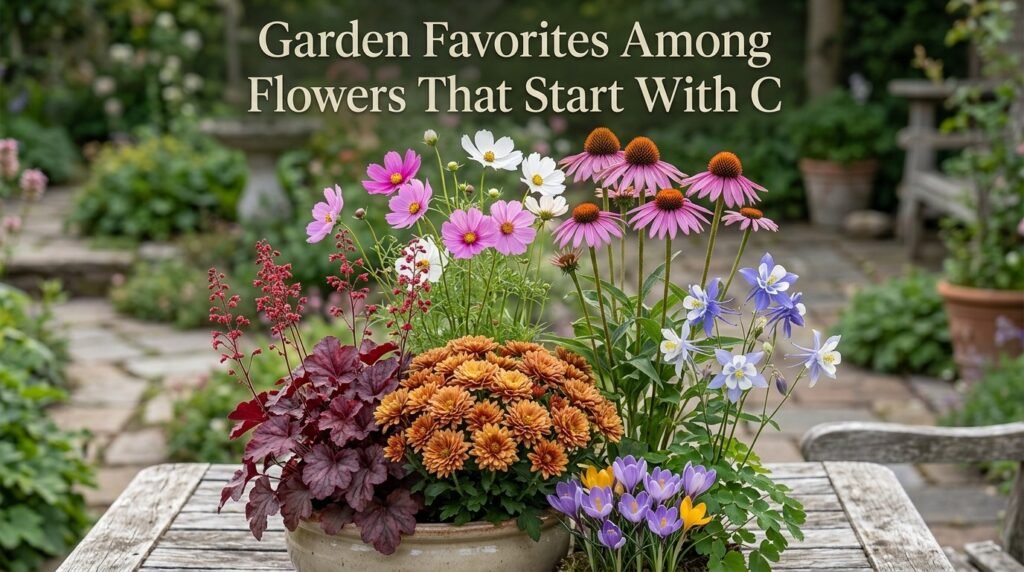
Purple Coneflower (Echinacea purpurea) sends up daisy-like pink-purple petals around a spiky orange-brown center each summer. Bees, butterflies, and later goldfinches all visit it through the season.
Chrysanthemum (Chrysanthemum morifolium) forms dense mounds of tightly packed petals in gold, bronze, red, or white each fall. It remains the single most recognized flower of the autumn garden.
Coral Bells (Heuchera sanguinea) grows mounded, colorful foliage topped with thin, airy stalks of tiny red or pink flowers. Hummingbirds visit the flower spikes even though the leaves are the main draw.
Cosmos (Cosmos bipinnatus) opens into simple, daisy-like blooms on tall, feathery stems from summer until frost. It reseeds easily, often returning on its own the following year.
- Purple Coneflower — tough native perennial, long summer bloom
- Chrysanthemum — dense fall color in nearly every shade
- Coral Bells — colorful foliage with airy flower spikes
- Cosmos — easy, fast-growing summer annual
- Columbine — delicate spring bloomer with spurred petals
- Crocus — one of the first flowers to bloom each year
These six plants suit very different garden needs. Purple Coneflower and Crocus both return reliably for years with almost no care. Cosmos and Columbine, by contrast, reward gardeners who enjoy fresh color changes through reseeding or short-lived blooms.
Indoor Plants Among Flowers That Start With C
Indoor flowers need to handle lower light and steady room temperatures. Cyclamen is a strong choice, since its upswept petals bloom reliably through cool winter months indoors. Christmas Cactus flowers like clockwork each winter with almost no attention required. Cattleya Orchid rewards patience with large, fragrant blooms prized by collectors. Cape Primrose rounds out the group with near-constant small purple flowers on a compact plant.
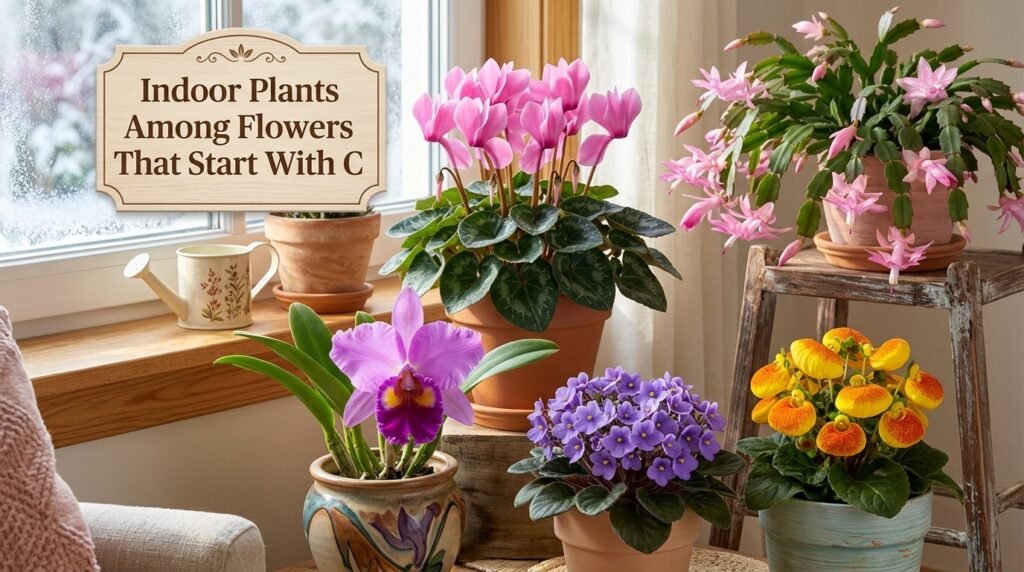
Cyclamen (Cyclamen persicum) produces upswept, butterfly-shaped flowers in pink, red, or white above heart-shaped leaves. It prefers cool rooms and blooms best through fall and winter. Image caption: Pink Cyclamen flowers above heart-shaped leaves.
Christmas Cactus (Schlumbergera truncata) blooms in pink, red, or white along flattened, segmented stems each winter. It needs little care beyond bright, indirect light and steady watering. Image caption: Pink Christmas Cactus blooms on a windowsill in winter.
Cattleya Orchid (Cattleya labiata) produces large, fragrant purple or white flowers that can last several weeks once open. It remains one of the most collected orchids in the world. Image caption: Large purple Cattleya Orchid bloom in a bright room.
- Cyclamen — cool-loving winter bloomer with upswept petals
- Christmas Cactus — reliable winter color, minimal care
- Cattleya Orchid — large, fragrant blooms for collectors
- Cape Primrose — near-constant small purple flowers
- Calceolaria — unusual pouch-shaped blooms for a bright room
Cattleya Orchid and Calceolaria both suit collectors who enjoy unusual bloom shapes over classic flower form. Cyclamen and Christmas Cactus are far more forgiving, tolerating typical household conditions with ease. Cape Primrose stays the easiest overall, flowering nearly nonstop with only routine watering.
Florist Favorites Among Flowers That Start With C
Florists choose flowers for strong stems, long vase life, and dependable color. Carnation remains one of the longest-lasting cut flowers sold anywhere, often staying fresh for two weeks or more. Camellia brings glossy, rose-like blooms that suit both bridal work and formal arrangements. Cape Jasmine, better known as Gardenia, adds one of the most fragrant white blooms used in event florals. Chocolate Cosmos offers a rare deep maroon color with a scent that resembles real chocolate.
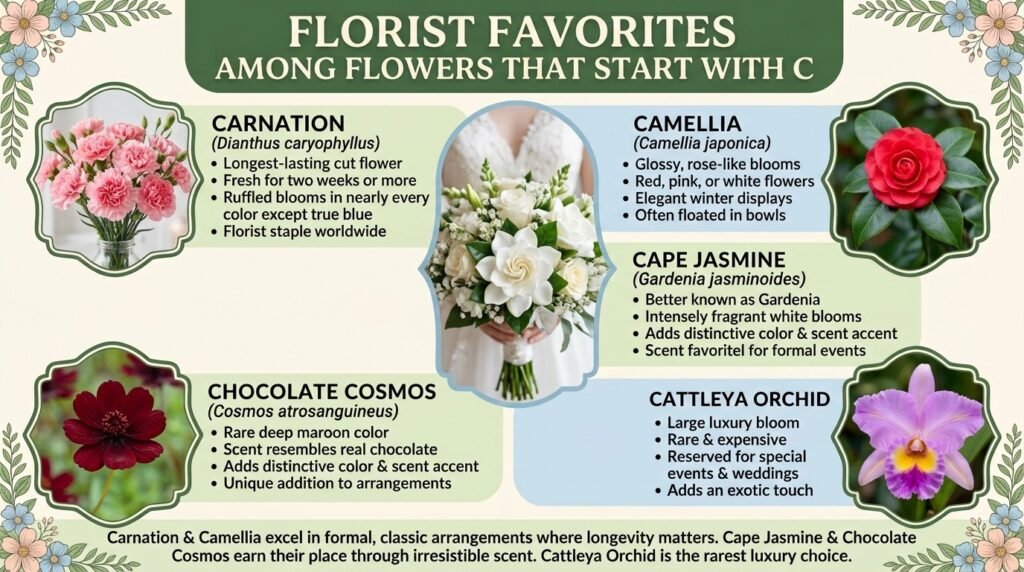
Carnation (Dianthus caryophyllus) produces ruffled, long-lasting blooms in nearly every color except true blue. Its exceptional vase life makes it a florist staple worldwide.
Camellia (Camellia japonica) opens into rose-like blooms in red, pink, or white against glossy evergreen leaves. Florists often float individual blooms in bowls for elegant winter displays.
Cape Jasmine (Gardenia jasminoides) produces intensely fragrant white flowers prized in bridal bouquets and boutonnieres. Its scent alone makes it a favorite for formal events.
- Carnation — long-lasting color in nearly every shade
- Camellia — rose-like blooms for elegant winter arrangements
- Cape Jasmine — intensely fragrant white blooms for weddings
- Chocolate Cosmos — rare maroon color with a chocolate scent
- Cattleya Orchid — large luxury bloom for special events
Carnation and Camellia both suit formal, classic arrangements where longevity matters most. Cape Jasmine and Chocolate Cosmos instead earn their place through scent rather than shape or color. Cattleya Orchid remains the rarest and most expensive of the group, often reserved for weddings or corsages.
Rare Flowers That Start With C
A handful of C-flowers rarely show up outside specialist growers or botanical collections. Century Plant blooms only once after years or even decades of growth, sending up a towering flower stalk before the plant dies back. Chalice Vine produces enormous, cream-colored trumpet flowers that fade to gold as they age, grown mostly by tropical plant collectors. Chocolate Flower is a lesser-known Southwestern native named for its cocoa-like morning scent. Corydalis remains uncommon in typical gardens despite its ferny foliage and long season of small yellow blooms.
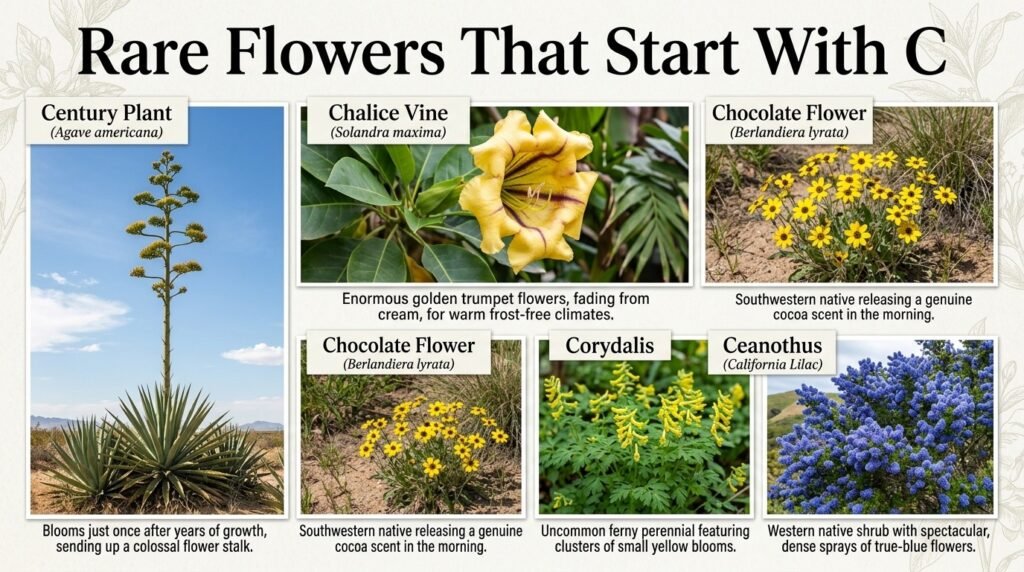
Century Plant (Agave americana) grows for years as a spiky rosette before sending up a flower stalk that can reach twenty feet tall. The plant dies after this single spectacular bloom event.
Chalice Vine (Solandra maxima) produces huge, trumpet-shaped flowers that open cream and fade to golden yellow with purple streaks. It needs a warm, frost-free climate to bloom well outdoors.
Chocolate Flower (Berlandiera lyrata) opens into small yellow daisies that release a genuine chocolate scent each morning. It thrives in poor, dry soil across the Southwestern United States.
- Century Plant — blooms once after years of growth
- Chalice Vine — enormous golden trumpet flowers for warm climates
- Chocolate Flower — Southwestern native with a real chocolate scent
- Corydalis — uncommon ferny perennial with small yellow blooms
- Ceanothus — Western native shrub with dense blue flower clusters
Century Plant and Chalice Vine both demand real patience or a warm climate that most home gardens cannot easily provide. Chocolate Flower and Corydalis instead simply remain overlooked, rather than difficult to grow. Ceanothus rewards Western gardeners specifically, since it struggles outside its native coastal range.
Flowers That Start With C and Need Caution
A meaningful group of C-flowers carries real toxicity risk, especially around kids and pets. Carolina Jessamine is highly toxic despite its cheerful yellow spring flowers, and even its nectar can affect bees. Christmas Rose contains toxic compounds throughout the plant, most concentrated in the roots and sap. Corn Cockle produces toxic seeds that were historically a serious contaminant in harvested grain. Chinese Lantern carries toxins in its unripe fruit and foliage, though the papery husks alone are harmless.
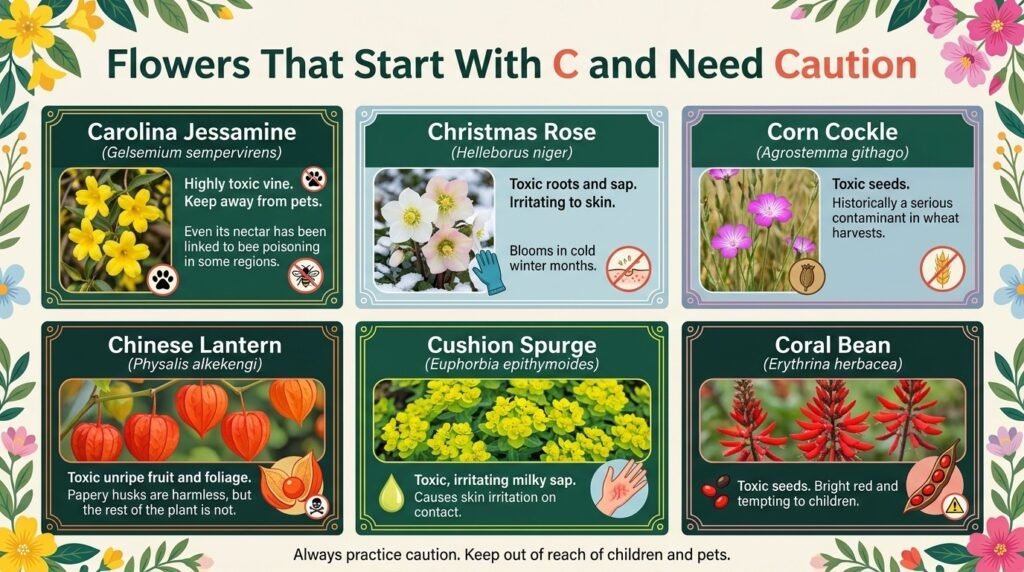
Carolina Jessamine (Gelsemium sempervirens) produces fragrant, funnel-shaped yellow flowers on a twining vine each spring. Every part of the plant is highly toxic if eaten.
Christmas Rose (Helleborus niger) blooms in white or pale pink through the coldest weeks of winter. Its roots and sap are toxic and can irritate skin on contact.
Corn Cockle (Agrostemma githago) produces bright pink-purple flowers on tall, slender stems in summer. Its seeds are toxic and were once a dangerous contaminant in wheat harvests.
- Carolina Jessamine — highly toxic vine; keep away from pets
- Christmas Rose — toxic roots and sap, irritating to skin
- Corn Cockle — toxic seeds, historically a grain contaminant
- Chinese Lantern — toxic unripe fruit and foliage
- Cushion Spurge — toxic, irritating milky sap
- Coral Bean — toxic seeds, bright red and tempting to children
Carolina Jessamine deserves the most caution here, since even its nectar has been linked to bee poisoning in some regions. Christmas Rose and Cushion Spurge both cause skin irritation on contact, not just when eaten. Even so, all six of these are best kept out of reach in homes with toddlers or curious pets.
Color-Based Groupings of Flowers That Start With C
Grouping flowers by color helps with planning a themed bed or bouquet. Yellow and gold tones show up often across this letter group. Cornflower’s golden centers, Chocolate Flower, and Coreopsis all bring warm gold shades that suit a native pollinator bed or a cheerful cutting garden.
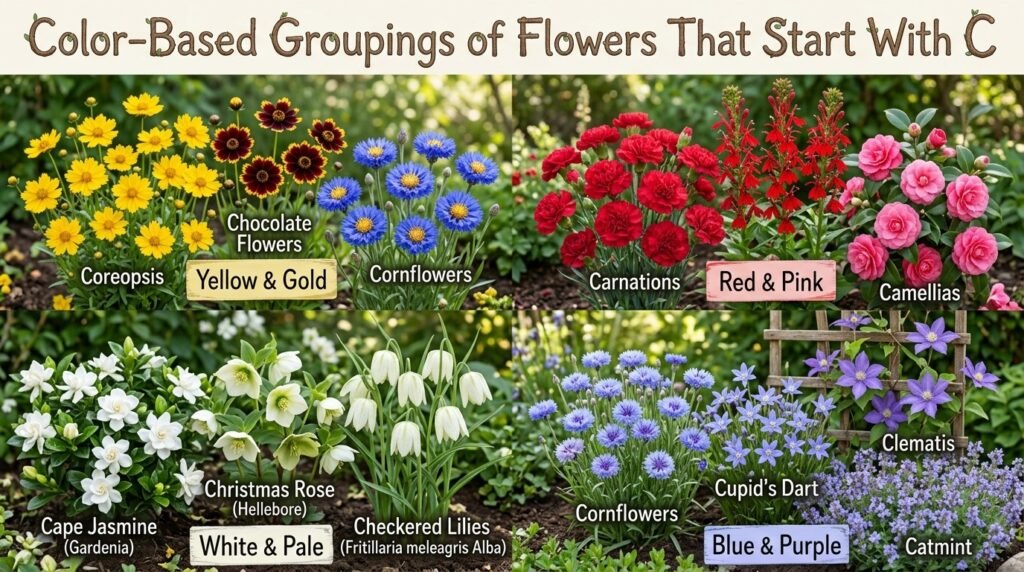
Red and pink flowers add heat and romance to sunny borders. Carnation and Camellia both lean into rich red and pink tones, while Cardinal Flower adds a matching fiery red bloom that hummingbirds seek out. These work well planted together for a bold, high-contrast display near a patio.
White flowers bring calm, fragrant contrast to almost any planting scheme. Cape Jasmine, Christmas Rose, and Checkered Lily all offer white or pale blooms with very different shapes and seasons. Cape Jasmine adds the strongest fragrance of the group, making it a favorite near entryways.
Blue and purple flowers suit cooler, calmer garden themes. Cornflower and Cupid’s Dart both bring soft blue tones to a summer border. Clematis adds the same purple-blue range on a climbing vine, and Catmint contributes a hazy lavender-blue groundcover nearby.
Life-Cycle Groupings of Flowers That Start With C
Knowing a flower’s life cycle helps you plan how often to replant a bed. Annuals complete their life cycle in a single season, so they need fresh seeds or plants each year. Perennials return from the same roots for years, while bulbs store energy underground between bloom cycles. Shrubs and woody vines take the longest to establish but reward patience with repeat yearly blooms.
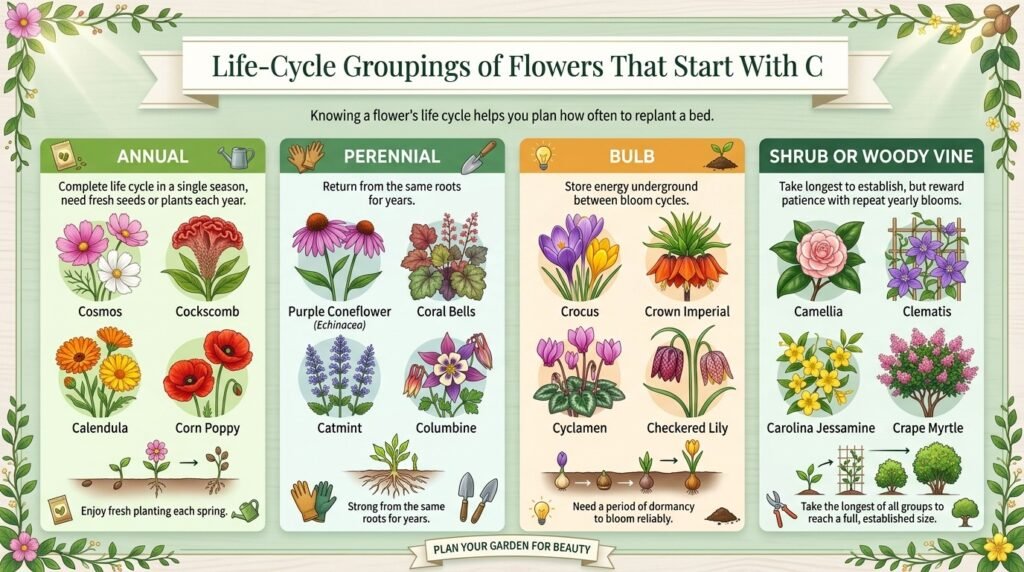
| Life Cycle Type | Example Flowers |
| Annual | Cosmos, Cockscomb, Calendula, Corn Poppy |
| Perennial | Purple Coneflower, Coral Bells, Catmint, Columbine |
| Bulb | Crocus, Crown Imperial, Cyclamen, Checkered Lily |
| Shrub or Woody Vine | Camellia, Clematis, Carolina Jessamine, Crape Myrtle |
Annuals like Cosmos and Calendula reward gardeners who enjoy fresh planting each spring. Bulb types such as Crocus and Crown Imperial need a period of dormancy to bloom each year reliably. Shrubs and woody vines take the longest of all four groups to reach a full, established size.
Botanical Name Crosswalk for Flowers That Start With C
Botanical names matter more than most gardeners expect. Common names shift by region, but a botanical name stays fixed everywhere in the world. This matters most when ordering online, since the wrong common name can return a completely different plant. The crosswalk below pairs common names with correct botanical names and plant families for accurate, confident searching.
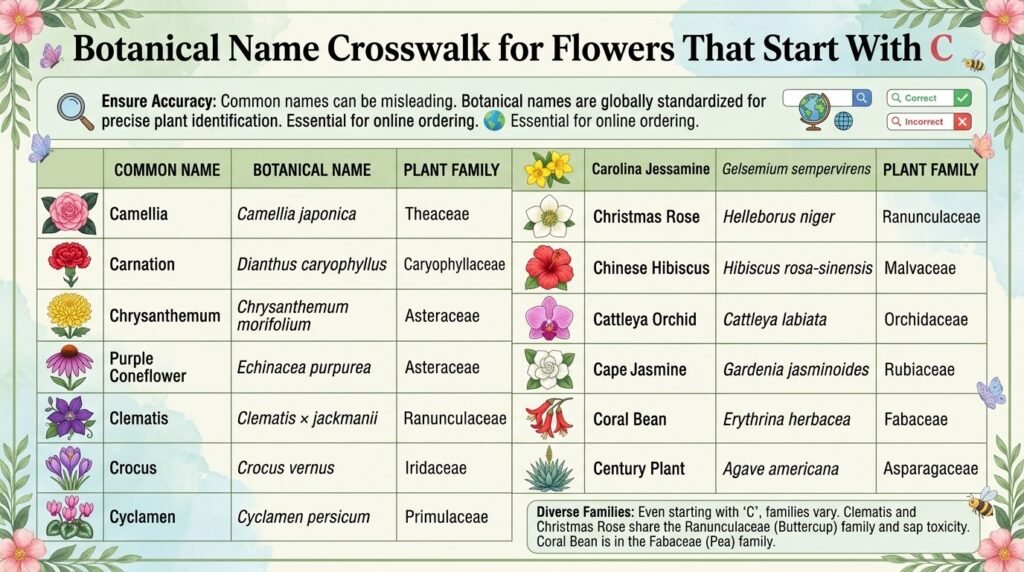
| Common Name | Botanical Name | Plant Family |
| Camellia | Camellia japonica | Theaceae |
| Carnation | Dianthus caryophyllus | Caryophyllaceae |
| Chrysanthemum | Chrysanthemum morifolium | Asteraceae |
| Purple Coneflower | Echinacea purpurea | Asteraceae |
| Clematis | Clematis × jackmanii | Ranunculaceae |
| Crocus | Crocus vernus | Iridaceae |
| Cyclamen | Cyclamen persicum | Primulaceae |
| Carolina Jessamine | Gelsemium sempervirens | Gelsemiaceae |
| Christmas Rose | Helleborus niger | Ranunculaceae |
| Chinese Hibiscus | Hibiscus rosa-sinensis | Malvaceae |
| Cattleya Orchid | Cattleya labiata | Orchidaceae |
| Cape Jasmine | Gardenia jasminoides | Rubiaceae |
| Coral Bean | Erythrina herbacea | Fabaceae |
| Century Plant | Agave americana | Asparagaceae |
This shortlist shows how varied the plant families really are, even within one letter. Clematis and Christmas Rose both sit in the buttercup family, which explains their shared sap toxicity. Coral Bean stands apart in the pea family, connecting it to other toxic legumes despite its bright, showy red flowers.
Flower Meanings and Symbolism
Flowers that start with C carry rich symbolism across many cultures. Camellia is deeply tied to Japanese tradition, where it once symbolized both love and, in samurai culture, a swift and honorable death because the bloom drops whole rather than wilting petal by petal. That dual meaning still shapes how the flower is viewed in floral art today. Chrysanthemum carries an equally strong meaning in East Asia, where it represents longevity, joy, and the arrival of autumn.
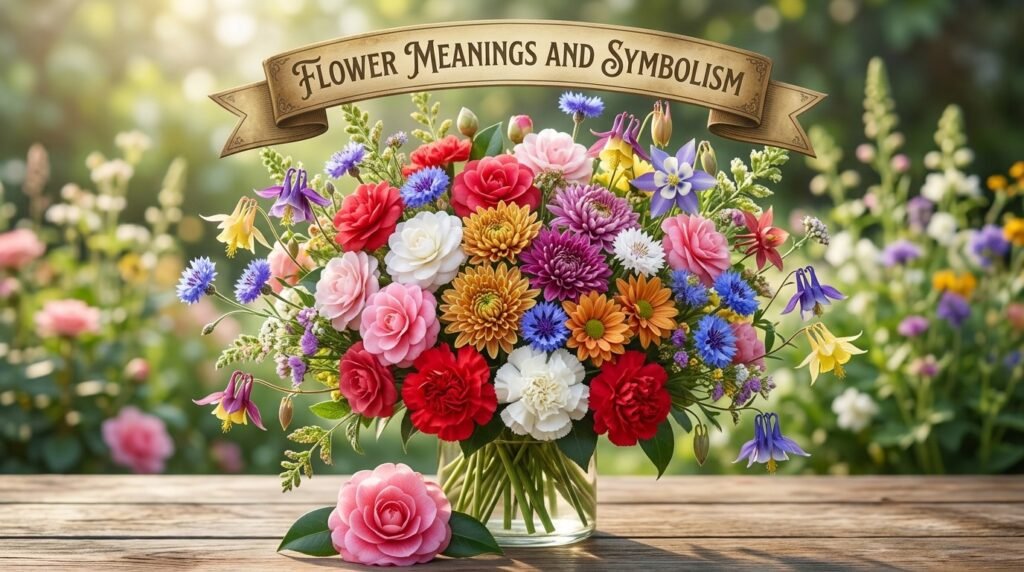
Carnation holds a color-dependent meaning that shifts with each shade. Red carnations symbolize deep love, while white ones stand for pure luck and good fortune in many traditions. Cornflower, by contrast, carries a quieter meaning tied to delicacy and hope, and it has long been associated with support for wounded soldiers in parts of Europe.
Columbine rounds out this section with a more folkloric history. Its unusually spurred petals were once linked to both foolishness and courage, depending on the era and region telling the story. That mix of meanings, from honor to whimsy, shows how widely this single letter’s symbolism can stretch.
Decision Guide: Which Flower That Starts With C Should You Choose?
Choosing the right flower often depends on where it will grow and who will be near it. The table below matches common situations to a flower pick from this list, along with a short reason for each match. Use it as a starting point, then check the full comparison table above for growing details.
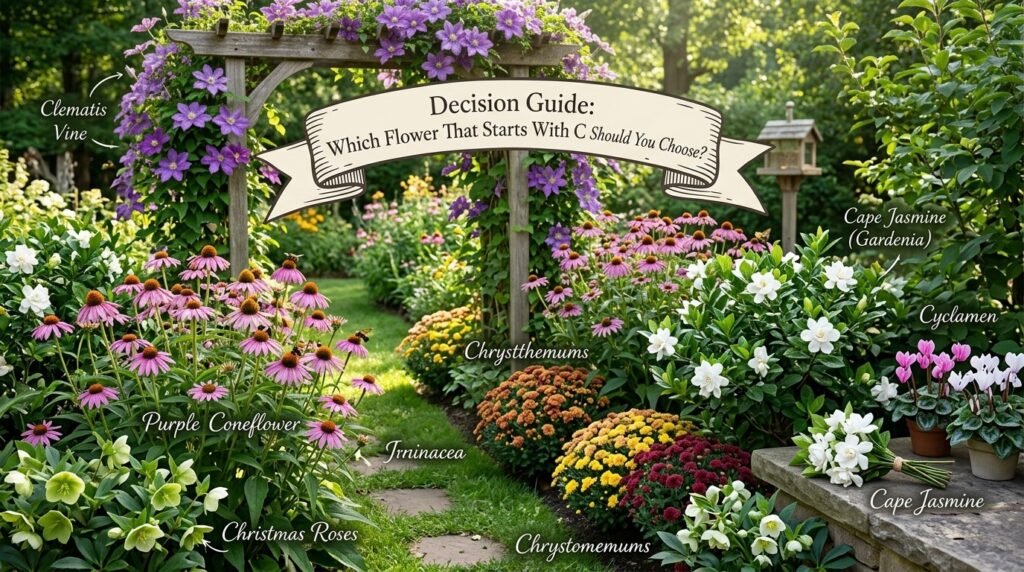
| Your Situation | Recommended Flower | Why It Fits |
| Sunny summer border | Purple Coneflower | Tough, reliable, long bloom time |
| Fall color display | Chrysanthemum | Dense blooms right as summer fades |
| Indoor bright room | Cyclamen | Blooms reliably through cool winter months |
| Fragrant cut flowers | Cape Jasmine | Intense scent, ideal for weddings |
| Native pollinator bed | Purple Coneflower | Feeds bees, butterflies, and finches |
| Household with pets | Purple Coneflower | Non-toxic and easy to grow |
| Climbing trellis cover | Clematis | Fast growth, large showy blooms |
| Winter garden interest | Christmas Rose | Blooms through cold weather, but toxic |
Notice that Purple Coneflower appears three times in this table, spanning sunny borders, pollinator beds, and pet-safe homes. That overlap is not an accident, since the same traits that make it easy to grow also make it a low-risk, high-reward choice almost everywhere. Christmas Rose, by contrast, is stunning for winter interest but needs careful placement, since it appears again in the caution section above.
Conclusion
Flowers that start with C offer some of the widest variety of any letter in this series. This guide covered 100 of them, complete with botanical names, native range, and toxicity notes. Whether you want a tough summer perennial, a fragrant florist favorite, or a flower to avoid around pets, this list has a fit. Keep it close the next time you plan a garden bed or a bouquet built around beautiful, unusual blooms.
Frequently Asked Questions
What are some common flowers that start with C?
Camellia, Chrysanthemum, Carnation, and Cosmos are the most common picks. All four appear regularly in gardens and florist shops. Chrysanthemum remains one of the most widely grown of the group.
Are there really 100+ flowers that start with C?
Yes, this guide lists 100 verified flowers starting with C. They range from tiny wildflowers to towering desert bloomers. Many share large genera, including Campanula, Dianthus, and Fritillaria.
Which flowers that start with C are toxic to pets?
Carolina Jessamine, Christmas Rose, Corn Cockle, and Coral Bean all carry a real toxicity risk. Carolina Jessamine is the most dangerous of the group. Keep all four away from pets and children who chew on plants.
Is Chrysanthemum safe to plant around children?
Chrysanthemum is mildly toxic if eaten in large amounts. Most children will not eat enough to cause serious harm. It remains a common, generally low-risk fall garden choice overall.
Which C-flower blooms the longest?
Cosmos blooms from early summer until the first frost with regular deadheading. Purple Coneflower comes close behind it with a long, steady summer bloom. Both reward gardeners who remove spent flowers regularly.
What is the tallest flower that starts with C?
Century Plant can send up a flower stalk over twenty feet tall. Among more common perennials, Crape Myrtle often reaches fifteen feet as a small tree. Century Plant suits only large, open spaces.