

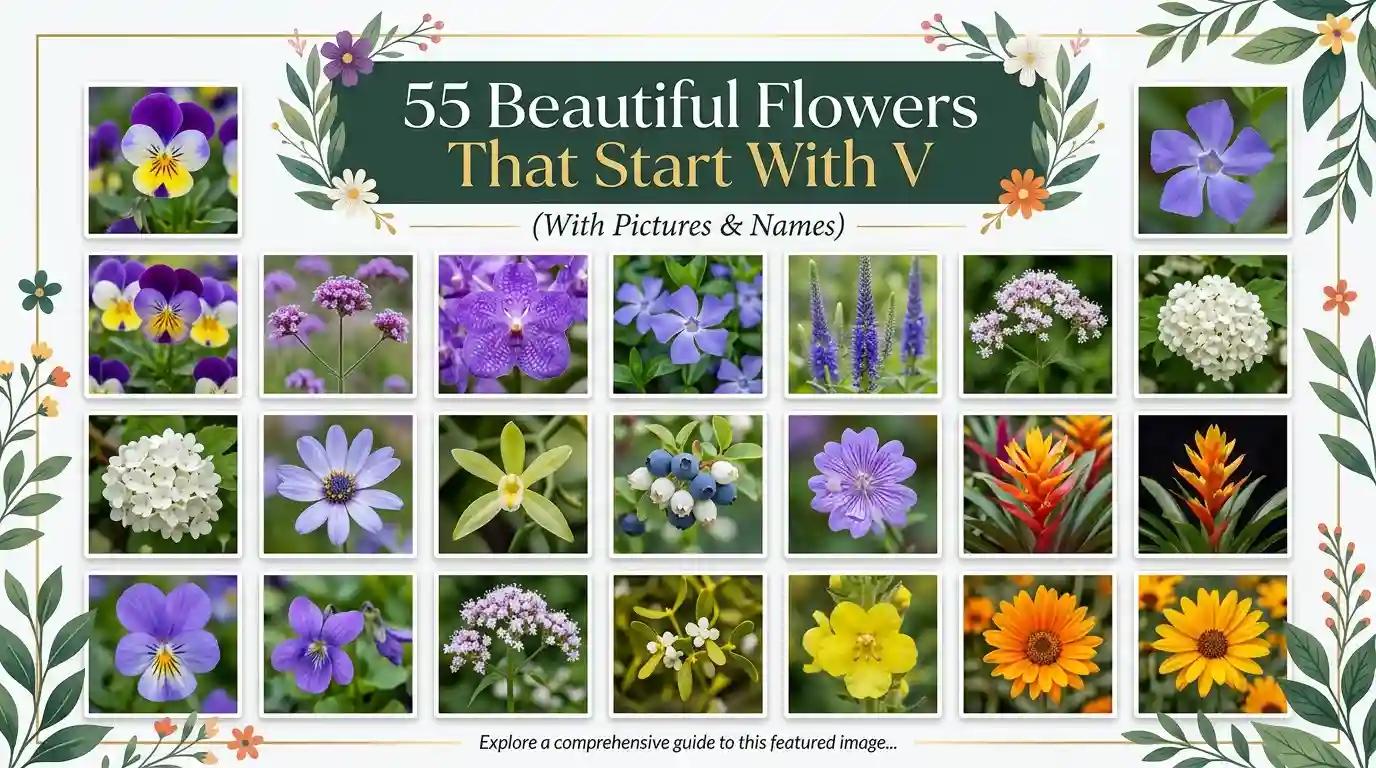
Flowers that start with V cover an unusually wide mix of plants, from tiny woodland violets to towering tropical orchids. This letter includes fragrant herbs, tough native wildflowers, and a few plants prized for flavor as much as beauty. It also includes several carnivorous and unusual specimens that surprise most casual gardeners. If you enjoy exploring flowers letter by letter, V offers far more range than its size suggests.
- Quick Answer: Best Flowers That Start With V
- Master Alphabetical List of Flowers That Start With V
- Full Comparison Table
- Garden Favorites
- Indoor Plants
- Florist Favorites
- Rare Flowers
- Caution and Toxicity
- Color-Based Groupings
- Life-Cycle Groupings
- Botanical Name Crosswalk
- Flower Meanings and Symbolism
- Decision-Flow Table: Which V Flower Should You Choose?
- Conclusion
- Frequently Asked Questions
This guide covers 55 flowers that start with V, checked against botanical sources rather than guessed. Some entries use a common name that starts with V, like Violet or Vervain. Others use a botanical genus name that starts with V, like Vernonia or Vriesea. We include both types, since gardeners search for plants both ways. A few entries, like Vanilla Leaf and Viper’s Grass, are grown partly for another purpose, but each produces a genuine flower worth knowing.
We built this guide for several kinds of readers. A home gardener might want reliable, colorful picks for a sunny border. A florist might want fragrant blooms for bouquets and events. A pet owner might want to know which V flowers to keep out of reach. A curious plant lover might simply want fresh facts and photo ideas from a letter with real hidden depth.
The list is organized by garden use, color, life cycle, and botanical name. Jump to whichever section fits your goal. Every section includes real explanations, not just a row of names. By the end, you will have a full picture of what flowers that start with V can bring to a garden, home, or bouquet.
Quick Answer: Best Flowers That Start With V
If you only have a minute, here are the standout picks. Violet is the most familiar V flower, prized for its sweet fragrance and long history in perfume. Verbena is a garden workhorse, blooming nonstop through summer while drawing bees and butterflies. Vinca, or periwinkle, is a tough, reliable groundcover for both sun and shade. Vanilla Orchid stands out worldwide as the source of natural vanilla flavoring.
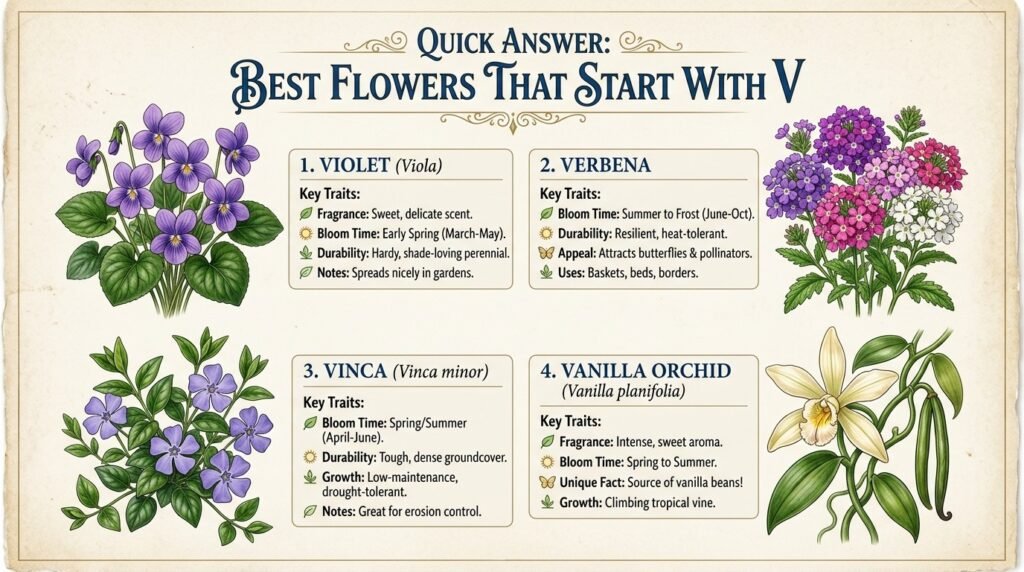
For something more dramatic, Vanda Orchid produces some of the most vivid blue and purple blooms in the orchid world. Venus Flytrap is famous for trapping insects, though its small white flowers often go unnoticed. Virginia Bluebells bring a soft, shifting color show to spring woodland gardens. Viburnum offers reliable clusters of white spring flowers on a tough, easy shrub. Together, these eight flowers show that the letter V holds real range, from cottage gardens to tropical greenhouses.
Master Alphabetical List of Flowers That Start With V
This list mixes two kinds of names. Some flowers use a common English name, like Violet or Viper’s Bugloss. Others use a botanical genus name, like Veltheimia or Vriesea. Both types are grouped together here, so you can scan the full letter V collection at once. Full details on each flower appear in the sections and tables below.
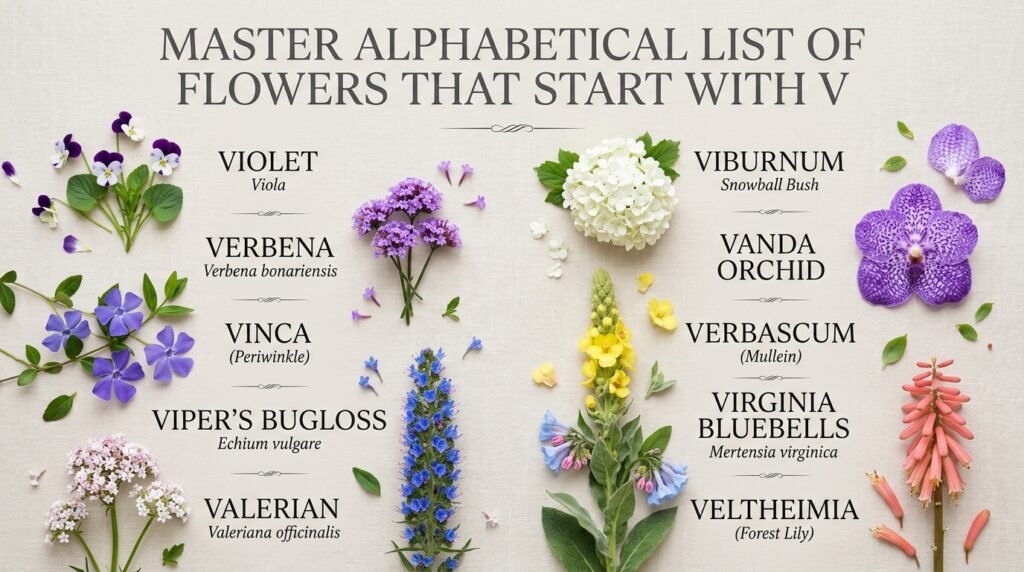
- Violet
- Viola (Pansy)
- Heartsease
- Common Blue Violet
- Verbena
- Vervain
- Tall Verbena
- Rose Verbena
- Slender Vervain
- Blue Vervain
- Hoary Vervain
- Moss Verbena
- Peruvian Vervain
- Veronica (Speedwell)
- Vinca (Periwinkle)
- Greater Periwinkle
- Vinca Rosea (Madagascar Periwinkle)
- Vetch
- Viper’s Bugloss
- Virginia Bluebells
- Vitex (Chaste Tree)
- Vanilla Orchid
- Verbascum (Mullein)
- Valerian
- Red Valerian
- Vanda Orchid
- Vernonia (Ironweed)
- Vancouveria (Inside-Out Flower)
- Veltheimia (Forest Lily)
- Venus Flytrap
- Venus Looking Glass
- Virginia Iris
- Virginia Meadow Beauty
- Violet Wood Sorrel
- Vireya Rhododendron
- Viburnum (Snowball Bush)
- Virginia Stock
- Vanilla Strawberry Hydrangea
- Vervain Mallow
- Venidium (Cape Daisy)
- Vanhoutte Spirea
- Virginia Spiderwort
- Voodoo Lily
- Volkameria
- Vriesea (Flaming Sword)
- Virginia Rose
- Vanilla Leaf
- Virginia Waterleaf
- Viper’s Grass
- Vestia
- Vinca Difformis
- Vitex trifolia
- Vallota (Scarborough Lily)
- Bird’s-Foot Violet
- Blue Vanda
Some of these names share a genus, like the seven Verbena and Vervain entries or the two Vinca species. This happens because several V genera hold a wide range of distinct, garden-worthy species. Others, like Vanilla Leaf and Viper’s Grass, are included with a clear note that they are grown partly for another purpose.
Full Comparison Table
The table below compares every flower on this list side by side. It shows the botanical name, native range, main colors, bloom season, and toxicity status. Use it to quickly compare options if you need a specific climate fit or a pet-safe garden. Toxicity notes reflect general guidance from sources like the ASPCA and are not a substitute for veterinary advice.
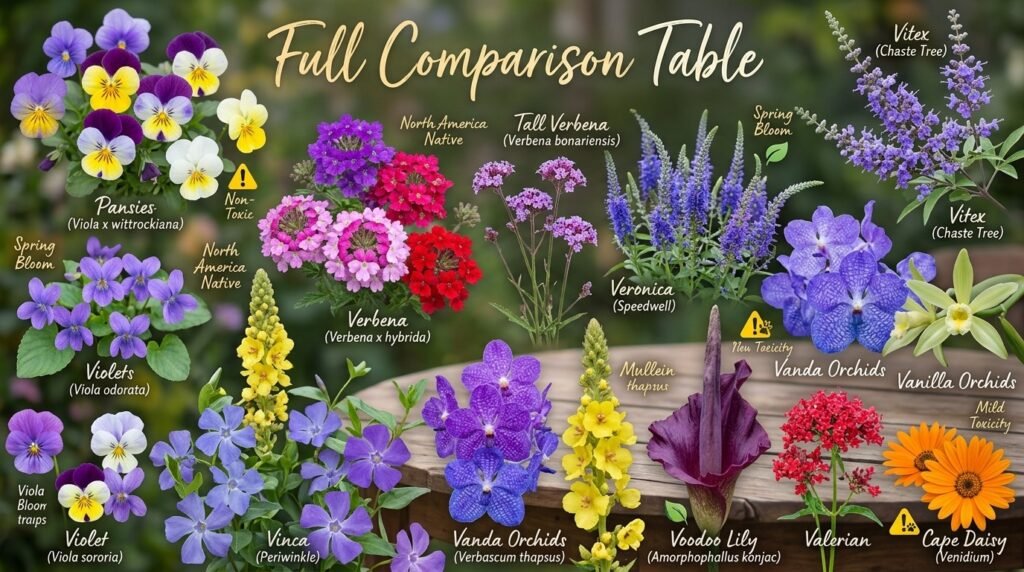
| Flower | Botanical Name | Native Range | Colors | Bloom Season | Toxic to Pets |
| Violet | Viola odorata | Europe, Asia | Purple, white | Spring | No |
| Viola (Pansy) | Viola x wittrockiana | Garden hybrid | Purple, yellow, white | Spring–fall | No |
| Heartsease | Viola tricolor | Europe | Purple, yellow, white | Spring–fall | No |
| Common Blue Violet | Viola sororia | Eastern North America | Purple | Spring | No |
| Verbena | Verbena x hybrida | South America | Purple, pink, red | Summer–fall | No |
| Vervain | Verbena officinalis | Europe, Asia | Purple | Summer | No |
| Tall Verbena | Verbena bonariensis | South America | Purple | Summer–fall | No |
| Rose Verbena | Verbena canadensis | North America | Pink, purple | Spring–fall | No |
| Slender Vervain | Verbena rigida | South America | Purple | Summer–fall | No |
| Blue Vervain | Verbena hastata | North America | Blue, purple | Summer | No |
| Hoary Vervain | Verbena stricta | North America | Purple | Summer | No |
| Moss Verbena | Verbena tenuisecta | South America | Purple | Spring–fall | No |
| Peruvian Vervain | Verbena peruviana | South America | Red | Summer–fall | No |
| Veronica (Speedwell) | Veronica spicata | Europe, Asia | Blue, purple, pink | Summer | No |
| Vinca (Periwinkle) | Vinca minor | Europe | Blue, purple | Spring | Yes, moderate |
| Greater Periwinkle | Vinca major | Southern Europe | Blue, purple | Spring–summer | Yes, moderate |
| Vinca Rosea | Catharanthus roseus | Madagascar | Pink, white | Year-round in warm zones | Yes, moderate |
| Vetch | Vicia sativa | Europe, Asia | Purple, pink | Spring–summer | Mild, seeds only |
| Viper’s Bugloss | Echium vulgare | Europe | Blue, purple | Summer | Mild, contact irritant |
| Virginia Bluebells | Mertensia virginica | Eastern United States | Pink turning blue | Early spring | No |
| Vitex (Chaste Tree) | Vitex agnus-castus | Mediterranean, Central Asia | Purple, lavender | Summer | No |
| Vanilla Orchid | Vanilla planifolia | Mexico, Central America | Pale yellow-green | Spring–summer | No |
| Verbascum (Mullein) | Verbascum thapsus | Europe, Asia | Yellow | Summer | No |
| Valerian | Valeriana officinalis | Europe, Asia | White, pink | Summer | Mild, root only |
| Red Valerian | Centranthus ruber | Mediterranean | Red, pink, white | Late spring–fall | No |
| Vanda Orchid | Vanda spp. | Southeast Asia | Purple, blue, pink, yellow | Varies, often year-round | No |
| Vernonia (Ironweed) | Vernonia noveboracensis | Eastern United States | Purple | Late summer–fall | No |
| Vancouveria | Vancouveria hexandra | Western United States | White | Late spring | No |
| Veltheimia (Forest Lily) | Veltheimia bracteata | South Africa | Pink | Winter–spring | Yes, mild |
| Venus Flytrap | Dionaea muscipula | Southeastern United States | White | Late spring–summer | No |
| Venus Looking Glass | Triodanis perfoliata | North America | Purple | Spring–summer | No |
| Virginia Iris | Iris virginica | Eastern United States | Blue, purple | Late spring | Yes, mild |
| Virginia Meadow Beauty | Rhexia virginica | Eastern United States | Pink | Summer | No |
| Violet Wood Sorrel | Oxalis violacea | North America | Purple | Spring | Yes, mild |
| Vireya Rhododendron | Rhododendron section Vireya | Southeast Asia, Pacific | Red, pink, orange, yellow | Varies, often year-round | Yes, severe |
| Viburnum (Snowball Bush) | Viburnum opulus | Europe, Asia | White | Late spring | Mild, berries only |
| Virginia Stock | Malcolmia maritima | Mediterranean | Pink, purple, white | Spring–summer | No |
| Vanilla Strawberry Hydrangea | Hydrangea paniculata ‘Vanilla Strawberry’ | Garden hybrid | White turning pink | Summer–fall | Yes, mild |
| Vervain Mallow | Malva alcea | Europe | Pink | Summer | No |
| Venidium (Cape Daisy) | Arctotis fastuosa | South Africa | Orange, cream | Summer | No |
| Vanhoutte Spirea | Spiraea x vanhouttei | Garden hybrid | White | Late spring | No |
| Virginia Spiderwort | Tradescantia virginiana | Eastern United States | Purple, blue | Late spring–summer | Mild, sap irritant |
| Voodoo Lily | Amorphophallus konjac | Southeast Asia | Deep purple, maroon | Late spring | Yes, moderate |
| Volkameria | Volkameria inermis | Coastal Asia, Pacific | White | Summer–fall | No |
| Vriesea (Flaming Sword) | Vriesea splendens | Brazil | Red bract, yellow flowers | Varies, often summer | No |
| Virginia Rose | Rosa virginiana | Eastern North America | Pink | Summer | No |
| Vanilla Leaf | Achlys triphylla | Western North America | White | Late spring | No |
| Virginia Waterleaf | Hydrophyllum virginianum | Eastern North America | White, purple | Spring | No |
| Viper’s Grass | Scorzonera hispanica | Europe, Western Asia | Yellow | Summer | No |
| Vestia | Vestia foetida | Chile | Yellow | Spring–summer | Mild |
| Vinca Difformis | Vinca difformis | Mediterranean | Pale blue | Fall–spring | Yes, moderate |
| Vitex trifolia | Vitex trifolia | Southeast Asia, Australia | Blue, purple | Summer | No |
| Vallota (Scarborough Lily) | Cyrtanthus elatus | South Africa | Red, orange | Late summer–fall | Yes, mild |
| Bird’s-Foot Violet | Viola pedata | Eastern North America | Purple, bicolor | Spring | No |
| Blue Vanda | Vanda coerulea | Northeast India, Southeast Asia | Blue | Fall | No |
A few rows deserve extra attention. Vireya Rhododendron is rated as severely toxic and should be kept well away from pets. Voodoo Lily, Vinca species, and Veltheimia carry moderate toxicity, mainly affecting the stomach if chewed. On the safer end, Violet, Verbena, and Vanda Orchid are all non-toxic and considered beginner-friendly across both garden and indoor settings.
Garden Favorites
Several V flowers have earned a lasting place in home gardens. Verbena is a top pick for sunny beds, since it blooms almost nonstop from spring through fall. Veronica adds strong vertical color to borders, with tall spikes that pollinators visit constantly. Virginia Bluebells fill shaded spring gardens with a color that shifts from pink to blue as flowers age. Vitex thrives as a small flowering tree, tolerating heat and drought once established.
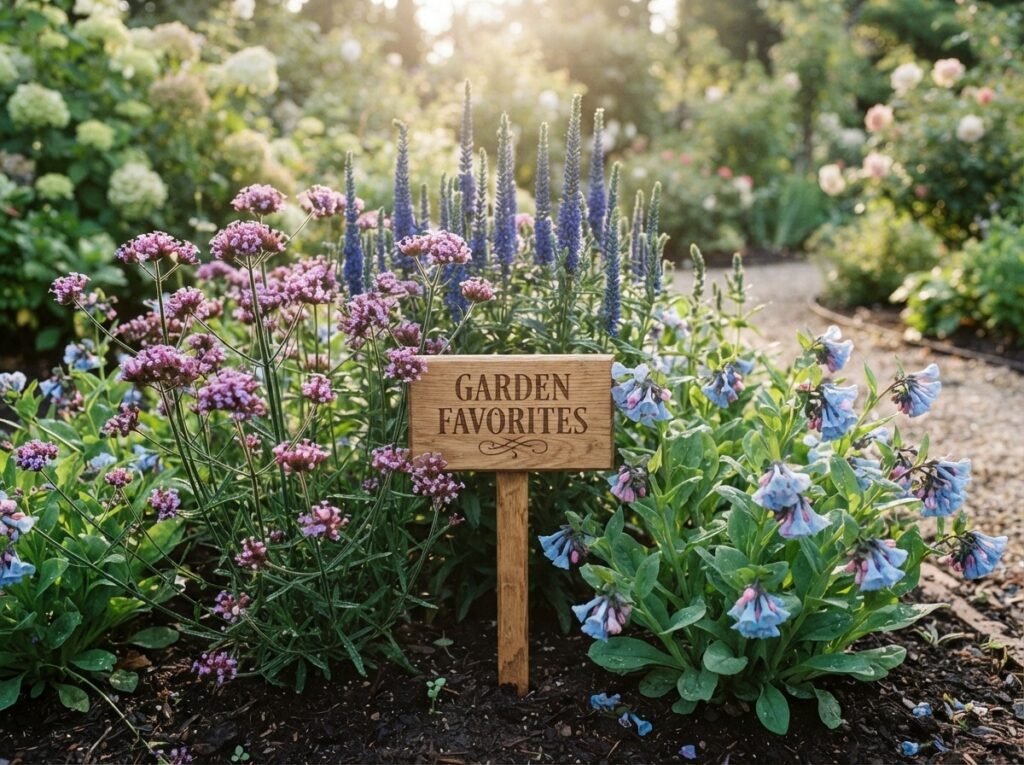
These plants share a few traits that make them dependable choices. Most tolerate average soil without needing constant feeding or care. Many also bloom for months at a time, which keeps color going through most of the growing season. Gardeners often reach for this group first because it forgives beginner mistakes.
- Verbena – nearly nonstop color from spring to fall
- Veronica – tall spikes that draw bees and butterflies
- Virginia Bluebells – soft, shifting color for shaded spring beds
- Vitex – heat-tolerant flowering tree for dry climates
- Vervain Mallow – long summer bloom with little upkeep
Each of these plants rewards fairly light effort with strong, lasting color. That balance is exactly why gardeners return to them season after season.
Indoor Plants
Several V flowers also do well indoors. Vanda Orchid is a favorite for bright, humid indoor spaces, often grown in a basket with exposed roots. Vriesea, or Flaming Sword, is a popular bromeliad houseplant, valued for its long-lasting red flower spike. Venus Flytrap can be grown indoors on a sunny sill, though it needs distilled water and occasional feeding.
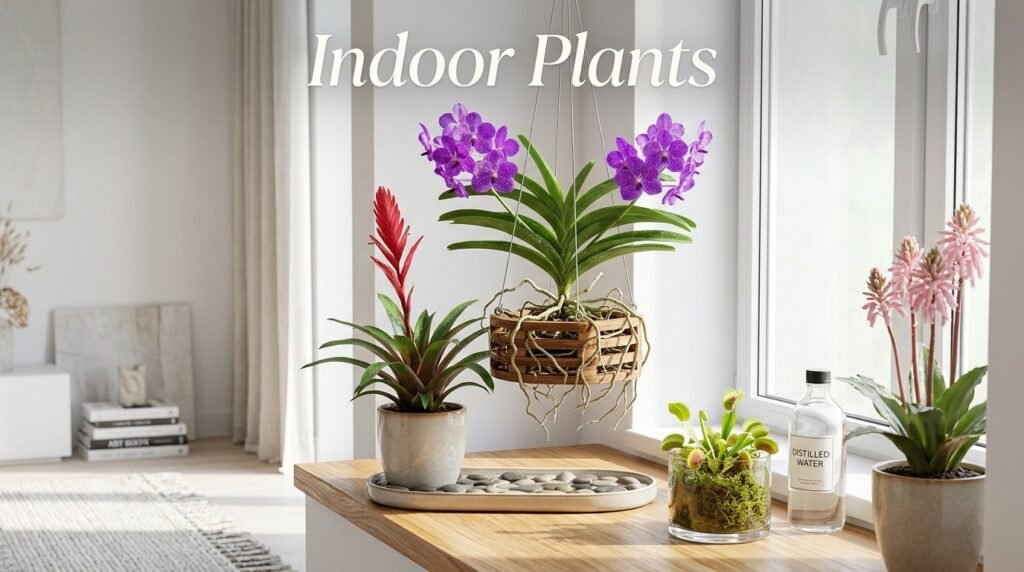
Veltheimia does well as a potted bulb, producing pink flower spikes in winter when little else blooms indoors.
Indoor growing changes what these plants need most. Light matters a great deal for Vanda Orchids, which need bright, indirect sun to bloom well. Humidity often drops too low indoors, especially near heating vents in winter. A pebble tray or occasional misting helps plants like Vanda and Vriesea stay healthy through dry months.
This group brings unusual texture and color into a home, well beyond typical houseplant choices. A single Vanda Orchid or Vriesea can shift the entire mood of a room.
Florist Favorites
Florists reach for a handful of key V flowers again and again. Violet is prized for its sweet fragrance, often used in small posies and vintage-style bouquets. Vanda Orchid brings bold, saturated color to modern arrangements, holding its shape well after cutting. Viburnum offers full, rounded clusters that add volume to spring wedding work. Vinca vine, though grown mainly for its trailing foliage, is often paired with cut flowers in mixed arrangements.
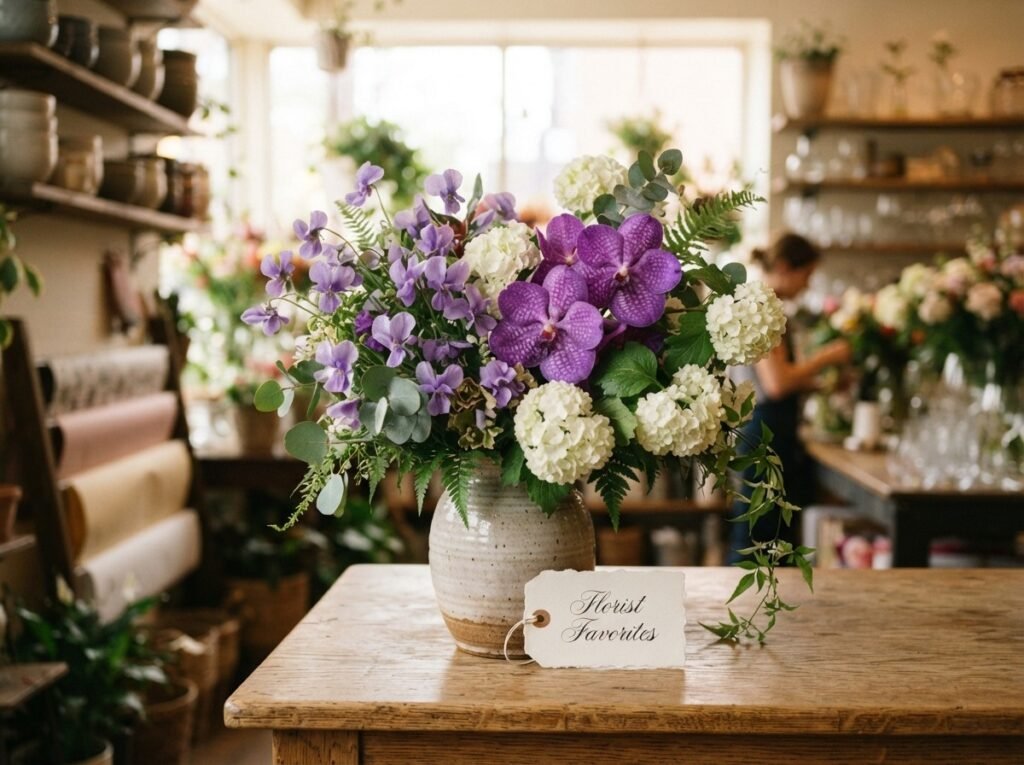
These flowers share traits that matter in the cut-flower trade. Fragrance matters greatly for Violet, since scent is central to its old-fashioned appeal. Vase life matters for Vanda Orchids, which can last one to two weeks with proper care. Structure matters for Viburnum, whose sturdy stems hold up well during transport and arranging.
Together, these flowers cover fragrance, bold color, and reliable structure within a single letter. That range explains why florists rely on V flowers throughout the year.
Rare Flowers
A few V flowers count as genuine rarities among plant collectors. Blue Vanda is one of the most prized orchids in the world, valued for its true blue color, which is rarely found in nature. It grows wild only in a narrow band of forest across northeast India and parts of Southeast Asia, and overcollection has made wild populations increasingly scarce. Vancouveria, or Inside-Out Flower, is uncommon outside its native range in the Pacific Northwest, where it grows in cool, shaded forest understories.
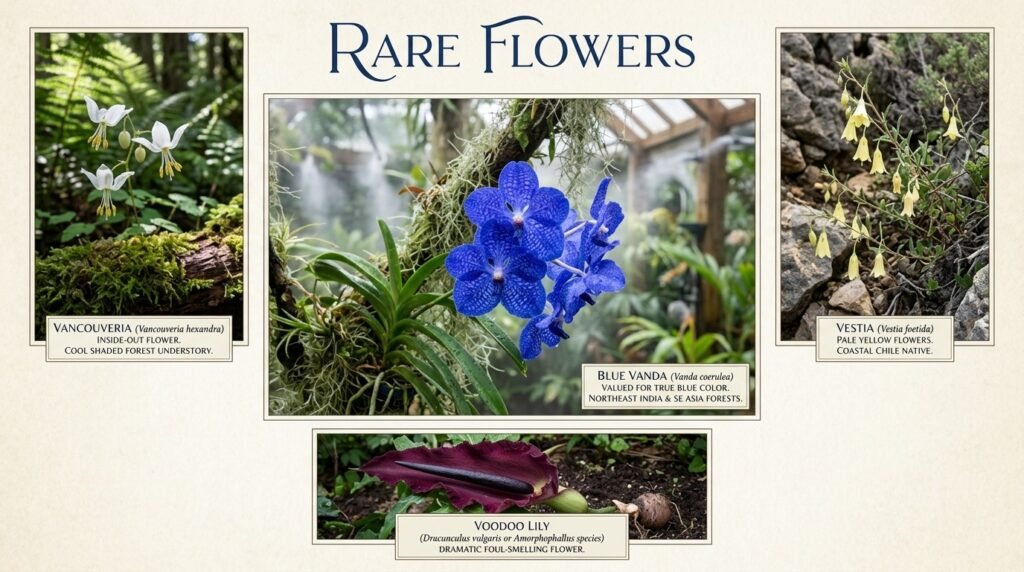
Vestia is another rare pick, native only to a small coastal region of Chile and rarely seen in gardens outside specialist collections. Its pale yellow, bell-shaped flowers have an unusual, slightly unpleasant scent that gives the plant its species name. Voodoo Lily draws attention for a different reason, producing a single dramatic, foul-smelling flower each year from an underground tuber.
These four flowers show that rarity within the letter V can come from a narrow habitat, overcollection, or simply unusual growing conditions. Each one rewards a patient collector willing to seek it out.
Caution and Toxicity
Not every flower that starts with V is safe around pets or small children. Vireya Rhododendron is the most serious concern here, since all rhododendrons contain compounds that can cause severe symptoms if eaten. Voodoo Lily contains calcium oxalate crystals, similar to other aroids, which cause mouth and throat irritation. Vinca species carry moderate toxicity too, since their alkaloids can cause vomiting and lowered blood pressure in pets.
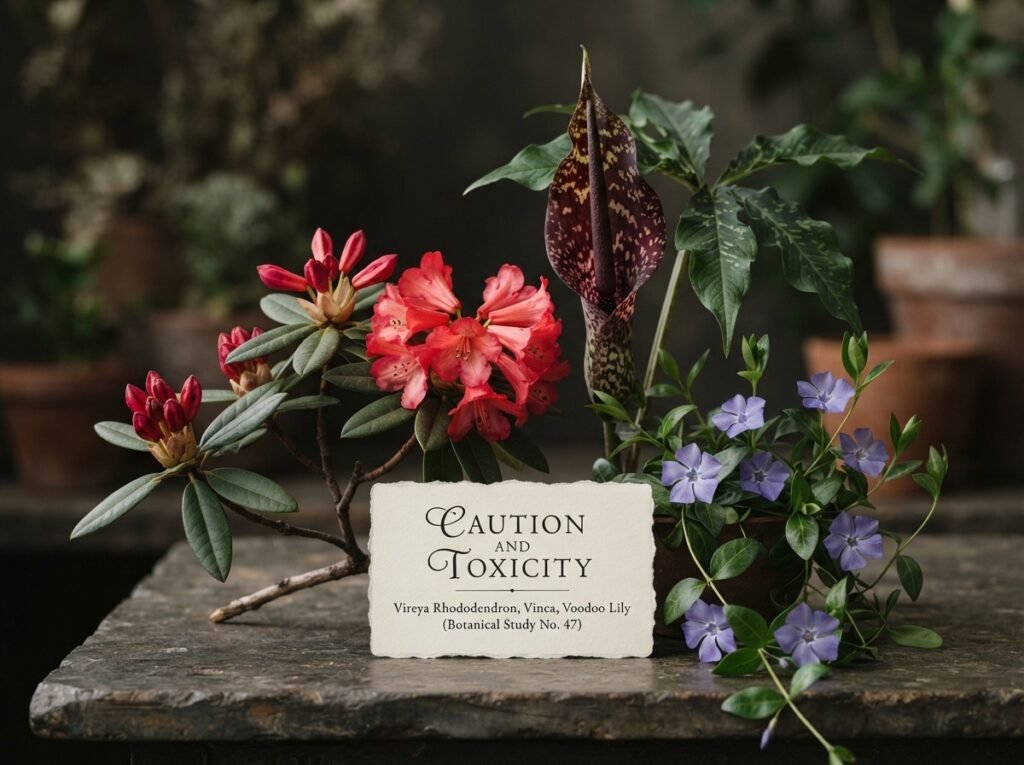
Milder cases still deserve some caution. Veltheimia and Vallota, both true bulbs, can cause stomach upset if a pet digs and chews them. Virginia Iris causes similar mild reactions, mainly from its rhizome. Viper’s Bugloss has bristly hairs that can irritate skin on contact, separate from any internal toxicity.
- Vireya Rhododendron – severe, toxic to dogs and cats
- Voodoo Lily – moderate, causes mouth irritation
- Vinca (Periwinkle) – moderate, contains toxic alkaloids
- Veltheimia – mild, mainly the bulb
- Vallota – mild, mainly the bulb
- Virginia Iris – mild, mainly the rhizome
If pets or young children share your home, always check a new plant before bringing it inside. A quick look at the ASPCA’s toxic plant list can prevent a stressful emergency later.
Color-Based Groupings
Color is often the first detail a gardener considers before choosing a plant. Grouping V flowers by color makes planning a bed or bouquet much simpler.
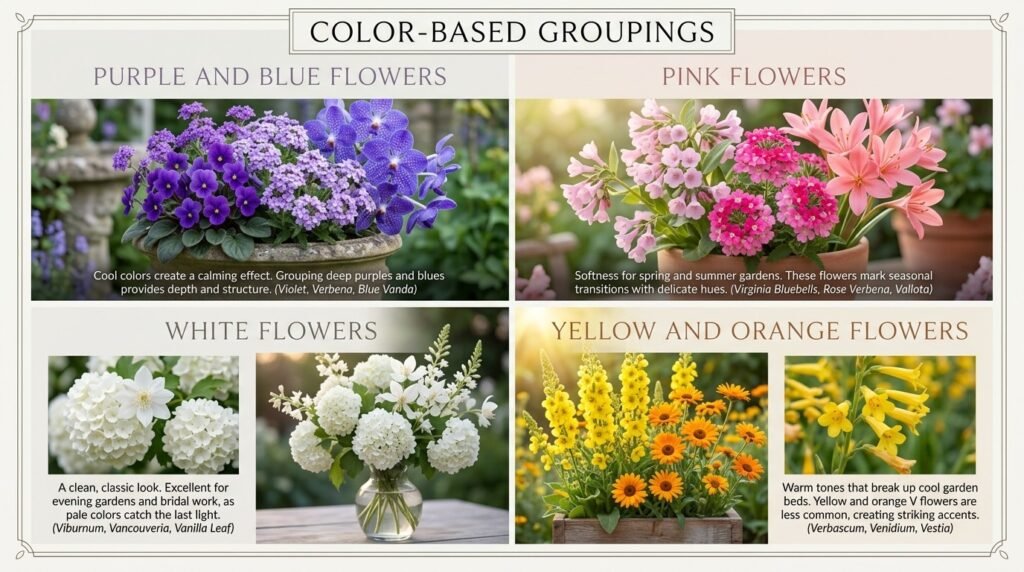
Purple and blue flowers dominate this letter more than any other color. Violet, Verbena, and Blue Vanda all offer strong purple or blue tones. These work beautifully together in cottage-style beds, where cool colors create a calming effect.
Pink flowers bring softness to spring and summer gardens. Virginia Bluebells, Rose Verbena, and Vallota all fall into this group. These flowers often mark seasonal transitions, from early spring blooms to late-summer color.
White flowers offer a clean, classic look for evening gardens and bridal work. Viburnum, Vancouveria, and Vanilla Leaf all fall into this group. These shades show up beautifully at dusk, when pale colors catch the last light.
Yellow and orange flowers are less common within this letter, which makes them stand out. Verbascum, Venidium, and Vestia all offer warm yellow or orange tones. Gardeners often use these to break up beds otherwise dominated by cooler purples and blues.
Color grouping offers a simple shortcut for planning, even without deep botanical knowledge. Once you know which V flowers fall into each shade, building a themed bed becomes far easier.
Life-Cycle Groupings
The life cycle affects how much replanting a garden needs each year. Annuals complete their cycle in one season and need replanting. Perennials return on their own for several years or longer. Bulbs, shrubs, and trees each follow their own longer-term patterns.
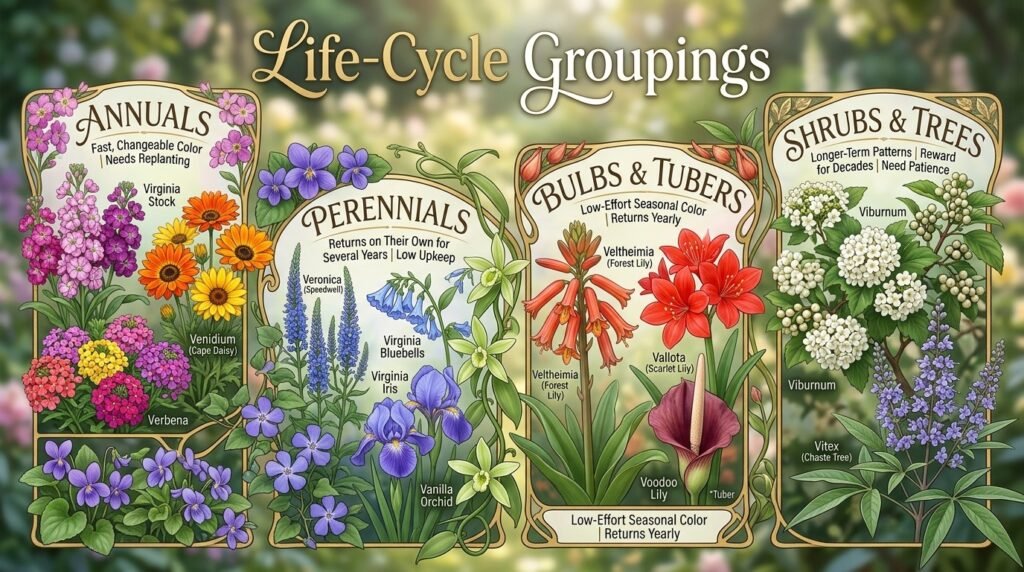
The table below sorts several V flowers by life cycle, so you can plan around your preferred maintenance level. If low upkeep matters most, lean toward the perennial, shrub, and bulb rows. If you want fast, changeable color, a few annual options are worth considering.
| Flower | Life Cycle |
| Violet | Perennial |
| Verbena | Annual (perennial in warm zones) |
| Veronica | Perennial |
| Vinca (Periwinkle) | Perennial groundcover |
| Virginia Bluebells | Perennial |
| Vitex | Perennial shrub or small tree |
| Viburnum | Perennial shrub |
| Veltheimia | Bulb |
| Vallota | Bulb |
| Virginia Iris | Perennial |
| Voodoo Lily | Tuber |
| Vanilla Orchid | Perennial vine |
| Virginia Stock | Annual |
| Venidium | Annual |
Bulbs like Veltheimia and Vallota are useful for low-effort seasonal color that returns yearly. Shrubs and trees like Viburnum and Vitex need patience but reward gardeners for decades. Annuals like Virginia Stock and Venidium need replanting, but they reward gardeners with fast, reliable color in a single season.
Botanical Name Crosswalk
Botanical names matter more than most beginners expect. Common names shift by region, but a botanical name stays consistent worldwide. This becomes especially useful within the letter V, where several unrelated plants share the common name “Vervain” or “Violet.” It also helps confirm you are buying the exact species you intended.
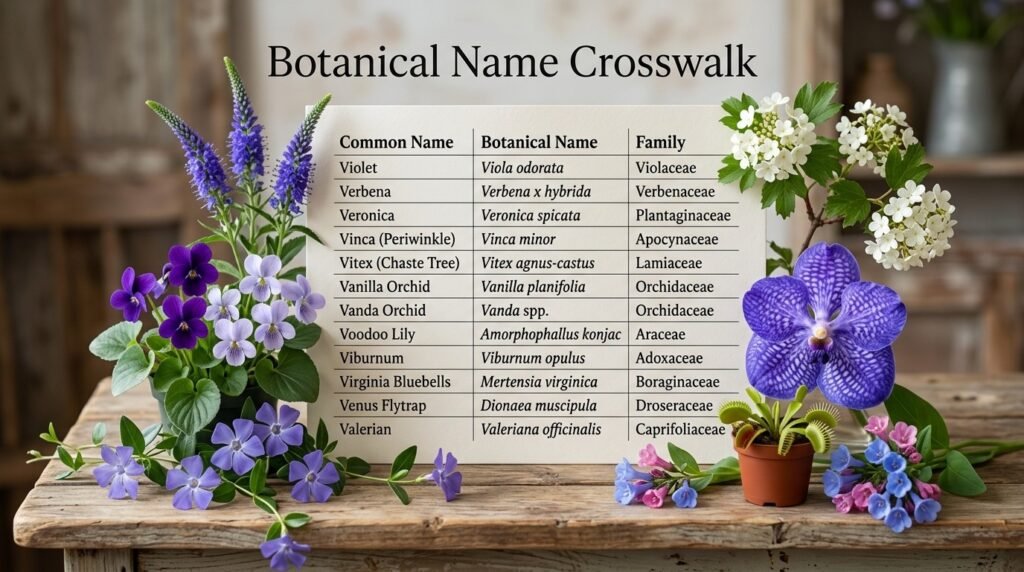
The table below matches common V flower names to their botanical names and plant families. Use it if you want to search more precisely or confirm you are buying the correct plant.
| Common Name | Botanical Name | Family |
| Violet | Viola odorata | Violaceae |
| Verbena | Verbena x hybrida | Verbenaceae |
| Veronica | Veronica spicata | Plantaginaceae |
| Vinca (Periwinkle) | Vinca minor | Apocynaceae |
| Vitex (Chaste Tree) | Vitex agnus-castus | Lamiaceae |
| Vanilla Orchid | Vanilla planifolia | Orchidaceae |
| Vanda Orchid | Vanda spp. | Orchidaceae |
| Voodoo Lily | Amorphophallus konjac | Araceae |
| Viburnum | Viburnum opulus | Adoxaceae |
| Virginia Bluebells | Mertensia virginica | Boraginaceae |
| Venus Flytrap | Dionaea muscipula | Droseraceae |
| Valerian | Valeriana officinalis | Caprifoliaceae |
Notice that Vanda Orchid and Vanilla Orchid share the same family despite looking very different. Both belong to Orchidaceae, the largest flowering plant family in the world. Vinca, by contrast, belongs to Apocynaceae, placing it closer to oleander than to true violets.
Flower Meanings and Symbolism
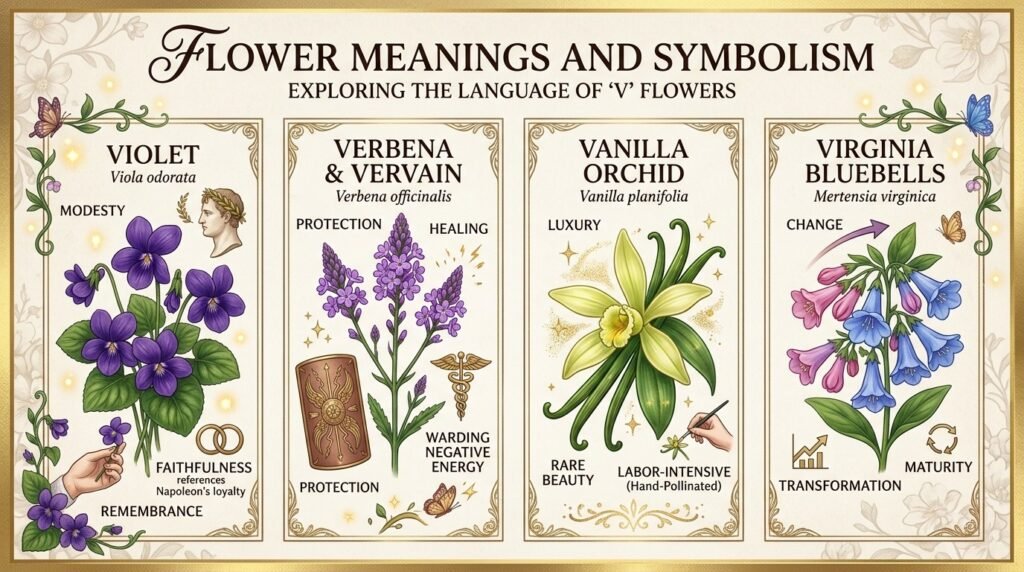
Flowers have carried symbolic meaning for centuries, and V flowers hold some genuinely rich stories. Violet traditionally symbolizes modesty, faithfulness, and remembrance. Napoleon Bonaparte was closely associated with violets, reportedly promising to return from exile “with the violets” in spring. This link made the flower a quiet symbol of loyalty among his supporters for years afterward.
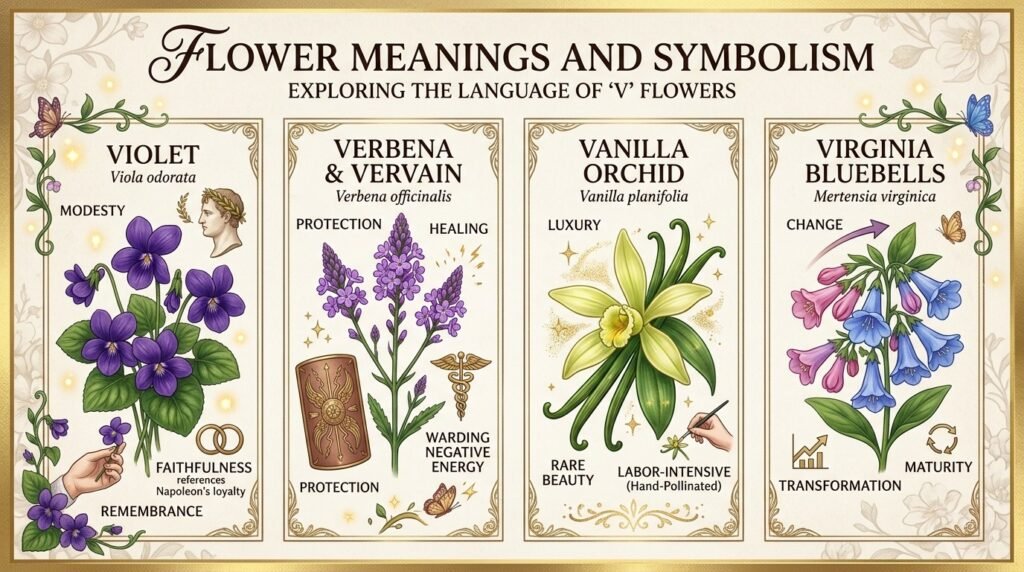
Verbena carries a different symbolism, tied to protection and healing in ancient Roman and Greek tradition. It was used in religious ceremonies and believed to ward off negative energy. Vervain, its close botanical relative, shares much of this same protective folklore across European herbal history.
Vanilla Orchid symbolizes luxury and rare beauty, fitting for a flower that must be hand-pollinated to produce its valuable pods. This labor-intensive process has made vanilla one of the most expensive spices in the world. Virginia Bluebells carry a gentler symbolism tied to change, since their flowers shift from pink to blue as they mature. Each of these meanings adds cultural depth to a letter group that spans cottage gardens and tropical greenhouses alike.
Decision-Flow Table: Which V Flower Should You Choose?
Choosing the right flower depends on your specific goal, not just its looks. The table below matches common goals to V flowers that fit well. Start with the row closest to your need, then check the earlier sections for full details.
| Your Goal | Recommended V Flower |
| Nonstop summer color for a sunny bed | Verbena |
| Fragrant flower for small bouquets | Violet |
| Tough groundcover for sun or shade | Vinca (Periwinkle) |
| Dramatic indoor orchid | Vanda Orchid |
| Shade-loving spring wildflower | Virginia Bluebells |
| Pet-safe flowering shrub | Viburnum |
| Rare collector orchid | Blue Vanda |
| Drought-tolerant flowering tree | Vitex |
| Carnivorous plant for a sunny sill | Venus Flytrap |
| Winter-blooming potted bulb | Veltheimia |
This table works best as a starting point rather than a strict rule. Many gardens benefit from combining several of these flowers together. A bed with Verbena, Veronica, and Virginia Bluebells, for example, covers three different bloom seasons in one space.
Conclusion
Flowers that start with V cover a remarkably wide range of colors, habits, and uses. From the fragrant Violet to the rare Blue Vanda, this letter offers real variety for gardeners, florists, and collectors alike. Whether you want an easy summer bloomer, a dramatic indoor orchid, or a pet-safe flowering shrub, there is a flower that starts with V for it. Use the tables and lists above as a starting point for your next planting project.
Frequently Asked Questions
What are some common flowers that start with V?
Common picks include Violet, Verbena, Veronica, and Vinca. These four are widely sold at nurseries and garden centers. They are also easy to find as seeds, bulbs, or potted plants.
Are there any rare flowers that start with V?
Yes, Blue Vanda and Vestia are both considered rare. Blue Vanda grows wild only in a narrow region of northeast India and Southeast Asia. Vestia is native to a small coastal area of Chile and is rarely seen outside collections.
Which flowers that start with V are toxic to pets?
Vireya Rhododendron, Voodoo Lily, and Vinca are the most concerning entries. Veltheimia and Vallota cause milder reactions in most cases. Always check a plant against the ASPCA list before bringing it near pets.
What is the most fragrant flower that starts with V?
Violet is widely considered the most fragrant V flower. Its scent is sweet and delicate, long used in perfume production. Vanilla Orchid is a close second, prized worldwide for its warm, sweet fragrance.
Which V flowers are best for beginners?
Verbena and Vinca are both forgiving and low-maintenance. They tolerate average soil and require little regular attention. Veronica is another strong beginner pick for sunny to partly shaded borders.
Can Vanda Orchids be grown indoors easily?
Vanda Orchids need bright, indirect light and high humidity to thrive. They are often grown in open baskets rather than soil. With consistent care, they can bloom multiple times a year indoors.
What flower symbolizes faithfulness and remembrance?
Violet is the flower most closely tied to this meaning. It has carried this symbolism since ancient Greek and Roman times. This makes it a popular choice for memorial arrangements and keepsakes.
Is Vinca the same as Vinca Rosea?
No, though the names sound similar, they refer to different plants. True Vinca belongs to the genus Vinca, used mainly as groundcover. Vinca Rosea is an older name for Catharanthus roseus, a different but related plant.
Which V flowers work well in shade?
Virginia Bluebells and Vancouveria both thrive in shaded, woodland conditions. Violet also tolerates partial shade quite well. These three are strong picks for a shaded garden bed.
What is the difference between Verbena and Vervain?
Verbena usually refers to garden hybrids grown for bedding and containers. Vervain typically refers to the wild species, Verbena officinalis, used in herbal traditions. Both belong to the same genus but serve different garden purposes.