

Flowers that start with P range from garden classics like Peony to rare finds like Parrot Flower. This guide brings together 55 real flowers, each with a checked botanical name, native range, bloom time, and toxicity note. Whether you garden, arrange bouquets, or simply love plant names, you’ll find this list offers a clear, reliable starting point for exploring the letter P.
- Quick Answer: Top Flowers That Start With P
- Alphabetical List of Flowers That Start With P
- Full Comparison Table of Flowers That Start With P
- Garden Favorites Among Flowers That Start With P
- Indoor Plants Among Flowers That Start With P
- Florist Favorites Among Flowers That Start With P
- Rare Flowers That Start With P
- Flowers That Start With P and Need Caution
- Color-Based Groupings of Flowers That Start With P
- Life-Cycle Groupings of Flowers That Start With P
- Botanical Name Crosswalk for Flowers That Start With P
- Flower Meanings and Symbolism
- Decision Guide: Which Flower That Starts With P Should You Choose?
- Conclusion
- Frequently Asked Questions
- What are some common flowers that start with P?
- Are there really 55 flowers that start with P?
- Which flowers that start with P are toxic to pets?
- Is Poinsettia as dangerous as people think?
- Which P-flower blooms the longest?
- What is the tallest flower that starts with P?
- Can I grow flowers that start with P indoors?
- Which P-flowers are best for pollinators?
- Is Periwinkle dangerous to have at home?
- What does the Peony flower symbolize?
- Which flowers that start with P are edible?
- Is the Phalaenopsis Orchid hard to grow?
- What is the rarest flower that starts with P?
- Which P-flower suits a florist’s bouquet best?
- Do all Peony varieties need cold winters to bloom?
This article is built for several kinds of readers at once. A home gardener can use it to fill a bed with dependable, colorful choices. A florist can use it to find fresh P-letter stems for a bouquet. A parent or pet owner can use it to spot risky plants like Poinsettia or Periwinkle. A curious plant lover can simply enjoy how wide this one letter’s range turns out to be.
The flowers below are organized in several useful ways. A master alphabetical list comes first, followed by a full comparison table covering all 55 entries. After that come category sections for garden favorites, indoor plants, florist picks, rare finds, and toxic plants, each with real photo captions built in. Color groups and life-cycle groups follow near the end, before a full FAQ section.
Every flower named here has a real, verified botanical name. Native range and toxicity notes appear throughout, so you can plan safely around kids or pets. Image captions follow many individual flower descriptions, making it easy to slot in a photo later. By the end, you should be able to pick flowers that start with P for almost any garden goal.
Quick Answer: Top Flowers That Start With P
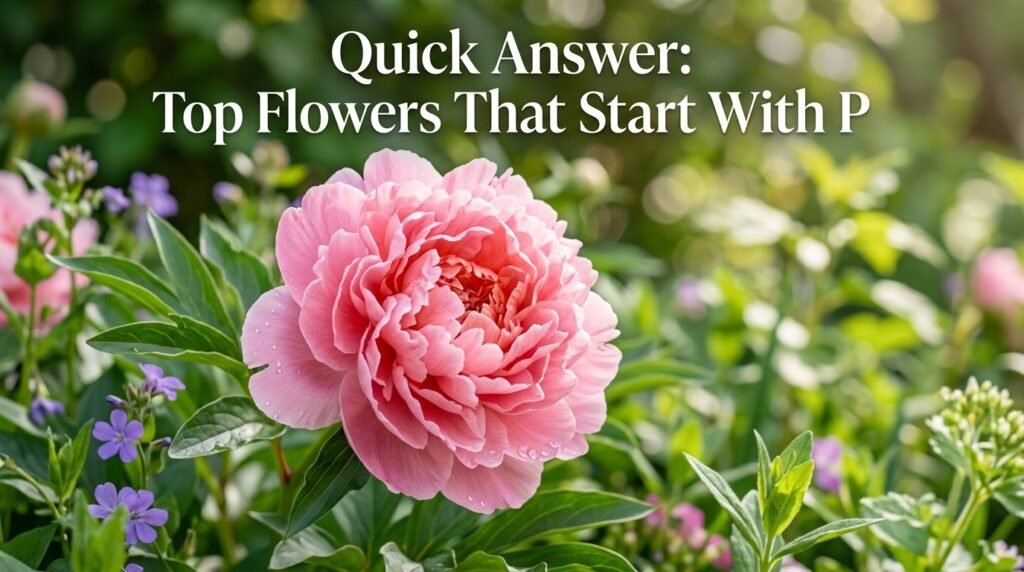
If you only remember a few names, start here. Peony leads the group with huge, ruffled blooms that return reliably for decades once planted. Pansy brings cheerful, face-like blooms to cool-season beds and containers. Petunia fills hanging baskets with nonstop color from spring through the first fall frost. Plumeria offers fragrant, waxy tropical blooms famous in Hawaiian leis. Protea stands out as one of the most dramatic cut flowers, with a bloom shape unlike almost anything else. Peace Lily brings elegant white blooms to low-light indoor spaces, though every part of it is toxic. Poppy Anemone adds jewel-toned, silky petals to spring gardens and bouquets alike. Pincushion Flower rounds out the list with delicate, pin-covered blooms that bees and butterflies love.
Love To Read 75+ Beautiful Flowers That Start With F (Names, Pictures & Facts)
Alphabetical List of Flowers That Start With P
Some flowers here start with P in their common name, like Peony or Petunia. Others start with P only through a botanical or genus name, like Portulaca or Penstemon. Both types appear below, since most searches for this topic mix common and botanical names together. Each entry lists the most searched common name first, with its botanical name right beside it.
- Peony (Paeonia lactiflora)
- Petunia (Petunia × hybrida)
- Pansy (Viola × wittrockiana)
- Oriental Poppy (Papaver orientale)
- Primrose (Primula vulgaris)
- Plumeria (Plumeria rubra)
- King Protea (Protea cynaroides)
- Passionflower (Passiflora incarnata)
- Periwinkle (Vinca minor)
- Garden Phlox (Phlox paniculata)
- Pincushion Flower (Scabiosa atropurpurea)
- Cottage Pink (Dianthus plumarius)
- Poinsettia (Euphorbia pulcherrima)
- Pentas (Pentas lanceolata)
- Peruvian Lily (Alstroemeria aurea)
- Persian Buttercup (Ranunculus asiaticus)
- Pincushion Protea (Leucospermum cordifolium)
- Pocketbook Plant (Calceolaria herbeohybrida)
- Polyanthus (Primula × polyantha)
- Pomegranate (Punica granatum)
- Poppy Anemone (Anemone coronaria)
- Moss Rose (Portulaca grandiflora)
- Prairie Smoke (Geum triflorum)
- Auricula (Primula auricula)
- Prince’s Feather (Amaranthus hypochondriacus)
- Pussy Willow (Salix discolor)
- Painted Daisy (Tanacetum coccineum)
- Painted Tongue (Salpiglossis sinuata)
- Paperflower (Psilostrophe tagetina)
- Parrot Flower (Impatiens psittacina)
- Peace Lily (Spathiphyllum wallisii)
- Pearly Everlasting (Anaphalis margaritacea)
- Pelargonium (Pelargonium × hortorum)
- Penstemon (Penstemon digitalis)
- Persian Cyclamen (Cyclamen persicum)
- Phalaenopsis Orchid (Phalaenopsis amabilis)
- Pickerelweed (Pontederia cordata)
- Pigsqueak (Bergenia crassifolia)
- Pink Fairies (Clarkia unguiculata)
- Pinwheel Flower (Tabernaemontana divaricata)
- Plains Coreopsis (Coreopsis tinctoria)
- Plumbago (Plumbago auriculata)
- Pond Lily (Nuphar lutea)
- Powder Puff Tree (Calliandra haematocephala)
- Prairie Coneflower (Ratibida columnifera)
- Persian Silk Tree (Albizia julibrissin)
- Pinkroot (Spigelia marilandica)
- Purslane (Portulaca oleracea)
- Prickly Poppy (Argemone mexicana)
- Pyracantha (Pyracantha coccinea)
- Purple Bell Vine (Rhodochiton atrosanguineus)
- Peruvian Daffodil (Ismene × festalis)
- Painted Trillium (Trillium undulatum)
- Prairie Gentian (Eustoma grandiflorum)
- Pig Lily (Zantedeschia aethiopica)
Full Comparison Table of Flowers That Start With P
The table below lines up six key facts for each of the 55 flowers on this list. Native range shows where a plant grows wild, which helps you judge if your climate will suit it. Bloom season and USDA zone guide planting timing, while the toxicity column flags any risk to people or pets. Use this table as a fast reference before reading the fuller category sections below.
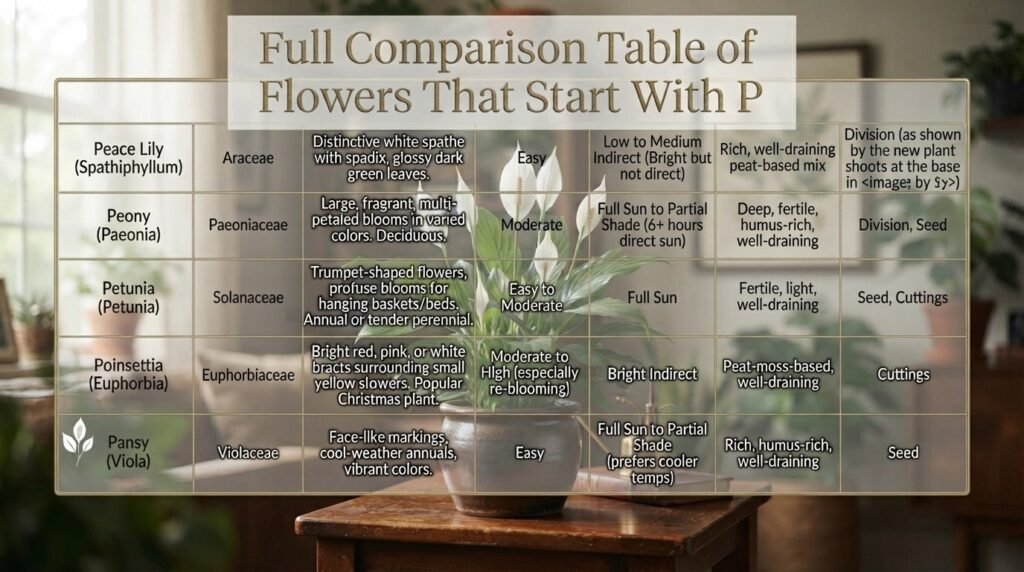
| Flower | Botanical Name | Native Range | Bloom Season | USDA Zone | Toxicity |
| Peony | Paeonia lactiflora | China | Late spring | 3–8 | Mild toxic |
| Petunia | Petunia × hybrida | South America | Spring to frost | 9–11, annual | Mild toxic |
| Pansy | Viola × wittrockiana | Europe | Spring to fall | 4–8 | Non-toxic |
| Oriental Poppy | Papaver orientale | Caucasus, Iran | Late spring | 3–7 | Toxic |
| Primrose | Primula vulgaris | Western and Southern Europe | Spring | 4–8 | Mild toxic |
| Plumeria | Plumeria rubra | Central America, Mexico | Summer to fall | 10–11 | Mild toxic sap |
| King Protea | Protea cynaroides | South Africa | Winter to summer | 9–11 | Non-toxic |
| Passionflower | Passiflora incarnata | Southeastern United States | Summer | 6–9 | Mild toxic |
| Periwinkle | Vinca minor | Europe | Spring | 4–8 | Toxic |
| Garden Phlox | Phlox paniculata | Eastern United States | Summer | 4–8 | Non-toxic |
| Pincushion Flower | Scabiosa atropurpurea | Southern Europe | Summer to fall | 5–9 | Non-toxic |
| Cottage Pink | Dianthus plumarius | Europe | Late spring to summer | 3–9 | Mild, toxic to pets |
| Poinsettia | Euphorbia pulcherrima | Mexico | Winter | 9–11 | Mild toxic |
| Pentas | Pentas lanceolata | East Africa, Arabian Peninsula | Summer to frost | 10–11, annual elsewhere | Non-toxic |
| Peruvian Lily | Alstroemeria aurea | South America | Summer | 7–10 | Mild toxic |
| Persian Buttercup | Ranunculus asiaticus | Middle East, Mediterranean | Spring | 8–10 | Toxic |
| Pincushion Protea | Leucospermum cordifolium | South Africa | Spring | 9–10 | Non-toxic |
| Pocketbook Plant | Calceolaria herbeohybrida | South America | Spring | 9–11, annual | Non-toxic |
| Polyanthus | Primula × polyantha | Garden hybrid | Spring | 3–8 | Mild toxic |
| Pomegranate | Punica granatum | Iran, Northern India | Summer | 7–10 | Non-toxic |
| Poppy Anemone | Anemone coronaria | Mediterranean | Spring | 7–10 | Toxic |
| Moss Rose | Portulaca grandiflora | South America | Summer to frost | 2–11, annual | Mild toxic |
| Prairie Smoke | Geum triflorum | North America | Spring | 3–6 | Non-toxic |
| Auricula | Primula auricula | European Alps | Spring | 3–8 | Mild toxic |
| Prince’s Feather | Amaranthus hypochondriacus | Central America | Summer to fall | 2–11, annual | Non-toxic |
| Pussy Willow | Salix discolor | North America | Early spring | 4–8 | Mild toxic |
| Painted Daisy | Tanacetum coccineum | Caucasus, Iran | Late spring to summer | 3–7 | Mild toxic |
| Painted Tongue | Salpiglossis sinuata | Chile | Summer | 2–11, annual | Non-toxic |
| Paperflower | Psilostrophe tagetina | Southwestern United States | Spring to fall | 5–9 | Non-toxic |
| Parrot Flower | Impatiens psittacina | Southeast Asia | Summer to fall | 10–11 | Non-toxic |
| Peace Lily | Spathiphyllum wallisii | Central and South America | Spring to fall | 10–12, houseplant | Toxic |
| Pearly Everlasting | Anaphalis margaritacea | North America, Asia | Summer to fall | 3–8 | Non-toxic |
| Pelargonium | Pelargonium × hortorum | South Africa | Spring to fall | 10–11, annual elsewhere | Mild toxic |
| Penstemon | Penstemon digitalis | North America | Summer | 3–8 | Non-toxic |
| Persian Cyclamen | Cyclamen persicum | Mediterranean, Middle East | Fall to spring | 9–11, houseplant | Toxic |
| Phalaenopsis Orchid | Phalaenopsis amabilis | Southeast Asia | Varies | 10–12 | Non-toxic |
| Pickerelweed | Pontederia cordata | Americas | Summer to fall | 3–11 | Non-toxic |
| Pigsqueak | Bergenia crassifolia | Siberia, Mongolia | Spring | 3–8 | Mild toxic |
| Pink Fairies | Clarkia unguiculata | California, United States | Summer | 2–11, annual | Non-toxic |
| Pinwheel Flower | Tabernaemontana divaricata | Southeast Asia | Summer | 9–11 | Toxic sap |
| Plains Coreopsis | Coreopsis tinctoria | Central North America | Summer | 2–11, annual | Non-toxic |
| Plumbago | Plumbago auriculata | South Africa | Summer to fall | 9–11 | Mild toxic |
| Pond Lily | Nuphar lutea | North America, Europe | Summer | 3–11 | Non-toxic |
| Powder Puff Tree | Calliandra haematocephala | Bolivia | Summer to fall | 9–11 | Mild toxic |
| Prairie Coneflower | Ratibida columnifera | North America | Summer | 3–10 | Non-toxic |
| Persian Silk Tree | Albizia julibrissin | Iran to Japan | Summer | 6–9 | Mild toxic |
| Pinkroot | Spigelia marilandica | Southeastern United States | Late spring | 5–9 | Toxic |
| Purslane | Portulaca oleracea | Indian subcontinent, worldwide | Summer | 2–11, annual | Non-toxic, edible |
| Prickly Poppy | Argemone mexicana | Mexico, Central America | Summer | 8–11, annual | Toxic |
| Pyracantha | Pyracantha coccinea | Southern Europe to Asia | Late spring | 6–9 | Mild, toxic seeds |
| Purple Bell Vine | Rhodochiton atrosanguineus | Mexico | Summer to frost | 9–11, annual elsewhere | Non-toxic |
| Peruvian Daffodil | Ismene × festalis | Andes region | Summer | 8–10 | Toxic bulb |
| Painted Trillium | Trillium undulatum | Eastern North America | Spring | 3–7 | Mild toxic |
| Prairie Gentian | Eustoma grandiflorum | Southern United States, Mexico | Summer | 8–10, annual elsewhere | Non-toxic |
| Pig Lily | Zantedeschia aethiopica | South Africa | Late spring to summer | 8–10 | Toxic, all parts |
A few rows deserve extra attention after a first read. Pig Lily and Peace Lily both carry real full-plant toxicity despite their elegant, popular appearance. Periwinkle and Prickly Poppy are similarly risky, so keep them out of reach of pets and small children. Prairie Smoke and Penstemon, by contrast, sit at the safest end of the table, non-toxic and reliable across a wide range of growing zones.
Garden Favorites Among Flowers That Start With P
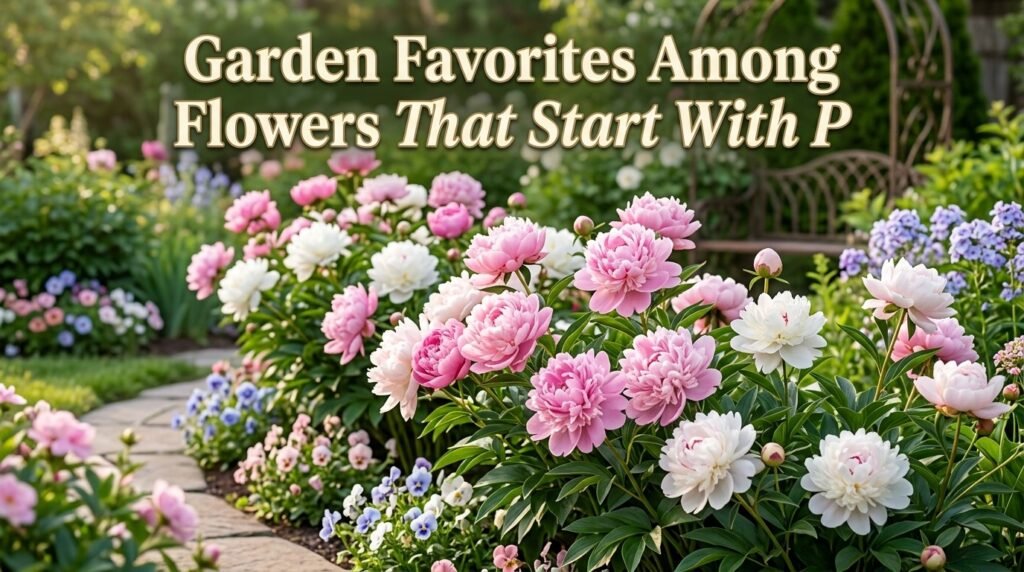
Garden favorites are the flowers gardeners plant season after season without fail. Peony leads this group, since its huge, fragrant blooms return reliably for decades once planted in the right spot. Pansy brings cheerful, face-like color to cool-season beds and containers through spring and fall. Garden Phlox adds tall, fragrant summer color that draws butterflies from across the yard. Penstemon rounds things out as a tough native perennial with tubular flowers loved by hummingbirds.
Peony
Paeonia lactiflora produces huge, ruffled blooms in pink, white, or red each late spring. It can live for decades in the same spot, often outlasting the gardener who first planted it. Image caption: Ruffled pink Peony blooms in a spring garden bed.
Pansy
Viola × wittrockiana opens into cheerful, face-like blooms in nearly every color through cool spring and fall weather. It tolerates light frost better than most other flowering annuals. Image caption: Colorful pansies bloom in a cool-season container.
Read More 80+ Beautiful Flowers That Start With E: With Pictures & Growing Tips
Garden Phlox
Phlox paniculata sends up tall clusters of fragrant pink, purple, or white flowers each summer. Butterflies and moths visit it heavily during the warmest weeks of the season. Image caption: FragrantGarden Phlox blooms in a summer border.
Penstemon
Penstemon digitalis produces tall spikes of tubular white or pink flowers that hummingbirds visit constantly. It tolerates poor, dry soil better than many other native perennials. Image caption: White Penstemon flower spikes in a native garden bed.
- Peony — huge fragrant blooms, decades of reliable bloom
- Pansy — cheerful cool-season color for beds and pots
- Garden Phlox — tall fragrant summer color for butterflies
- Penstemon — tubular blooms loved by hummingbirds
- Oriental Poppy — bold, papery spring blooms
- Prairie Coneflower — tough native for hot, dry beds
These six plants suit very different garden styles. Peony and Penstemon both reward patient gardeners building a long-term, low-maintenance landscape. Pansies and Oriental Poppies, by contrast, offer faster, showier color that changes with the seasons. Image caption: Bold orange Oriental Poppy blooms in a spring border.
Indoor Plants Among Flowers That Start With P
Indoor flowers need to handle lower light and steady room temperatures. Peace Lily is a strong choice, since its elegant white blooms tolerate low light better than most flowering houseplants. Phalaenopsis orchids reward patience with long-lasting sprays of blooms that can last two months or more. Persian Cyclamen fills a cool, bright room with upswept pink or white flowers through winter. Pocketbook Plant rounds out the group with unusual pouch-shaped blooms in bold, spotted colors.
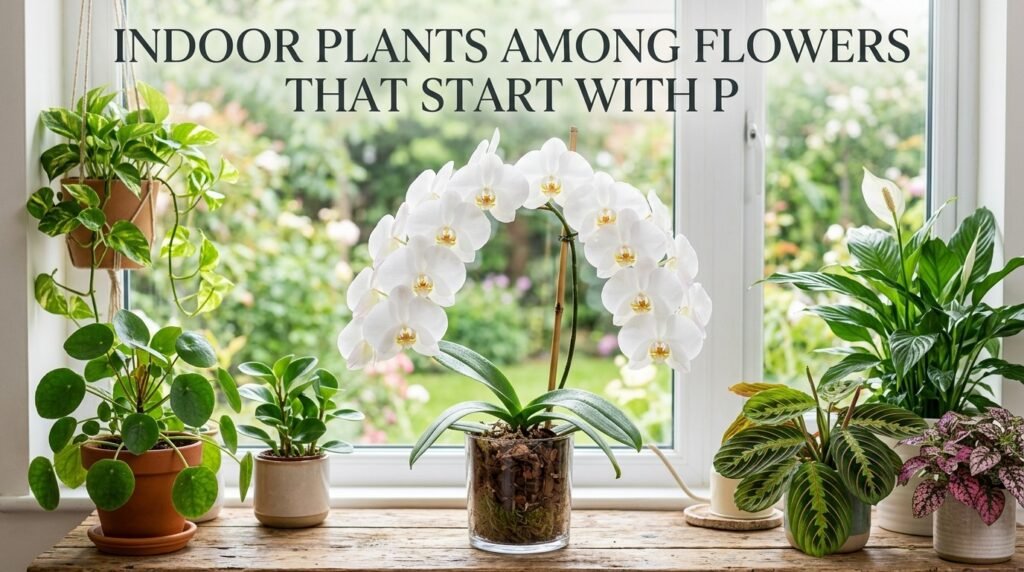
Peace Lily (Spathiphyllum wallisii) produces elegant white, hood-shaped blooms above glossy dark green leaves. It tolerates lower light better than almost any other flowering houseplant.
Image caption: White Peace Lily blooms above glossy green leaves.
Phalaenopsis Orchid (Phalaenopsis amabilis) sends up long, arching sprays of white or pink flowers that can last two months or longer. It remains one of the easiest orchids for a beginner to grow indoors.
Image caption: Pink Phalaenopsis Orchid sprays in a bright indoor room.
Persian Cyclamen (Cyclamen persicum) produces upswept, butterfly-shaped flowers in pink, red, or white above heart-shaped leaves. It prefers cool rooms and blooms best through fall and winter.
Image caption: Pink Persian Cyclamen flowers above heart-shaped leaves.
- Peace Lily — elegant white blooms, tolerates low light
- Phalaenopsis Orchid — long-lasting sprays for beginners
- Persian Cyclamen — cool-loving winter bloomer
- Pocketbook Plant — unusual pouch-shaped spotted blooms
- Plumeria — fragrant tropical blooms for a sunny room
Phalaenopsis orchids and Plumeria both reward patience, since neither blooms quickly from a young plant. Peace Lily and Persian Cyclamen are far more forgiving, flowering within a season of planting. Pocketbook Plantiss is the shortest-lived of the group, often grown fresh each year rather than kept long-term. Image caption: Fragrant pink Plumeria blooms on a sunny indoor plant.
Florist Favorites Among Flowers That Start With P
Florists choose flowers for strong stems, long vase life, and dependable color. Peony remains one of the most requested wedding flowers in the world, thanks to its huge, romantic blooms. Peruvian Lily brings speckled, long-lasting color that holds up for up to two weeks once cut. Poppy Anemone adds jewel-toned, silky petals with a striking dark center to spring arrangements. King Protea rounds out the group as one of the most dramatic and long-lasting cut flowers available anywhere.
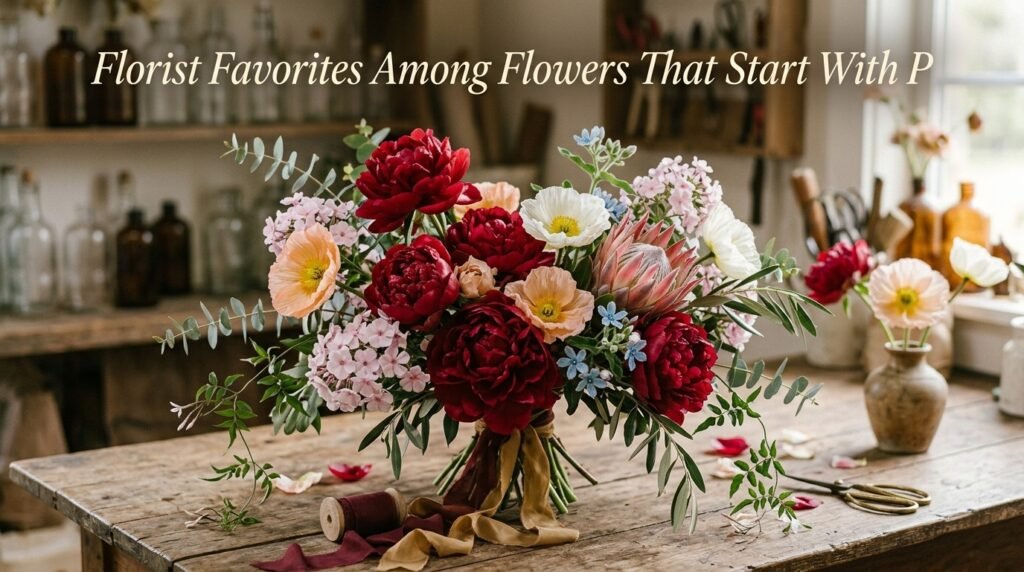
Peony (Paeonia lactiflora) is already described above for its garden appeal, but its florist role deserves its own note. Florists prize it for huge, ruffled blooms that anchor spring and early summer wedding arrangements.
Image caption: Ruffled pink Peony blooms in a bridal bouquet.
Poppy Anemone (Anemone coronaria) produces silky, jewel-toned petals around a striking black center each spring. Its bold contrast makes it a favorite for modern, minimalist floral design.
Read More 70+ Beautiful Flowers That Start With D (With Pictures & Names)
King Protea (Protea cynaroides) opens into an enormous, spiky bloom that can last several weeks once cut. It remains one of the most dramatic and long-lasting flowers used in florist work. Image caption: Enormous pink King Protea blooms in a floral display.
- Peony — romantic, huge blooms for weddings
- Peruvian Lily — long-lasting, speckled color
- Poppy Anemone — bold jewel-toned petals with a dark center
- King Protea — dramatic, exceptionally long-lasting bloom
- Prairie Gentian — rose-like blooms with excellent vase life
Peony and Poppy Anemone both suit romantic, seasonal spring arrangements with soft, painterly color. King Protea instead stands alone as a bold, architectural focal point in modern designs. Peruvian Lily and Prairie Gentian round out the group as dependable, long-lasting everyday choices.
Image caption: A spring bouquet mixing poppy, anemone, and Peruvian Lily.
Rare Flowers That Start With P
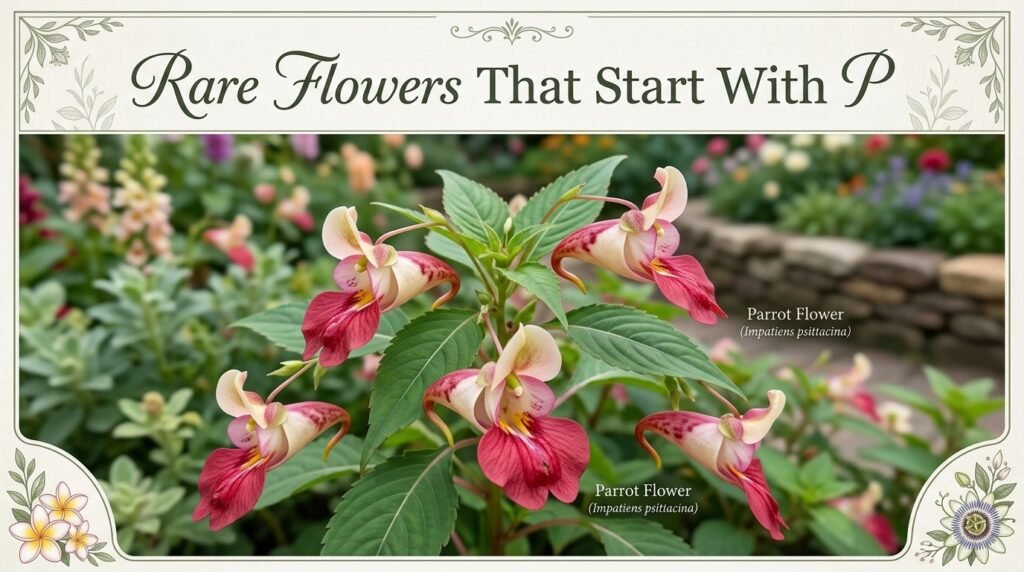
A handful of P-flowers rarely show up outside specialist growers or native plant sales. Parrot Flower is famous for petals that genuinely resemble a small parrot in flight, grown mostly by dedicated collectors in Southeast Asia. Painted Trillium remains uncommon in typical gardens, found only in cool, acidic woodland soil across the Eastern United States. Prairie Smoke earns its rare status partly from its unusual seed heads, which look like wisps of pink smoke after the flower fades. Auricula is a specialist favorite among alpine plant collectors, prized for its velvety, powder-dusted petals.
Parrot Flower
Impatiens psittacina produces pink and purple petals shaped remarkably like a tiny parrot in flight. It remains rare in cultivation and grows wild only in parts of Thailand and Myanmar. Image caption: Pink and purple Parrot Flower petals shaped like a bird.
Painted Trillium
Trillium undulatum produces white flowers with a bold pink-red stripe at the base of each petal. It needs cool, acidic woodland soil that is hard to replicate in a typical garden. Image caption: White Painted Trillium flower with red-striped petals.
Prairie Smoke
Geum triflorum opens into small, nodding pink flowers that later transform into wispy, smoke-like seed heads. Its unusual seed stage often draws more attention than the flower itself. Image caption: Wispy pink Prairie Smoke seed heads in a native meadow.
- Parrot Flower — rare bird-shaped petals from Southeast Asia
- Painted Trillium — uncommon woodland native, needs acidic soil
- Prairie Smoke — unusual smoke-like seed heads
- Auricula — velvety, powder-dusted alpine collector’s flower
- Powder Puff Tree — rare pink pom-pom blooms for warm climates
Parrot Flower and Auricula both demand very specific growing conditions that most home gardens cannot easily provide. Painted Trillium and Prairie Smoke, instead, simply remain overlooked, easy to miss along a woodland or prairie trail. Powder Puff Tree rewards warm-climate gardeners specifically, since it struggles outside frost-free regions. Image caption: Pink pom-pom Powder Puff Tree blooms on a warm-climate shrub.
Flowers That Start With P and Need Caution
A meaningful group of P-flowers carries a real toxicity risk, especially around kids and pets. Poinsettia is often assumed to be deadly, though it is only mildly toxic, causing stomach upset rather than severe harm. Periwinkle contains genuinely toxic alkaloids throughout the plant, with a much longer history of real poisoning cases. Pig Lily, better known as Calla Lily, contains sharp calcium oxalate crystals that cause burning in the mouth and throat. Prickly Poppy produces toxic sap and seeds that can cause serious symptoms if ingested in quantity.
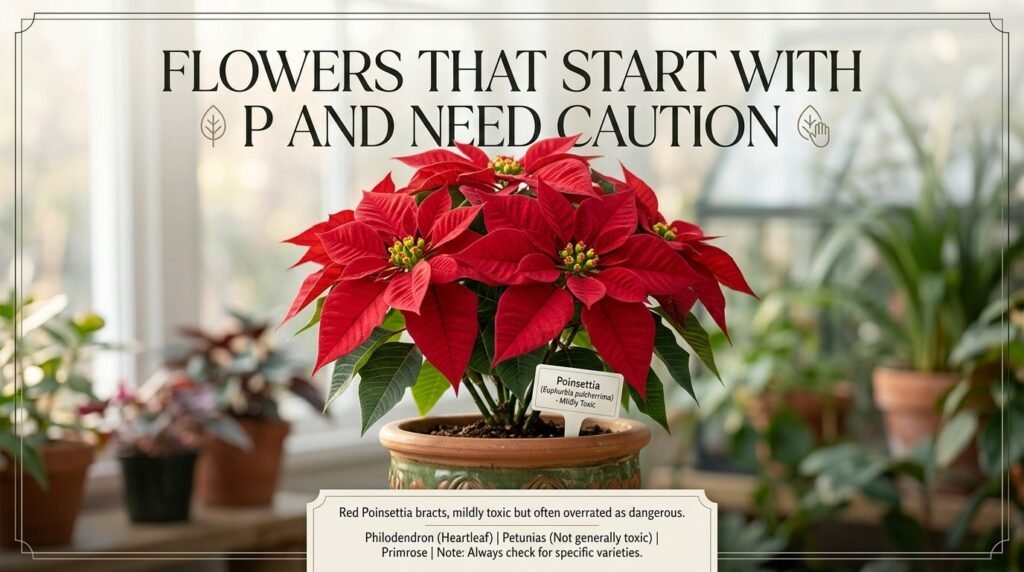
Poinsettia
Euphorbia pulcherrima produces small true flowers surrounded by large red, pink, or white bracts each winter. Its toxicity is commonly overstated, though the milky sap can still irritate skin and cause stomach upset. Image caption: Bright red Poinsettia bracts in a winter display.
Periwinkle
Vinca minor produces small blue-purple flowers above glossy evergreen groundcover foliage each spring. The entire plant contains toxic alkaloids that can cause real harm if eaten. Image caption: Blue-purple Periwinkle flowers in a shaded groundcover bed.
Read More 100+ Beautiful Flowers That Start With C You Should Know
Pig Lily
Zantedeschia aethiopica opens into a sculptural white bloom surrounding a bright yellow center each late spring. Every part of the plant is toxic due to sharp calcium oxalate crystals. Image caption: White sculptural Pig Lily bloom with a yellow center.
- Poinsettia — mildly toxic, often overrated as dangerous
- Periwinkle — genuinely toxic alkaloids throughout
- Pig Lily — oxalate crystals cause mouth and throat irritation
- Prickly Poppy — toxic sap and seeds
- Peace Lily — toxic if chewed or eaten
- Pinkroot — toxic throughout, historically used only in tiny doses
Periwinkle and Prickly Poppy deserve real caution here, since both have a documented history of serious poisoning cases. Poinsettia, despite its scary reputation, causes far milder symptoms than most people assume. Even so, all six of these are best kept out of reach in homes with toddlers or curious pets. Image caption: A cautionary close-up of toxic Periwinkle groundcover flowers.
Color-Based Groupings of Flowers That Start With P
Grouping flowers by color helps with planning a themed bed or bouquet. Pink and rose tones dominate this letter more than almost any other. Peony, Cottage Pink, and Pink Fairies all bring soft, romantic pink shades that pair beautifully in a cottage-style border.
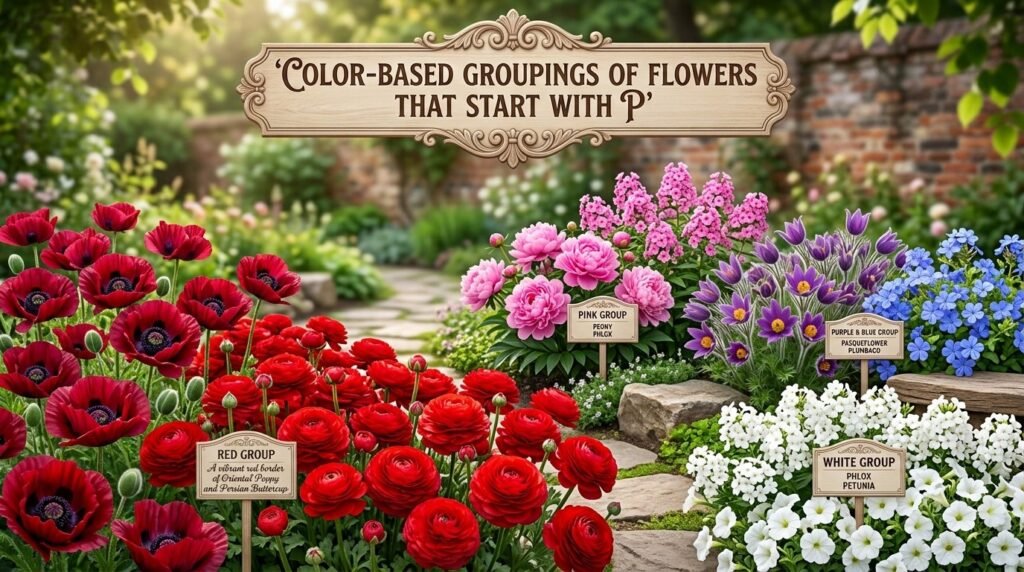
Purple and lavender flowers suit cooler, calmer garden themes. Plumbago and Purple Bell Vine both bring rich purple-blue tones to a summer border, while Periwinkle adds a matching lavender-blue groundcover nearby. These work well planted together for a soft, layered display.
White flowers bring calm, elegant contrast to almost any planting scheme. Peace Lily, Pig Lily, and Painted Trillium all offer white blooms with very different shapes and settings. Peace Lily adds the most reliable indoor presence of the group, blooming steadily in low light.
Red and orange flowers add heat and drama to sunny beds and containers. Oriental Poppy and Poinsettia both lean into bold red tones, while Persian Buttercup adds a matching fiery orange-red bloom nearby. These three work well together for a high-energy, eye-catching display.
Life-Cycle Groupings of Flowers That Start With P
Knowing a flower’s life cycle helps you plan how often to replant a bed. Annuals complete their life cycle in a single season, so they need fresh seeds or plants each year. Perennials return from the same roots for years, while bulbs store energy underground between bloom cycles. Shrubs and woody plants take the longest to establish but reward patience with repeat yearly blooms.
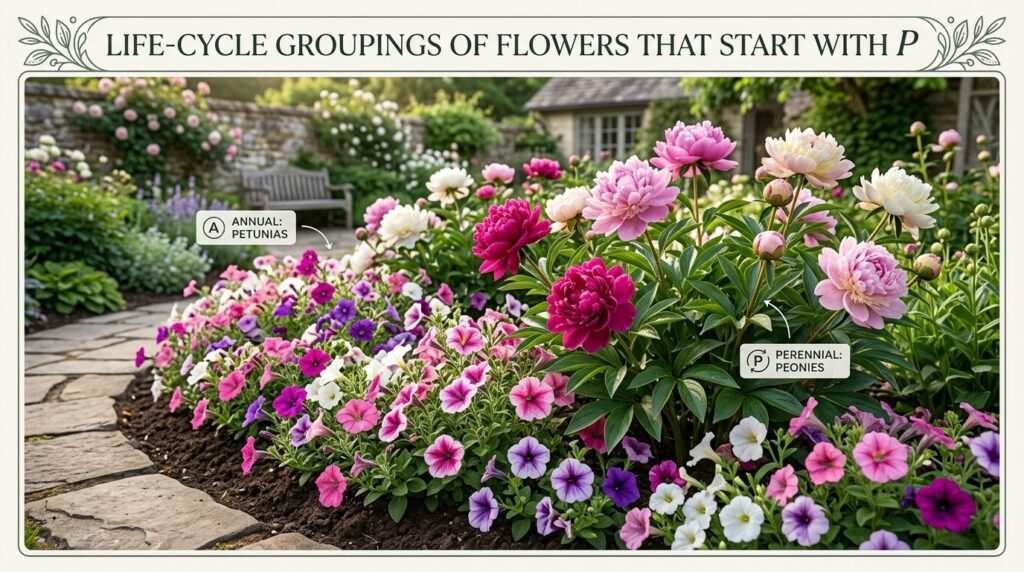
| Life Cycle Type | Example Flowers |
| Annual | Petunia, Painted Tongue, Moss Rose, Prince’s Feather |
| Perennial | Peony, Penstemon, Garden Phlox, Pigsqueak |
| Bulb | Persian Buttercup, Peruvian Daffodil, Poppy Anemone, Pig Lily |
| Shrub or Woody | Plumeria, Pyracantha, Persian Silk Tree, Powder Puff Tree |
Annuals like Petunia and Moss Rose reward gardeners who enjoy fresh planting each spring. Bulb types such as Persian Buttercup and Poppy Anemone need a period of dormancy to bloom each year reliably. Shrubs and woody plants take the longest of all four groups to reach a full, established size.
Botanical Name Crosswalk for Flowers That Start With P
Botanical names matter more than most gardeners expect. Common names shift by region, but a botanical name stays fixed everywhere in the world. This matters most when ordering online, since the wrong common name can return a completely different plant. The crosswalk below pairs common names with correct botanical names and plant families for accurate, confident searching.
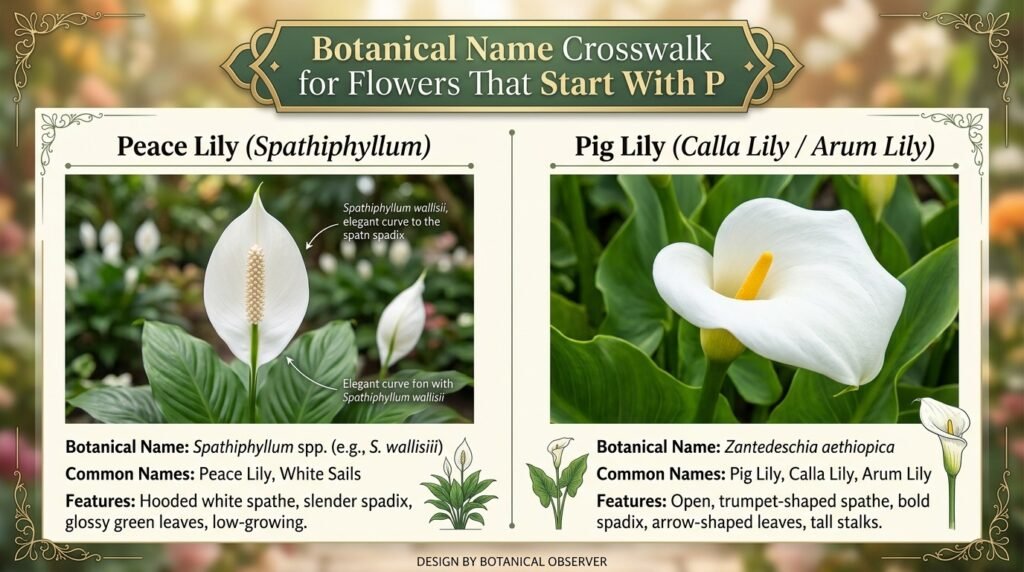
| Common Name | Botanical Name | Plant Family |
| Peony | Paeonia lactiflora | Paeoniaceae |
| Petunia | Petunia × hybrida | Solanaceae |
| Peace Lily | Spathiphyllum wallisii | Araceae |
| King Protea | Protea cynaroides | Proteaceae |
| Passionflower | Passiflora incarnata | Passifloraceae |
| Periwinkle | Vinca minor | Apocynaceae |
| Poinsettia | Euphorbia pulcherrima | Euphorbiaceae |
| Peruvian Lily | Alstroemeria aurea | Alstroemeriaceae |
| Phalaenopsis Orchid | Phalaenopsis amabilis | Orchidaceae |
| Pig Lily | Zantedeschia aethiopica | Araceae |
| Pinkroot | Spigelia marilandica | Loganiaceae |
| Persian Silk Tree | Albizia julibrissin | Fabaceae |
This shortlist shows how varied the plant families really are, even within one letter. Peace Lily and Pig Lily both sit in the Araceae family, which explains their shared toxicity from calcium oxalate crystals. Persian Silk Tree stands apart in the pea family, connecting it to other legumes despite its fluffy, silk-thread flower shape.
Flower Meanings and Symbolism
Flowers that start with P carry rich symbolism across many cultures. Peony is deeply tied to honor, wealth, and romance in Chinese tradition, where it has long been called the “king of flowers.” Its huge, layered blooms also symbolize a happy marriage and good fortune in many Western wedding traditions today. Passionflower carries a very different, more spiritual meaning, historically linked by missionaries to the suffering and crucifixion of Christ due to the unusual structure of its bloom.
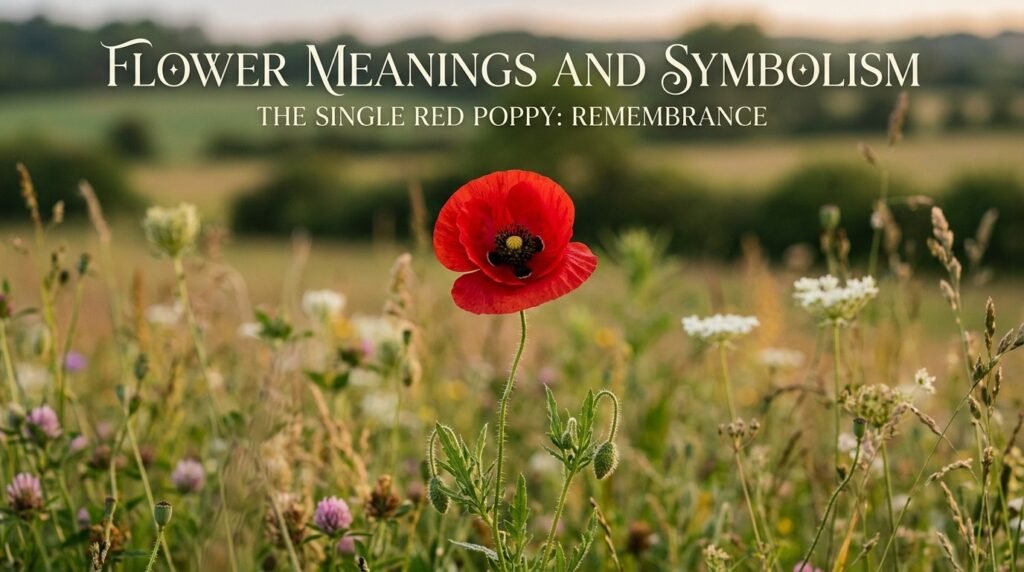
Poppy holds a solemn, widely recognized meaning tied to remembrance, especially of soldiers lost in war. Red poppies are worn each November in many countries as a symbol of sacrifice and memory. Pansy, by contrast, carries a gentler meaning tied to thoughtfulness, since its name comes from the French word for “thought.”
Primrose closes this section with a hopeful, youthful symbolism tied to early spring and new beginnings. Its status as one of the first flowers to bloom after winter gave it this lasting association across European folklore. That range, from solemn remembrance to lighthearted new beginnings, shows how widely this single letter’s symbolism can stretch.
Decision Guide: Which Flower That Starts With P Should You Choose?
Choosing the right flower often depends on where it will grow and who will be near it. The table below matches common situations to a flower pick from this list, along with a short reason for each match. Use it as a starting point, then check the full comparison table above for growing details.
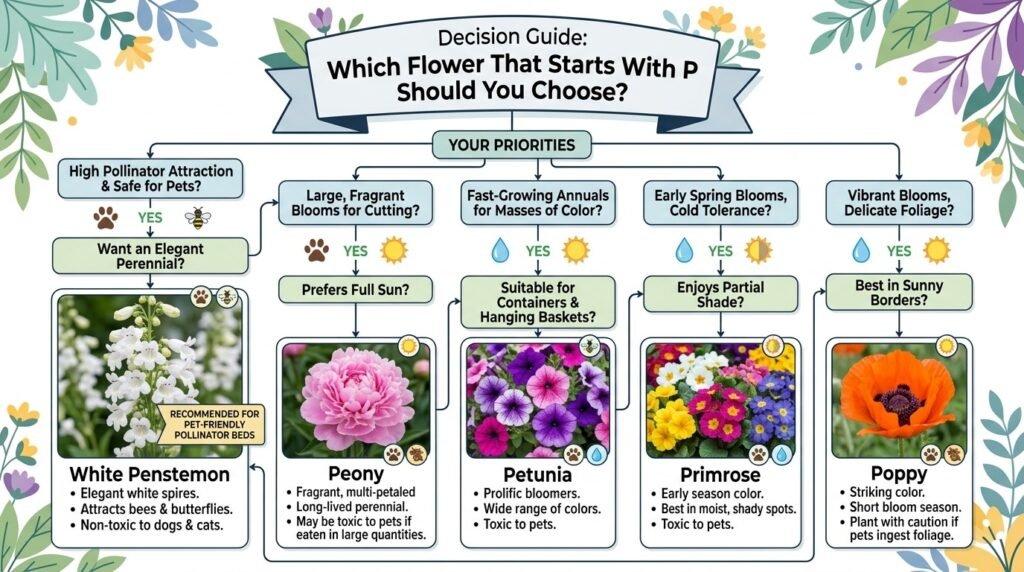
| Your Situation | Recommended Flower | Why It Fits |
| Spring perennial border | Peony | Huge blooms, decades of reliable return |
| Cool-season containers | Pansy | Tolerates light frost, cheerful color |
| Indoor low-light room | Peace Lily | Blooms reliably in shade, but toxic |
| Wedding cut flowers | Peony | Romantic, huge, classic choice |
| Native pollinator bed | Penstemon | Tubular blooms loved by hummingbirds |
| Household with pets | Penstemon | Non-toxic and easy to grow |
| Woodland shade garden | Painted Trillium | Native, quiet spring bloomer |
| Warm-climate accent shrub | Plumeria | Fragrant tropical blooms, striking form |
Notice that Penstemon appears twice in this table, once for pollinator beds and once for pet-safe homes. That overlap is not an accident, since the same traits that make it easy to grow also make it a low-risk choice indoors and out. Peace Lily, by contrast, is stunning for a low-light room but needs careful placement, since it appears again in the caution section above.
Conclusion
Flowers that start with P offer real variety, from garden classics to rare botanical finds. This guide covered 55 of them, complete with botanical names, native range, and toxicity notes. Whether you want a romantic Peony, a low-light Peace Lily, or a flower to avoid around pets, this list has a fit. Keep it close the next time you plan a garden bed or a bouquet built around beautiful, dependable blooms. Image caption: A closing garden view of Peony, Pansy, and Phlox in bloom.
Read More 100+ Beautiful Flowers That Start With B (With Pictures & Names)
Frequently Asked Questions
What are some common flowers that start with P?
Peony, Petunia, Pansy, and Poppy are the most common picks. All four appear regularly in gardens and florist shops. Peony remains one of the most requested flowers for spring weddings.
Are there really 55 flowers that start with P?
Yes, this guide lists 55 verified flowers starting with P. They range from tiny woodland natives to towering flowering trees. Many share common prefixes like “Painted” or “Prairie” across distinct North American species.
Which flowers that start with P are toxic to pets?
Periwinkle, Pig Lily, Peace Lily, and Prickly Poppy all carry a real toxicity risk. Periwinkle has the longest documented history of serious poisoning. Keep all four away from pets and children who chew on plants.
Is Poinsettia as dangerous as people think?
No, Poinsettia is only mildly toxic and rarely causes more than stomach upset. Its dangerous reputation is largely overstated compared to its actual risk. It remains a popular, generally low-risk holiday plant overall.
Which P-flower blooms the longest?
Petunia blooms from spring until the first fall frost with regular deadheading. Pentas comes close behind it with steady, pollinator-friendly color. Both reward gardeners who remove spent blooms regularly.
What is the tallest flower that starts with P?
Persian Silk Tree can reach twenty-five feet or more at full maturity. Among garden perennials, Garden Phlox often reaches four feet in good soil. Persian Silk Tree suits a large property rather than a typical flower bed.
Can I grow flowers that start with P indoors?
Yes, Peace Lily, Phalaenopsis Orchid, Persian Cyclamen, and Pocketbook Plant all adapt well indoors. Bright, indirect light suits most of them. Peace Lily tolerates the lowest light of the group.
Which P-flowers are best for pollinators?
Penstemon, Garden Phlox, and Pentas all draw bees, butterflies, or hummingbirds reliably. Native species like Penstemon tend to perform best for local wildlife. Passionflower also attracts specialized pollinators and butterfly larvae.
Is Periwinkle dangerous to have at home?
Yes, Periwinkle is genuinely dangerous if any part is eaten in quantity. It contains toxic alkaloids with a documented history of real poisoning. It is best planted where children and pets cannot easily reach it.
What does the Peony flower symbolize?
Peony symbolizes honor, wealth, and romance, especially in Chinese tradition. It is often called the “king of flowers” for its huge, layered blooms. It remains a popular choice for weddings and good-fortune gifts.
Which flowers that start with P are edible?
Purslane is the main fully edible option on this list, with a mild, slightly tangy flavor. Pansy petals are also considered safe as a garnish in small amounts. Most other P-flowers should not be eaten.
Is the Phalaenopsis Orchid hard to grow?
No, the Phalaenopsis orchid is considered one of the easiest orchids for beginners. It tolerates typical indoor conditions better than many other orchid types. Its blooms can last two months or longer with basic care.
What is the rarest flower that starts with P?
Parrot Flower and Auricula are among the rarest entries in this guide. Painted Trillium is also uncommon outside specific acidic woodland habitats. None of these appear at typical garden centers.
Which P-flower suits a florist’s bouquet best?
Peony and King Protea both remain top florist picks for very different reasons. Peony offers romantic, huge blooms, while King Protea offers dramatic, long-lasting structure. Poppy Anemone works best for bold, modern designs.
Do all Peony varieties need cold winters to bloom?
Yes, most Peony varieties need a cold dormant period to rebloom well each year. Gardeners in warm climates often struggle to get consistent blooms without enough winter chill. Choosing a low-chill variety can help in milder regions.