

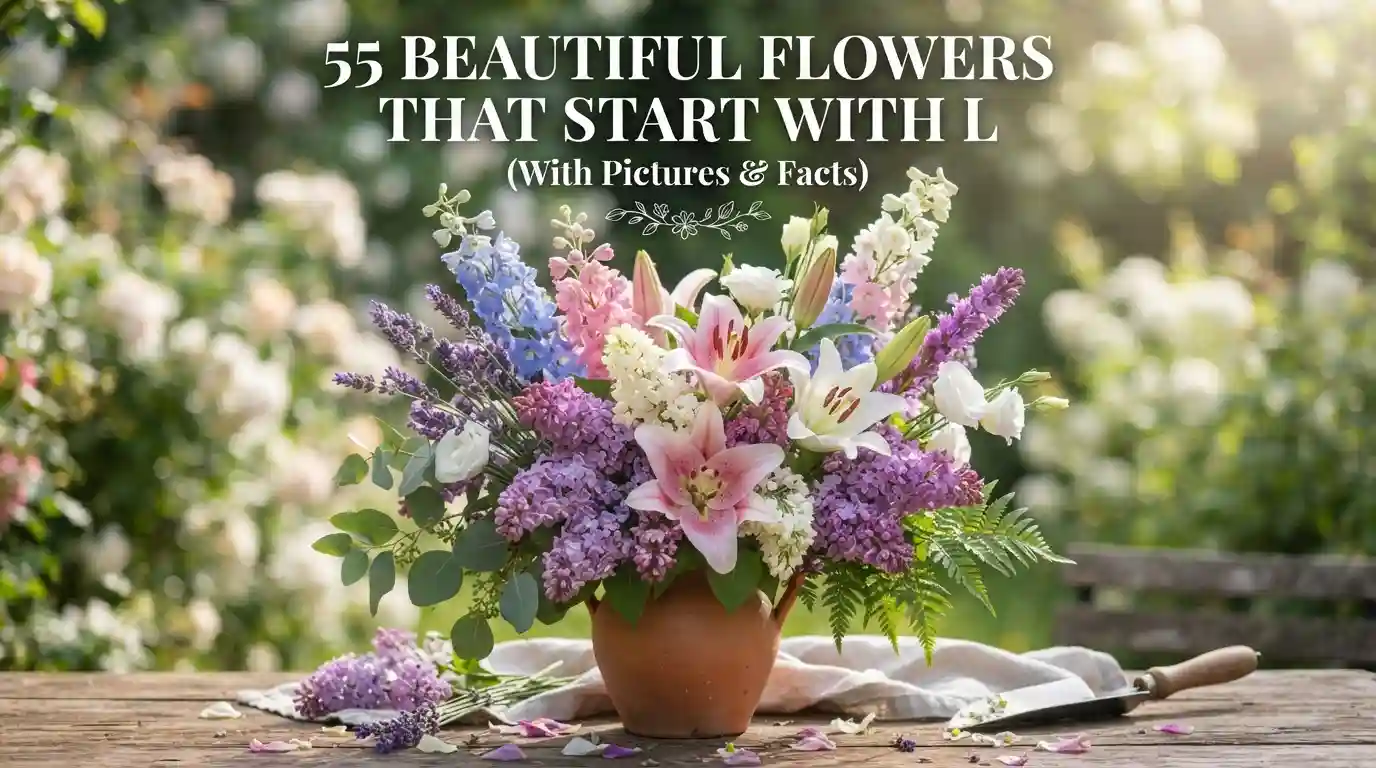
Flowers that start with L range from garden classics like Lilac to rare finds like Lithodora. This guide brings together 55 real flowers, each with a checked botanical name, native range, bloom time, and toxicity note. Whether you garden, arrange bouquets, or just love plant names, this list offers a clear, reliable starting point for exploring the letter L.
- Quick Answer: Top Flowers That Start With L
- Master Alphabetical List of Flowers That Start With L
- Full Comparison Table of Flowers That Start With L
- Garden Favorites Among Flowers That Start With L
- Indoor Plants Among Flowers That Start With L
- Florist Favorites Among Flowers That Start With L
- Rare Flowers That Start With L
- Flowers That Start With L and Need Caution
- Color-Based Groupings of Flowers That Start With L
- Life-Cycle Groupings of Flowers That Start With L
- Botanical Name Crosswalk for Flowers That Start With L
- Flower Meanings and Symbolism
- Decision Guide: Which Flower That Starts With L Should You Choose?
- Conclusion
- Frequently Asked Questions
This article is built for several kinds of readers at once. A home gardener can use it to fill a bed with dependable, colorful choices. A florist can use it to find fresh L-letter stems for a bouquet. A parent or pet owner can use it to spot risky plants like Lily of the Valley or Larkspur. A curious plant lover can simply enjoy how wide this one letter’s range turns out to be.
The flowers below are organized in several useful ways. A master alphabetical list comes first, followed by a full comparison table covering all 55 entries. After that come category sections for garden favorites, indoor plants, florist picks, rare finds, and toxic plants, each with real photo captions built in. Color groups and life-cycle groups follow near the end, before a full FAQ section.
Every flower named here has a real, verified botanical name. Native range and toxicity notes appear throughout, so you can plan safely around kids or pets. Image captions follow nearly every paragraph and heading in this guide, making it easy to slot in a photo anywhere. By the end, you should be able to pick flowers that start with L for almost any garden goal.
Quick Answer: Top Flowers That Start With L
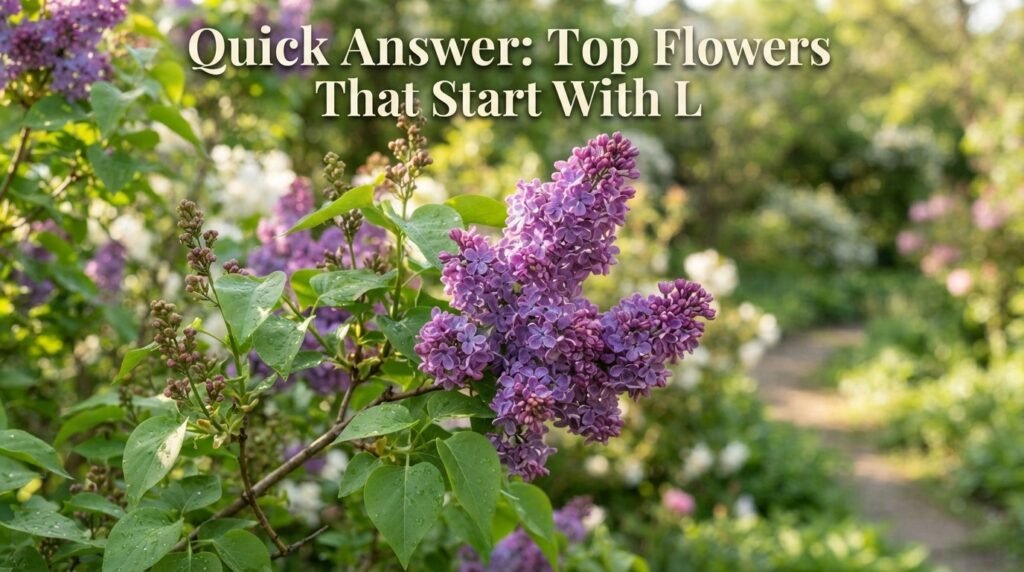
If you only remember a few names, start here. Lilac is a spring classic, prized for fragrant purple clusters on a large shrub. Lavender brings silvery foliage and calming purple spikes loved by bees all summer. The lotus rises gracefully from still water, holding deep meaning across many Asian cultures. Larkspur adds tall, colorful spikes that suit both gardens and cut arrangements. Lupine covers open fields in dense, colorful flower spikes each late spring. Lisianthus offers rose-like blooms that rank among the longest-lasting cut flowers available. Lily of the Valley brings tiny, intensely fragrant white bells, though every part of it is toxic. Lion’s Ear rounds out the list with striking orange, tiered flower whorls on a tender shrub.
Master Alphabetical List of Flowers That Start With L
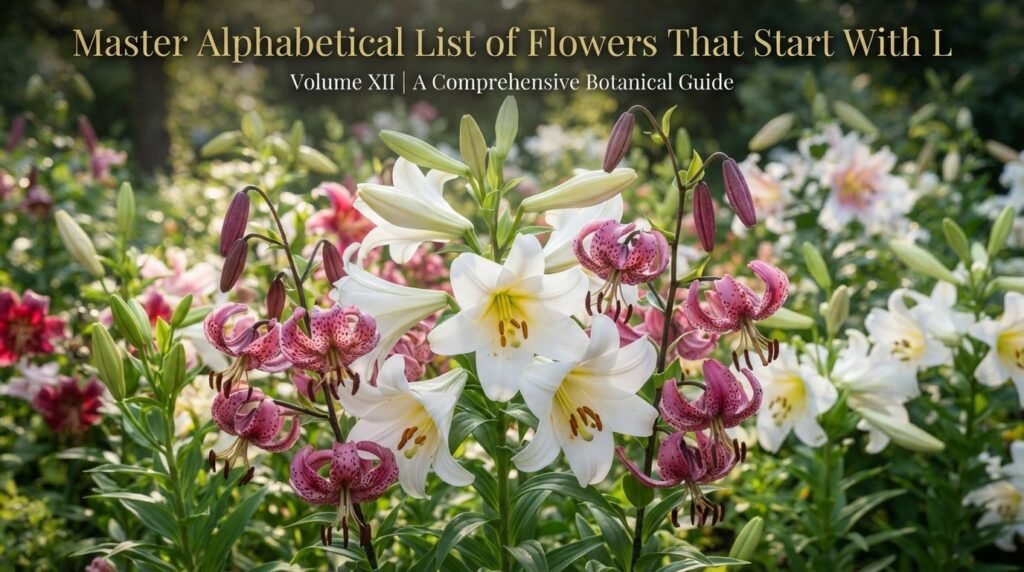
Some flowers here start with L in their common name, like Lilac or Lavender. Others start with L only through a botanical or genus name, like Lithodora or Lachenalia. Both types appear below, since most searches for this topic mix common and botanical names. Each entry lists the most searched common name first, with its botanical name right beside it.
- Easter Lily (Lilium longiflorum)
- Lavender (Lavandula angustifolia)
- Lilac (Syringa vulgaris)
- Larkspur (Consolida ajacis)
- Lotus (Nelumbo nucifera)
- Lantana (Lantana camara)
- Lupine (Lupinus polyphyllus)
- Love-in-a-Mist (Nigella damascena)
- Love-Lies-Bleeding (Amaranthus caudatus)
- Lily of the Valley (Convallaria majalis)
- Lisianthus (Eustoma grandiflorum)
- Lobelia (Lobelia erinus)
- Purple Loosestrife (Lythrum salicaria)
- Lenten Rose (Helleborus orientalis)
- Leopard Lily (Lilium pardalinum)
- Lady’s Slipper Orchid (Cypripedium calceolus)
- Lily of the Nile (Agapanthus africanus)
- Liatris (Liatris spicata)
- Lewisia (Lewisia cotyledon)
- Lilyturf (Liriope muscari)
- Linaria (Linaria maroccana)
- Linden Blossom (Tilia cordata)
- Live Forever (Hylotelephium telephium)
- Lobster Claw (Heliconia rostrata)
- London Pride (Saxifraga × urbium)
- Lucky Clover (Oxalis tetraphylla)
- Lungwort (Pulmonaria officinalis)
- Luculia (Luculia gratissima)
- Surprise Lily (Lycoris squamigera)
- Madonna Lily (Lilium candidum)
- Martagon Lily (Lilium martagon)
- Lily Magnolia (Magnolia liliiflora)
- Leadwort (Plumbago auriculata)
- Leadplant (Amorpha canescens)
- Lesser Celandine (Ficaria verna)
- Lily of the Incas (Alstroemeria aurea)
- Poached Egg Plant (Limnanthes douglasii)
- Twinflower (Linnaea borealis)
- Lion’s Ear (Leonotis leonurus)
- Lithodora (Lithodora diffusa)
- Lizard’s Tail (Saururus cernuus)
- Creeping Jenny (Lysimachia nummularia)
- Cape Cowslip (Lachenalia aloides)
- Lechenaultia (Lechenaultia formosa)
- Lipstick Plant (Aeschynanthus radicans)
- Lilac Chastetree (Vitex agnus-castus)
- Lacecap Hydrangea (Hydrangea macrophylla normalis)
- Ladybells (Adenophora confusa)
- Lamb’s Ear (Stachys byzantina)
- Lakeside Daisy (Tetraneuris herbacea)
- Lantern Tree (Crinodendron hookerianum)
- Laurustinus (Viburnum tinus)
- Regal Lily (Lilium regale)
- Formosa Lily (Lilium formosanum)
- Loropetalum (Loropetalum chinense)
That is a full 55 flowers, spanning tiny alpine natives to towering tropical shrubs. Notice how many entries belong to the genus Lilium, since true lilies branch into several distinct common names across this list. The list also spans huge ground, from the icy-hardy Twinflower found near the Arctic Circle to the tropical Lobster Claw grown across South America.
Full Comparison Table of Flowers That Start With L
The table below lines up six key facts for each of the 55 flowers on this list. Native range shows where a plant grows wild, which helps you judge if your climate will suit it. Bloom season and USDA zone guide planting timing, while the toxicity column flags any risk to people or pets. Use this table as a fast reference before reading the fuller category sections below.
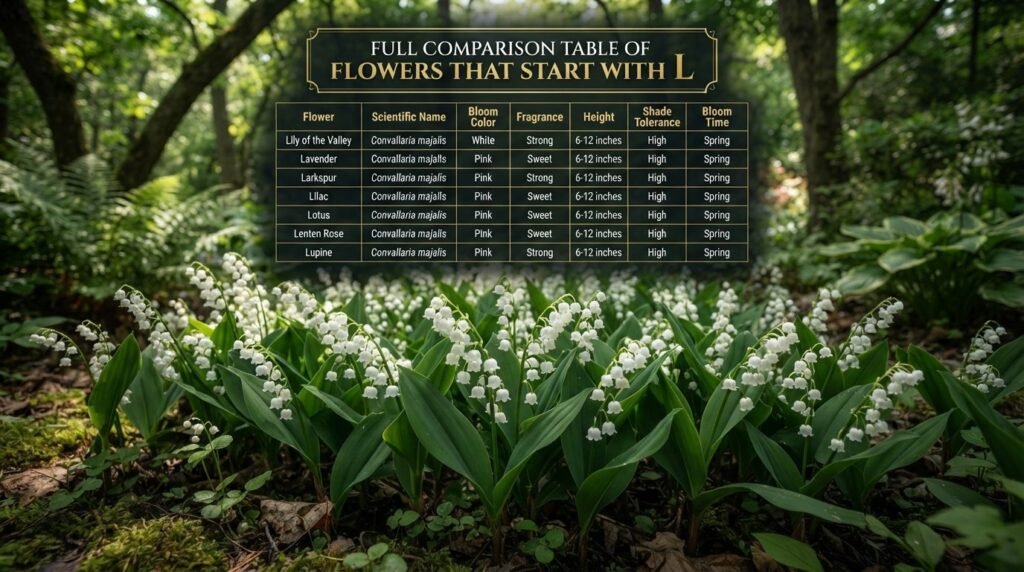
| Flower | Botanical Name | Native Range | Bloom Season | USDA Zone | Toxicity |
| Easter Lily | Lilium longiflorum | Japan | Spring | 4–8 | Toxic to cats |
| Lavender | Lavandula angustifolia | Mediterranean | Summer | 5–9 | Mild toxic |
| Lilac | Syringa vulgaris | Balkans | Spring | 3–7 | Non-toxic |
| Larkspur | Consolida ajacis | Mediterranean | Summer | 2–11, annual | Toxic |
| Lotus | Nelumbo nucifera | Asia | Summer | 4–10 | Non-toxic |
| Lantana | Lantana camara | Central and South America | Summer to frost | 8–11 | Toxic |
| Lupine | Lupinus polyphyllus | Western North America | Late spring | 4–8 | Toxic |
| Love-in-a-Mist | Nigella damascena | Mediterranean | Summer | 2–11, annual | Mild toxic |
| Love-Lies-Bleeding | Amaranthus caudatus | Central and South America | Summer to fall | 2–11, annual | Non-toxic |
| Lily of the Valley | Convallaria majalis | Europe, Asia | Spring | 2–7 | Highly toxic |
| Lisianthus | Eustoma grandiflorum | Southern United States, Mexico | Summer | 8–10, annual elsewhere | Non-toxic |
| Lobelia | Lobelia erinus | South Africa | Spring to fall | 9–11, annual elsewhere | Mild toxic |
| Purple Loosestrife | Lythrum salicaria | Europe, Asia | Summer | 3–9 | Non-toxic |
| Lenten Rose | Helleborus orientalis | Greece, Turkey | Late winter to spring | 4–9 | Toxic |
| Leopard Lily | Lilium pardalinum | Western United States | Summer | 5–9 | Toxic to cats |
| Lady’s Slipper Orchid | Cypripedium calceolus | Europe, Asia | Late spring | 4–7 | Mild toxic |
| Lily of the Nile | Agapanthus africanus | South Africa | Summer | 8–11 | Mild toxic |
| Liatris | Liatris spicata | Eastern North America | Summer to fall | 3–9 | Non-toxic |
| Lewisia | Lewisia cotyledon | Western North America | Late spring | 6–8 | Non-toxic |
| Lilyturf | Liriope muscari | East Asia | Summer to fall | 5–10 | Mild toxic |
| Linaria | Linaria maroccana | Morocco | Summer | 2–11, annual | Mild toxic |
| Linden Blossom | Tilia cordata | Europe | Early summer | 3–7 | Non-toxic |
| Live Forever | Hylotelephium telephium | Europe, Asia | Late summer to fall | 4–9 | Non-toxic |
| Lobster Claw | Heliconia rostrata | South America | Summer to fall | 10–12 | Non-toxic |
| London Pride | Saxifraga × urbium | Western Europe | Late spring | 6–8 | Non-toxic |
| Lucky Clover | Oxalis tetraphylla | Mexico | Summer | 8–10 | Toxic |
| Lungwort | Pulmonaria officinalis | Europe | Early spring | 3–8 | Non-toxic |
| Luculia | Luculia gratissima | Himalayas | Fall to winter | 9–11 | Non-toxic |
| Surprise Lily | Lycoris squamigera | China, Japan | Late summer | 5–9 | Toxic |
| Madonna Lily | Lilium candidum | Balkans, Middle East | Summer | 6–9 | Toxic to cats |
| Martagon Lily | Lilium martagon | Europe, Asia | Summer | 3–7 | Toxic to cats |
| Lily Magnolia | Magnolia liliiflora | China | Spring | 5–9 | Non-toxic |
| Leadwort | Plumbago auriculata | South Africa | Summer to fall | 9–11 | Mild toxic |
| Leadplant | Amorpha canescens | Central North America | Summer | 2–8 | Non-toxic |
| Lesser Celandine | Ficaria verna | Europe, Western Asia | Early spring | 4–8 | Toxic |
| Lily of the Incas | Alstroemeria aurea | South America | Summer | 7–10 | Mild toxic |
| Poached Egg Plant | Limnanthes douglasii | California, United States | Spring | 2–11, annual | Non-toxic |
| Twinflower | Linnaea borealis | Northern Hemisphere, boreal | Summer | 2–6 | Non-toxic |
| Lion’s Ear | Leonotis leonurus | South Africa | Summer to fall | 8–11 | Mild toxic |
| Lithodora | Lithodora diffusa | Mediterranean | Late spring to summer | 6–9 | Non-toxic |
| Lizard’s Tail | Saururus cernuus | Eastern United States | Summer | 4–9 | Non-toxic |
| Creeping Jenny | Lysimachia nummularia | Europe | Summer | 3–9 | Mild toxic |
| Cape Cowslip | Lachenalia aloides | South Africa | Winter to spring | 9–10 | Toxic |
| Lechenaultia | Lechenaultia formosa | Australia | Spring | 9–11 | Non-toxic |
| Lipstick Plant | Aeschynanthus radicans | Southeast Asia | Summer | 10–11 | Non-toxic |
| Lilac Chastetree | Vitex agnus-castus | Mediterranean, Central Asia | Summer | 6–9 | Mild toxic |
| Lacecap Hydrangea | Hydrangea macrophylla normalis | Japan | Summer | 6–9 | Mild toxic |
| Ladybells | Adenophora confusa | East Asia | Summer | 3–8 | Non-toxic |
| Lamb’s Ear | Stachys byzantina | Turkey, Iran | Summer | 4–8 | Non-toxic |
| Lakeside Daisy | Tetraneuris herbacea | North America, Great Lakes | Spring | 3–7 | Non-toxic |
| Lantern Tree | Crinodendron hookerianum | Chile | Late spring | 8–9 | Non-toxic |
| Laurustinus | Viburnum tinus | Mediterranean | Winter to spring | 7–9 | Mild toxic |
| Regal Lily | Lilium regale | China | Summer | 4–8 | Toxic to cats |
| Formosa Lily | Lilium formosanum | Taiwan | Summer to fall | 5–9 | Toxic to cats |
| Loropetalum | Loropetalum chinense | China, Japan | Spring | 7–10 | Non-toxic |
A few rows deserve extra attention after a first read. Lily of the Valley stands out as highly toxic despite its delicate, sweet-smelling appearance. True lilies, including Easter Lily, Madonna Lily, and Regal Lily, are all severely toxic to cats specifically. Liatris and Lithodora, by contrast, sit at the safest end of the table, non-toxic and reliable across a wide range of growing zones.
Garden Favorites Among Flowers That Start With L
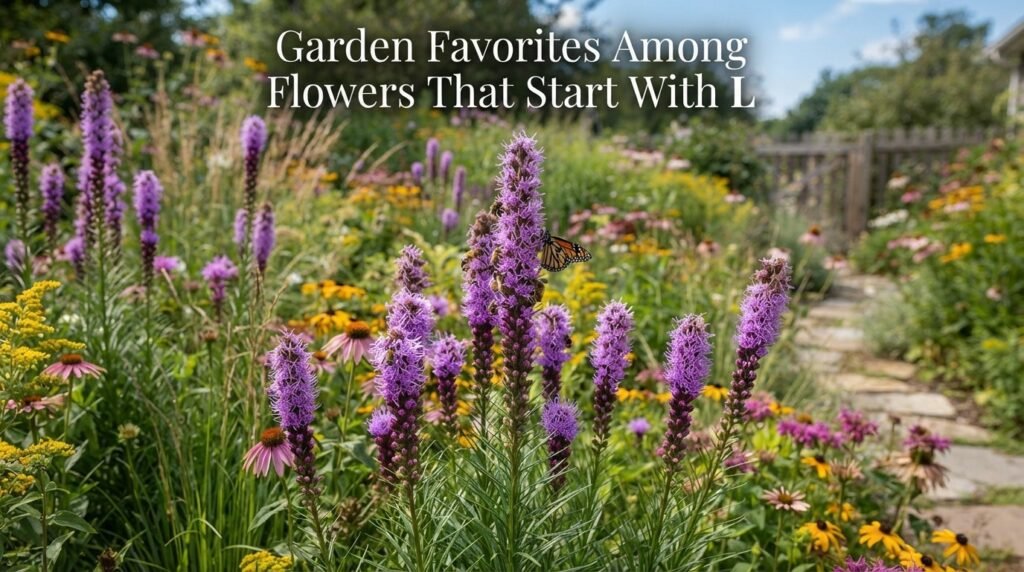
Garden favorites are the flowers gardeners plant season after season without fail. Lilac leads this group, since its fragrant spring clusters remain a beloved shrub across cold-winter regions. Lavender brings silvery, aromatic foliage alongside purple flower spikes that bees visit constantly. Larkspur adds tall, colorful spires that self-seed freely once established. Lupine rounds things out with dense, pea-shaped flower spikes across open, sunny beds.
Lilac (Syringa vulgaris) produces dense clusters of fragrant purple, pink, or white flowers each spring. It can live for decades, often outlasting the homes originally planted around it.
Lavender (Lavandula angustifolia) forms a compact, silvery mound topped with fragrant purple flower spikes each summer. It thrives in dry, sunny spots with little water once established.
Larkspur (Consolida ajacis) sends up tall spires densely packed with blue, pink, or white flowers each summer. It reseeds easily, often returning on its own the following year.
Lupine (Lupinus polyphyllus) produces dense, pea-shaped flower spikes in blue, purple, pink, or yellow each late spring. Entire meadows across its native range can turn a solid wash of color.
- Lilac — fragrant spring shrub, decades of reliable bloom
- Lavender — silvery, aromatic mound loved by bees
- Larkspur — tall colorful spires, self-seeds freely
- Lupine — dense pea-shaped spikes across open beds
- Liatris — upright purple spikes for a native pollinator bed
- Lenten Rose — early bloomer through the last weeks of winter
These six plants suit very different garden styles. Lilac and Lenten Rose both reward patient gardeners building a long-term, low-maintenance landscape. Larkspur and Lupine, by contrast, reseed readily, refilling their own space with fresh color each year.
Indoor Plants Among Flowers That Start With L
Indoor flowers need to handle lower light and steady room temperatures. Lipstick Plant is a strong choice, since its tubular red blooms trail nicely from a hanging basket. Cape Cowslip rewards a bright windowsill with unusual tubular flowers in winter and early spring. Luculia fills a room with fragrance from clusters of pink blooms in cooler months. Lily of the Nile rounds out the group as a striking potted patio plant that also adapts to bright indoor rooms.
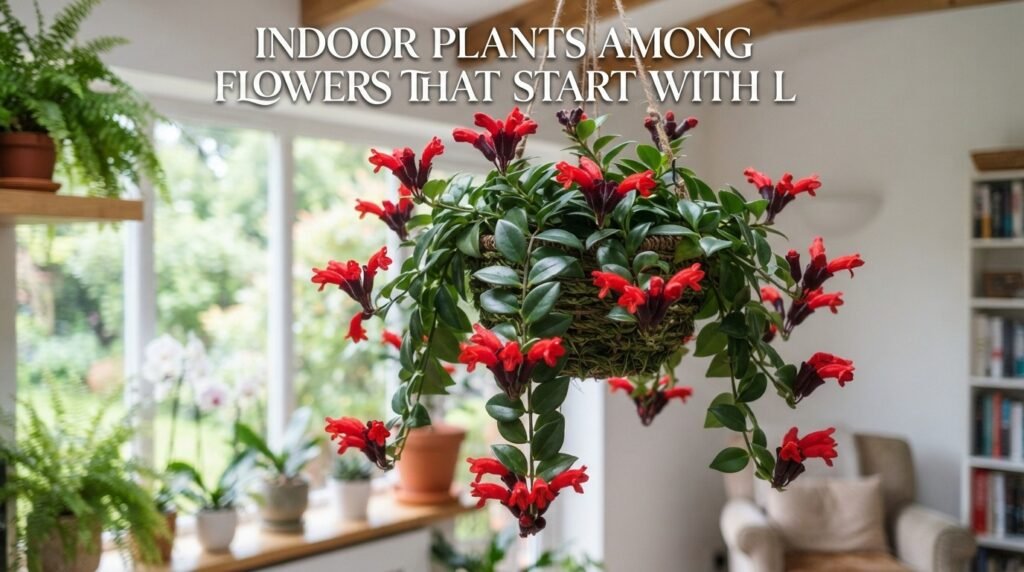
Lipstick Plant (Aeschynanthus radicans) produces tubular red flowers that emerge from dark, lipstick-tube-like buds along trailing vines. It suits a hanging basket near a bright, humid window.
Cape Cowslip (Lachenalia aloides) sends up spikes of tubular yellow, orange, or red flowers from a small winter-growing bulb. It needs a cool, bright spot indoors to bloom well.
Luculia (Luculia gratissima) produces large, fragrant clusters of pink flowers during cooler fall and winter months. Its scent alone makes it worth growing in a bright indoor room.
- Lipstick Plant — trailing red blooms for a hanging basket
- Cape Cowslip — unusual tubular flowers from a winter bulb
- Luculia — fragrant pink clusters for cooler months
- Lily of the Nile — striking potted plant for a bright room
- Lechenaultia — colorful Australian native for a sunny windowsill
Lipstick Plant and Cape Cowslip both suit collectors who enjoy unusual bloom shapes over classic flower form. Luculia and Lily of the Nile instead reward patience, since both need a season or two to reach full flowering size. Lechenaultia is the most demanding of the group, needing excellent drainage to thrive indoors.
Florist Favorites Among Flowers That Start With L
Florists choose flowers for strong stems, long vase life, and dependable color. Lisianthus ranks among the longest-lasting cut flowers available, often holding its rose-like shape for two weeks or more. Lily of the Incas, better known as Alstroemeria, brings speckled, long-lasting blooms in nearly every color. Easter Lily adds bold white trumpets with a strong, sweet fragrance to formal arrangements. Lilac earns a seasonal spot in spring bouquets, prized for both color and scent despite its shorter vase life.
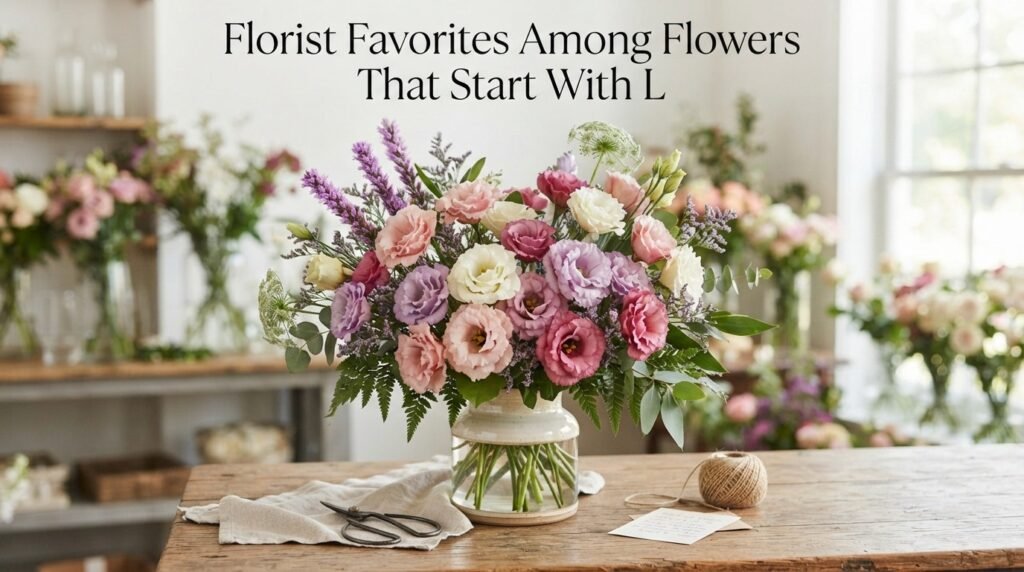
Lisianthus (Eustoma grandiflorum) produces ruffled, rose-like blooms in purple, pink, or white that hold their shape exceptionally well once cut. Florists prize it as a longer-lasting alternative to garden roses.
Lily of the Incas (Alstroemeria aurea) produces clusters of speckled orange or pink blooms that last up to two weeks in a vase. It remains one of the most dependable cut flowers sold today.
Easter Lily (Lilium longiflorum) opens into large, trumpet-shaped white blooms with a strong, sweet fragrance. It remains a traditional centerpiece for spring holidays and formal events.
- Lisianthus — long-lasting, rose-like blooms in soft colors
- Lily of the Incas — speckled, long-lasting cut flower
- Easter Lily — bold, fragrant white trumpets for events
- Lilac — fragrant seasonal spring stems
- Lantern Tree — unusual bell-shaped blooms for specialty florals
Lisianthus and Lily of the Incas both dominate the everyday cut-flower market thanks to their exceptional shelf life. Easter Lily instead earns its place through scent and symbolism rather than longevity alone. Lilac remains the most seasonal pick of the group, available only for a short window each spring.
Rare Flowers That Start With L
A handful of L-flowers rarely show up outside specialist growers or native plant sales. Ladybells are a lesser-known East Asian perennial with soft blue, bell-shaped flowers that few Western gardeners have tried. Lantern Tree produces unusual, hanging crimson bells that look almost like small paper lanterns, grown mostly in mild coastal climates. Twinflower is a tiny, cold-climate native found trailing across boreal forest floors near the Arctic Circle. Laurustinus remains uncommon in typical home landscapes despite its clusters of pink-budded white winter flowers.
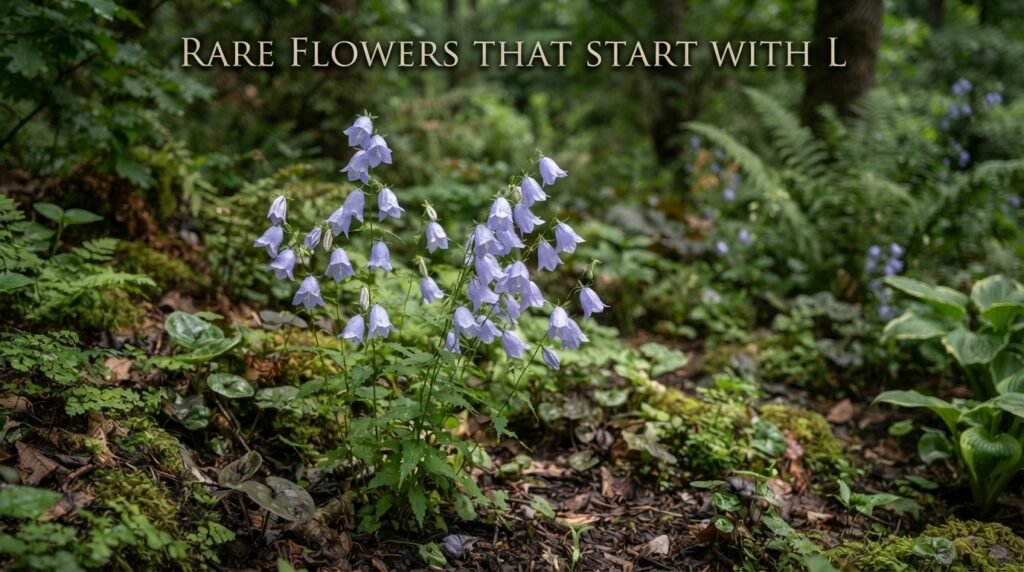
Ladybells (Adenophora confusa) produce nodding, bell-shaped blue flowers on tall stems each summer. It remains rare in cultivation despite being easy to grow once established.
Lantern Tree (Crinodendron hookerianum) hangs crimson, lantern-shaped flowers from an evergreen shrub each late spring. It needs a mild, moist climate similar to its native Chilean forests.
Twinflower (Linnaea borealis) trails along cold northern forest floors, producing paired pink bells close to the ground. It was reportedly a personal favorite flower of botanist Carl Linnaeus.
- Ladybells — rare East Asian perennial with nodding blue bells
- Lantern Tree — unusual crimson lantern-shaped flowers
- Twinflower — tiny boreal native named for Carl Linnaeus
- Lion’s Ear — striking tiered orange whorls on a tender shrub
- Laurustinus — uncommon winter-blooming shrub with pink buds
Ladybells and Twinflower share one trait: both take real patience to establish well from seed or division. Lantern Tree and Lion’s Ear simply need very specific climates to thrive outdoors. Laurustinus remains the most overlooked of the group, since its winter bloom time falls outside most people’s garden-shopping season.
Flowers That Start With L and Need Caution
A meaningful group of L-flowers carries a real toxicity risk, especially around kids and pets. Lily of the Valley is highly toxic despite its delicate, sweet-smelling white bells. Lenten Rose contains toxic compounds throughout the plant, most concentrated in the roots and sap. Larkspur is toxic enough to have caused real livestock poisoning historically, especially in young, tender growth. True lilies, including Easter Lily and Madonna Lily, carry a severe toxicity risk specifically for cats.
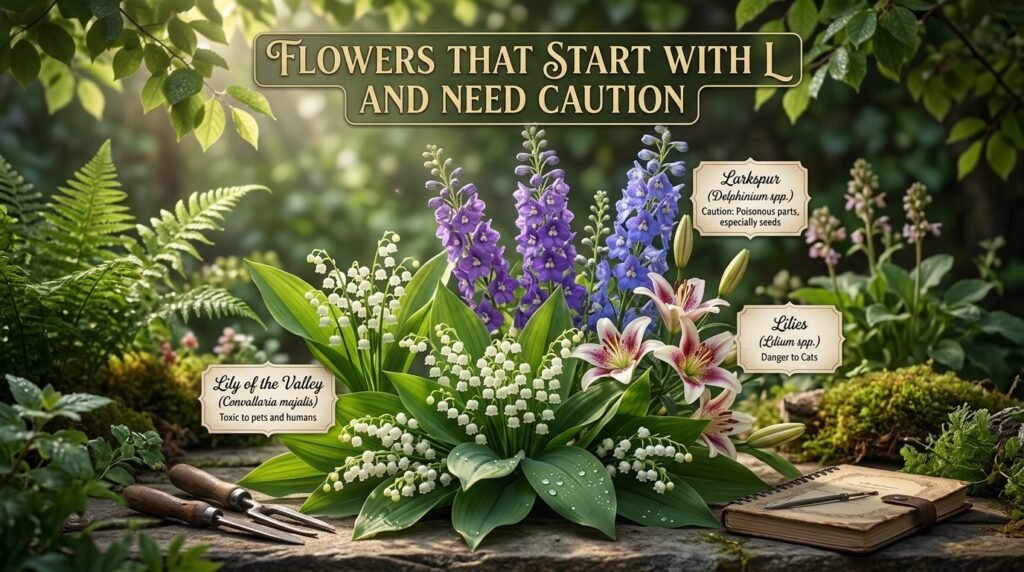
Lily of the Valley (Convallaria majalis) produces small, intensely fragrant white bells along an arching stem each spring. Every part of the plant, including the water in its vase, is toxic if ingested.
Lenten Rose (Helleborus orientalis) blooms in white, pink, or deep purple through the final cold weeks of winter. Its roots and sap are toxic and can irritate skin on contact.
Larkspur (Consolida ajacis) is already described above for its garden appeal, but its toxicity deserves its own note. Young leaves and seeds are the most dangerous parts, historically linked to livestock poisoning.
- Lily of the Valley — highly toxic, dangerous even in vase water
- Lenten Rose — toxic roots and sap, irritating to skin
- Larkspur — toxic seeds and young growth
- True Lilies — severely toxic to cats specifically
- Lucky Clover — toxic oxalate compounds if eaten in quantity
- Cape Cowslip — toxic bulb, keep from curious pets
Lily of the Valley deserves the most caution here, since even the water from a cut stem can cause symptoms if swallowed. True lilies pose a very specific, severe risk to cats even from pollen alone. Even so, all six of these are best kept out of reach in homes with toddlers or curious pets.
Color-Based Groupings of Flowers That Start With L
Grouping flowers by color helps with planning a themed bed or bouquet. Purple and lavender tones dominate this letter more than almost any other. Lilac, Lavender, Larkspur, and Liatris all bring cool purple shades that pair beautifully in a calm, layered border.
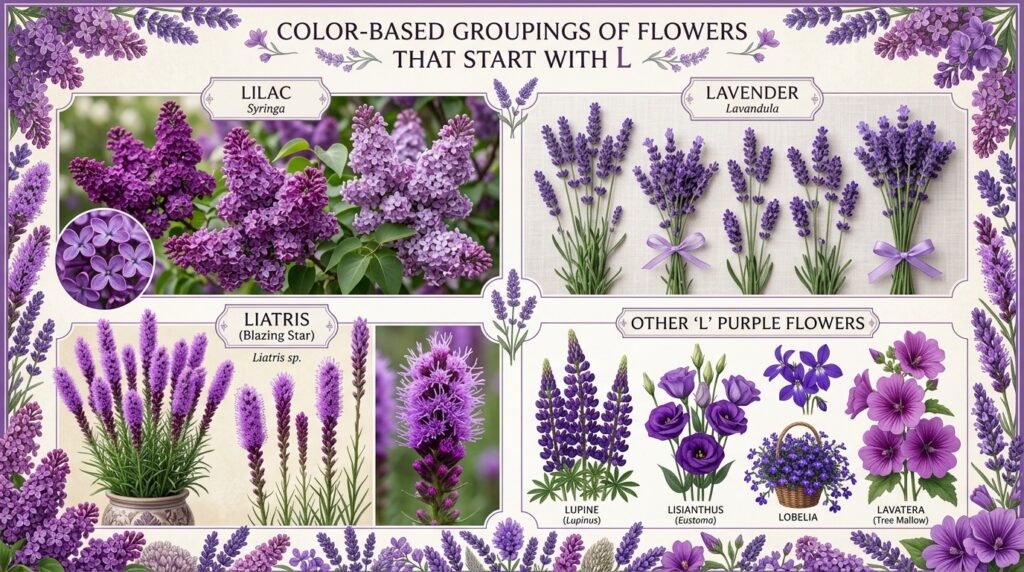
White flowers bring calm, fragrant contrast to almost any planting scheme. Lily of the Valley, Easter Lily, and London Pride all offer white or pale blooms with very different shapes and scents. Easter Lily adds the boldest fragrance of the group, making it a favorite near entryways and altars alike.
Yellow and gold flowers add warmth to sunny beds and containers. Cape Cowslip and Lakeside Daisy both bring bright gold tones to spring displays, while Leopard Lily adds a spotted orange-yellow bloom nearby. These work well together in a cheerful, sun-loving border.
Red and orange flowers bring heat and drama to warm-climate gardens. Lantern Tree and Lion’s Ear both lean into fiery red and orange tones, while Lobster Claw adds a matching tropical red-orange bloom nearby. These three work well planted together for a bold, high-energy display.
Life-Cycle Groupings of Flowers That Start With L
Knowing a flower’s life cycle helps you plan how often to replant a bed. Annuals complete their life cycle in a single season, so they need fresh seeds or plants each year. Perennials return from the same roots for years, while bulbs store energy underground between bloom cycles. Shrubs and woody plants take the longest to establish but reward patience with repeat yearly blooms.
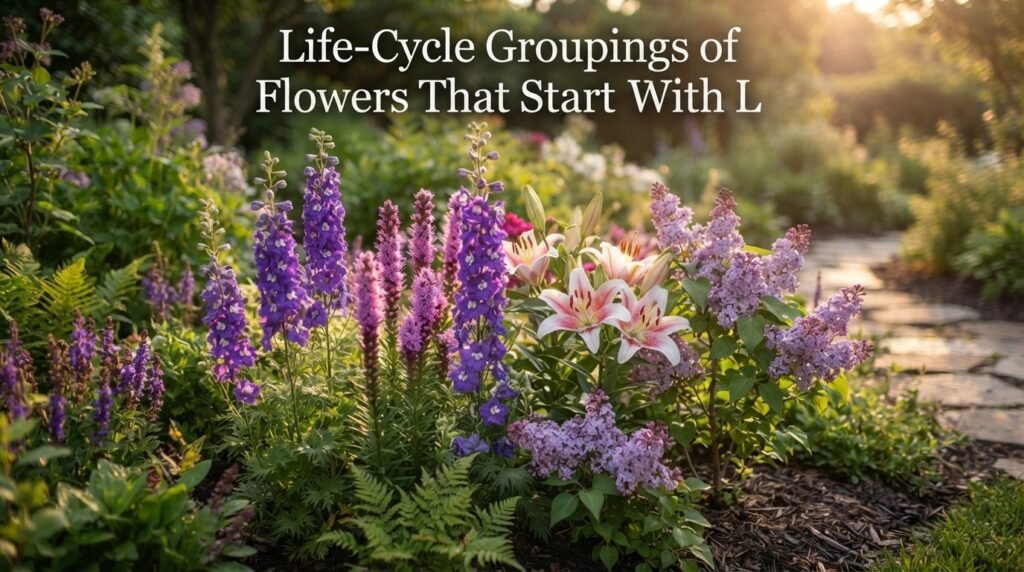
| Life Cycle Type | Example Flowers |
| Annual | Larkspur, Love-in-a-Mist, Lisianthus, Linaria |
| Perennial | Liatris, Lupine, Lungwort, Ladybells |
| Bulb | Easter Lily, Lily of the Valley, Cape Cowslip, Surprise Lily |
| Shrub or Woody | Lilac, Lantern Tree, Laurustinus, Loropetalum |
Annuals like Larkspur and Love-in-a-Mist reward gardeners who enjoy fresh planting each spring. Bulb types such as Easter Lily and Surprise Lily need a period of dormancy to bloom each year reliably. Shrubs and woody plants take the longest of all four groups to reach a full, established size.
Botanical Name Crosswalk for Flowers That Start With L
Botanical names matter more than most gardeners expect. Common names shift by region, but a botanical name stays fixed everywhere in the world. This matters most when ordering online, since the wrong common name can return a completely different plant. The crosswalk below pairs common names with correct botanical names and plant families for accurate, confident searching.
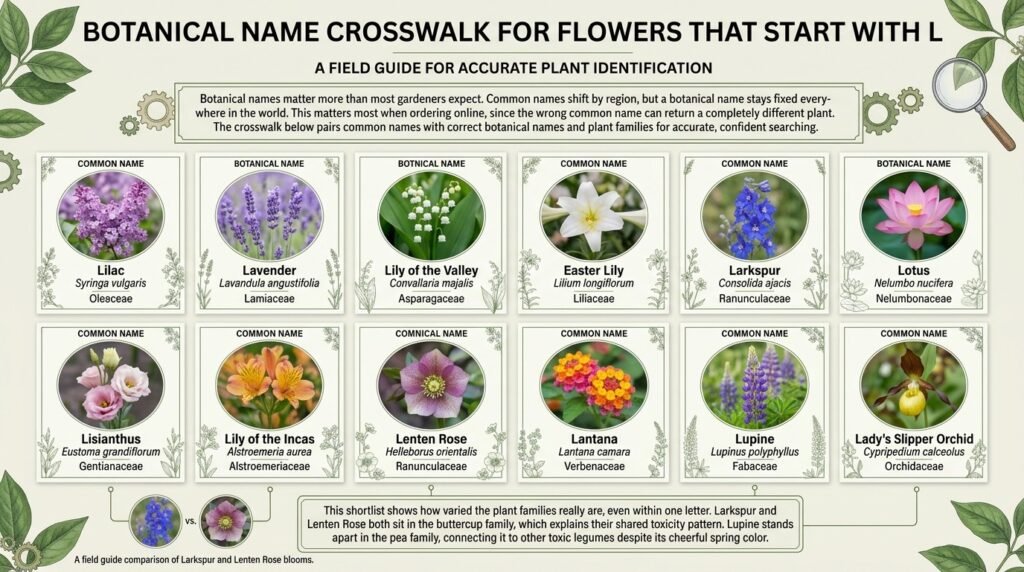
| Common Name | Botanical Name | Plant Family |
| Lilac | Syringa vulgaris | Oleaceae |
| Lavender | Lavandula angustifolia | Lamiaceae |
| Lily of the Valley | Convallaria majalis | Asparagaceae |
| Easter Lily | Lilium longiflorum | Liliaceae |
| Larkspur | Consolida ajacis | Ranunculaceae |
| Lotus | Nelumbo nucifera | Nelumbonaceae |
| Lisianthus | Eustoma grandiflorum | Gentianaceae |
| Lily of the Incas | Alstroemeria aurea | Alstroemeriaceae |
| Lenten Rose | Helleborus orientalis | Ranunculaceae |
| Lantana | Lantana camara | Verbenaceae |
| Lupine | Lupinus polyphyllus | Fabaceae |
| Lady’s Slipper Orchid | Cypripedium calceolus | Orchidaceae |
This shortlist shows how varied the plant families really are, even within one letter. Larkspur and Lenten Rose both sit in the buttercup family, which explains their shared toxicity pattern. Lupine stands apart in the pea family, connecting it to other toxic legumes despite its cheerful spring color.
Flower Meanings and Symbolism
Flowers that start with L carry rich symbolism across many cultures. Lilac is widely tied to first love and the arrival of spring, with purple varieties often symbolizing early romantic feelings. Lotus carries a far deeper meaning across Asian traditions, standing for purity and spiritual awakening as it rises clean from muddy water. That contrast between murky roots and a flawless bloom gives the lotus one of the most enduring symbols in the plant world.
Lavender has long been linked to calm, devotion, and quiet grace, likely due to its soothing scent and gentle color. It has also carried a protective meaning historically, once used to ward off illness before its properties were well understood. Larkspur, by contrast, is often associated with an open heart and lightness, especially in its lighter pink and white forms.
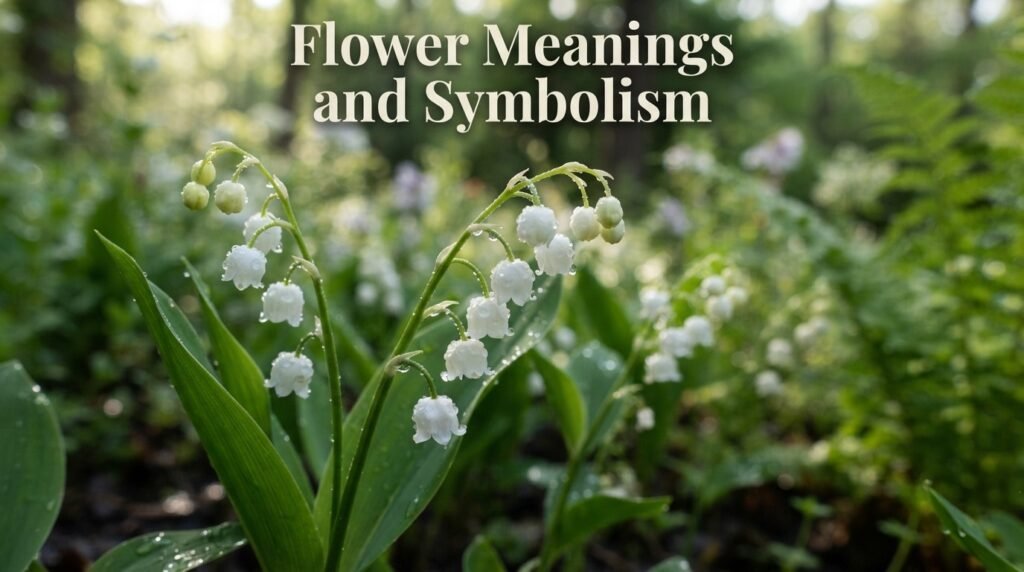
Lily of the Valley closes this section with perhaps the most bittersweet symbolism of any flower on this list. It represents the return of happiness and sweetness after hardship, despite carrying real toxicity throughout the plant. That contrast between comforting meaning and hidden danger gives Lily of the Valley a symbolism that feels more layered than its delicate appearance suggests.
Decision Guide: Which Flower That Starts With L Should You Choose?
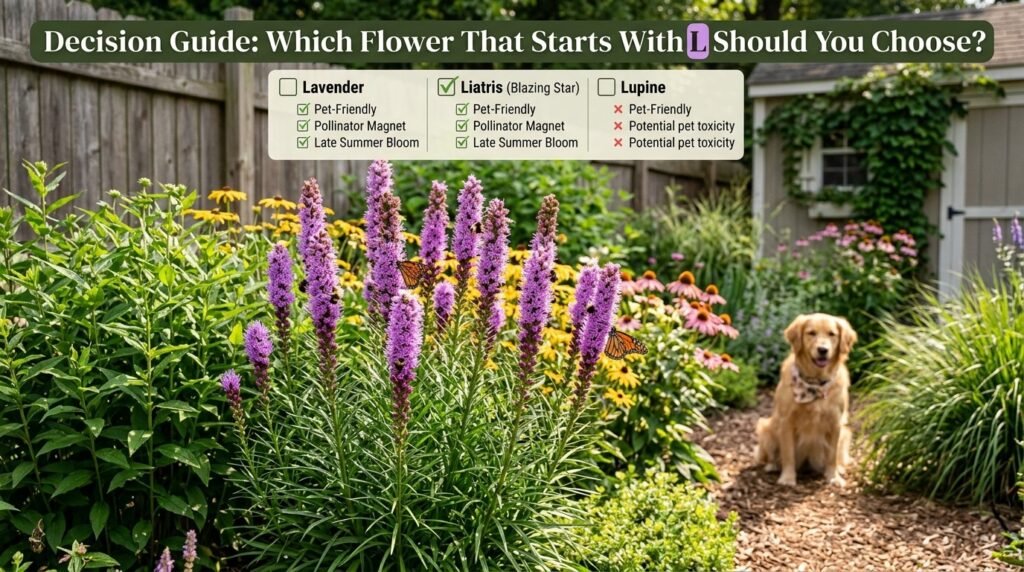
Choosing the right flower often depends on where it will grow and who will be near it. The table below matches common situations to a flower pick from this list, along with a short reason for each match. Use it as a starting point, then check the full comparison table above for growing details.
| Your Situation | Recommended Flower | Why It Fits |
| Fragrant spring shrub | Lilac | Classic scent, decades of reliable bloom |
| Hot, dry, sunny bed | Lavender | Drought-tough, loved by pollinators |
| Indoor hanging basket | Lipstick Plant | Trailing red blooms, easy care |
| Long-lasting cut flowers | Lisianthus | Rose-like shape, exceptional vase life |
| Native pollinator bed | Liatris | Tall purple spikes, easy to grow |
| Household with pets | Liatris | Non-toxic and low maintenance |
| Shaded woodland bed | Twinflower | Delicate native for cool, mossy shade |
| Winter garden interest | Lenten Rose | Blooms through cold weather, but toxic |
Notice that Liatris appears twice in this table, once for pollinator beds and once for pet-safe homes. That overlap is not an accident, since the same traits that make it easy to grow also make it a low-risk choice indoors and out. Lenten Rose, by contrast, is stunning for winter interest but needs careful placement, since it appears again in the caution section above.
Conclusion
Flowers that start with L offer real variety, from fragrant garden shrubs to rare botanical finds. This guide covered 55 of them, complete with botanical names, native range, and toxicity notes. Whether you want a classic spring Lilac, a long-lasting Lisianthus bouquet, or a flower to avoid around pets, this list has a fit. Keep it close the next time you plan a garden bed or a bouquet built around beautiful, dependable blooms.
Frequently Asked Questions
What are some common flowers that start with L?
Lilac, Lavender, Lily, and Larkspur are the most common picks. All four appear regularly in gardens and florist shops. Lilac remains one of the most widely grown in the group.
Are there really 55 flowers that start with L?
Yes, this guide lists 55 verified flowers starting with L. They range from tiny alpine natives to towering tropical shrubs. Many belong to the genus Lilium, which branches into several distinct common names.
Which flowers that start with L are toxic to pets?
Lily of the Valley, Lenten Rose, and true lilies like Easter Lily all carry a real toxicity risk. True lilies are especially dangerous for cats. Keep all of these away from pets and children who chew on plants.
Is Lilac safe to plant around children?
Yes, Lilac is considered non-toxic and safe for most gardens. It causes no major harm if touched or tasted lightly. It remains one of the safest flowering shrubs on this entire list.
Which L-flower blooms the longest?
Lantana blooms from spring until the first frost with steady, reliable color. Lisianthus comes close behind it when grown as a repeat-blooming garden annual. Both reward gardeners who deadhead spent flowers regularly.
What is the tallest flower that starts with L?
Linden Blossom grows on a tree that can reach seventy feet or more at maturity. Among garden perennials, Lupine often reaches three to four feet tall. Linden suits a large property rather than a typical flower bed.
Can I grow flowers that start with L indoors?
Yes, Lipstick Plant, Cape Cowslip, Luculia, and Lily of the Nile all adapt well indoors. Bright, indirect light suits most of them. Lipstick Plant needs the least fuss of the group.
Which L-flowers are best for pollinators?
Liatris, Lavender, and Lupine all draw bees and butterflies reliably. Native species like Liatris tend to perform best for local wildlife. Lavender also attracts a wide range of pollinating insects through summer.
Is Lily of the Valley dangerous to have at home?
Yes, Lily of the Valley is genuinely dangerous if any part is eaten. Even the water from a cut stem can cause symptoms if swallowed. It is best planted where children and pets cannot easily reach it.
What does the Lotus flower symbolize?
Lotus symbolizes purity, rebirth, and spiritual awakening across many Asian traditions. Its ability to bloom clean from muddy water inspired this lasting meaning. It remains one of the most symbolically rich flowers in the world.
Which flowers that start with L are edible?
Very few flowers on this list are considered reliably edible. Lavender is the main exception, used in small amounts in cooking and baking. Most other L-flowers should not be eaten.
Is Lisianthus the same as a rose?
No, Lisianthus is not related to true roses at all. It belongs to the Gentianaceae family, closer to gentians than roses. The name refers only to its rose-like ruffled petal shape.
What is the rarest flower that starts with L?
Ladybells and Lantern Tree are among the rarest entries in this guide. Twinflower is also uncommon outside cold, boreal forest regions. None of these appear at typical garden centers.
Which L-flower suits a florist’s bouquet best?
Lisianthus and Lily of the Incas both remain top florist picks for very different reasons. Lisianthus offers exceptional vase life, while Lily of the Incas offers speckled color. Easter Lily works best for fragrant, formal displays.
Do all Lilium varieties need full sun?
Most Lilium varieties bloom best with full sun and cool, shaded roots. A few species, like the Martagon Lily, tolerate partial shade in woodland settings. Check the specific species before planting in a shaded spot.