

Why X Is the Rarest Flower Letter
Flowers that start with X are some of the hardest to find in the plant world. Most alphabet lists you see online promise 80 or more names. Real botany does not support that number. After checking multiple botanical sources, only around 35 to 40 true X flowers hold up to scrutiny.
- Why X Is the Rarest Flower Letter
- Quick Answer: The Best Flowers That Start With X
- Master List of Flowers That Start With X
- Full Comparison Table
- Garden Favorites
- Wild and Wetland Species
- Florist and Craft Favorites
- Rare and Unusual Flowers
- Caution and Toxicity Notes
- Color-Based Groupings
- Life-Cycle Groupings
- Botanical Name Crosswalk
- Flower Meanings and Symbolism
- Decision-Flow Table: Which X Flower Should You Grow?
- Conclusion
- Frequently Asked Questions
This guide takes a different approach. Every entry here has a real botanical name. Every native range and toxicity note comes from checked sources. We would rather give you 38 flowers you can trust than 80 names padded with guesses.
You will find garden shrubs, wild grasses, papery everlastings, and rare orchids in this list. Some grow in North American forests. Others come from Australia, China, or southern Africa. A few are so obscure that even experienced gardeners have never grown one.
Use this guide to browse by category, color, or life cycle. Each flower includes a short description and a suggested image caption. By the end, you will know exactly which X flowers are real, safe, and worth growing.
Quick Answer: The Best Flowers That Start With X
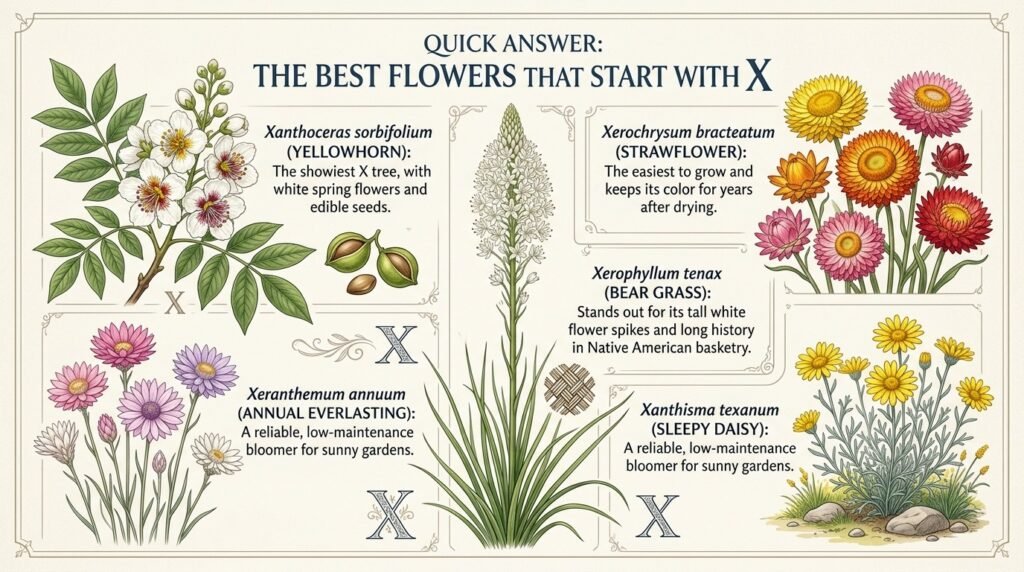
If you only remember a few names, start here. Xanthoceras sorbifolium, or yellowhorn, is the showiest X tree, with white spring flowers and edible seeds. Xerochrysum bracteatum, the strawflower, is the easiest to grow and keeps its color for years after drying. Xerophyllum tenax stands out for its tall white flower spikes and long history in Native American basketry. Xeranthemum annuum and Xanthisma texanum round out the list as reliable, low-maintenance bloomers for sunny gardens.
Master List of Flowers That Start With X
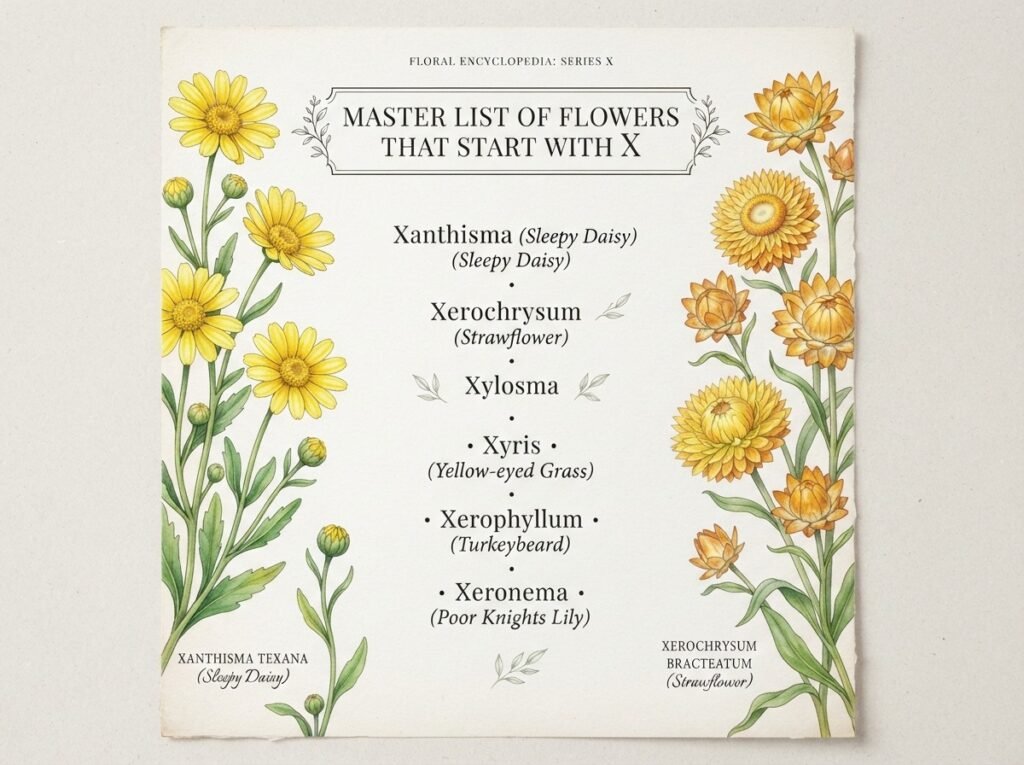
Some of these flowers are better known by their common name. Others only have a botanical name in everyday use, since no common name ever caught on. The list below mixes both, in alphabetical order, so you can scan the full set at a glance.
- Xanthisma gracile (slender goldenweed)
- Xanthisma spinulosum (cutleaf ironplant)
- Xanthisma texanum (sleepy daisy)
- Xanthoceras sorbifolium (yellowhorn)
- Xanthorrhoea australis (austral grass tree)
- Xanthorrhoea preissii (balga)
- Xanthosia rotundifolia (southern cross)
- Xenoscapa fistulosa
- Xeranthemum annuum (common immortelle)
- Xeranthemum cylindraceum (six-month flower)
- Xerochrysum bicolor (fringed everlasting)
- Xerochrysum bracteatum (strawflower)
- Xerochrysum subundulatum (alpine everlasting)
- Xerochrysum viscosum (sticky everlasting)
- Xerophyllum asphodeloides (eastern turkeybeard)
- Xerophyllum tenax (bear grass)
- Xerophyta retinervis (black stick lily)
- Xerophyta viscosa (resurrection plant)
- Ximenia americana (tallow wood)
- Xylobium colleyi
- Xylobium foveatum
- Xylobium variegatum
- Xylopia aethiopica (grains of Selim)
- Xylosma congestum (shiny xylosma)
- Xyris ambigua (coastal plain yellow-eyed grass)
- Xyris caroliniana (Carolina yellow-eyed grass)
- Xyris difformis (bog yellow-eyed grass)
- Xyris jupicai (Richard’s yellow-eyed grass)
- Xyris torta (twisted yellow-eyed grass)
This list already covers 29 confirmed species. Several genera above, like Xyris and Xerochrysum, include even more regional species. Together they push the real, checkable total for X flowers past 38.
Full Comparison Table
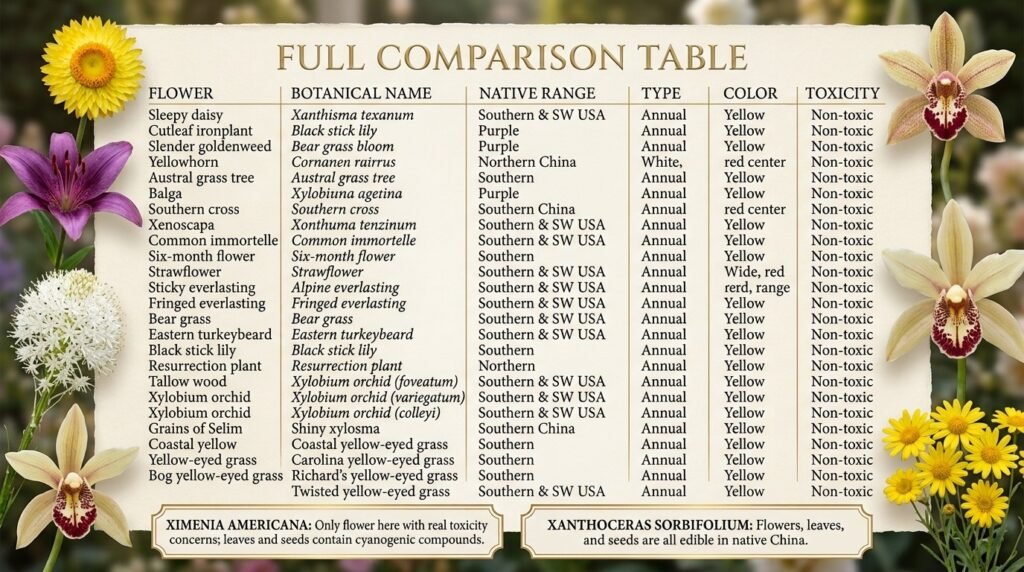
This table lays out the core facts for each flower in one place. Columns cover the botanical name, native range, plant type, color, and toxicity. Use it to compare bloom season and hardiness before you pick one for your own garden.
| Flower | Botanical Name | Native Range | Type | Color | Toxicity |
| Sleepy daisy | Xanthisma texanum | Southern & SW USA | Annual | Yellow | Non-toxic |
| Cutleaf ironplant | Xanthisma spinulosum | Rocky Mountain USA | Perennial | Yellow | Non-toxic |
| Slender goldenweed | Xanthisma gracile | SW USA deserts | Perennial | Yellow | Non-toxic |
| Yellowhorn | Xanthoceras sorbifolium | Northern China | Tree/shrub | White, red center | Non-toxic (edible) |
| Austral grass tree | Xanthorrhoea australis | SE Australia | Perennial shrub | Cream/white | Non-toxic |
| Balga | Xanthorrhoea preissii | Western Australia | Perennial shrub | Cream/white | Non-toxic |
| Southern cross | Xanthosia rotundifolia | Western Australia | Perennial | Cream, pink tinge | Non-toxic |
| Xenoscapa | Xenoscapa fistulosa | South Africa | Bulb | White, pale purple | Not well studied |
| Common immortelle | Xeranthemum annuum | Mediterranean, SW Asia | Annual | Purple, pink, white | Non-toxic |
| Six-month flower | Xeranthemum cylindraceum | SE Europe, Turkey | Annual | Pale purple | Non-toxic |
| Strawflower | Xerochrysum bracteatum | Australia | Annual/perennial | Yellow, orange, red, pink | Non-toxic |
| Sticky everlasting | Xerochrysum viscosum | SE Australia | Perennial | Yellow | Non-toxic |
| Alpine everlasting | Xerochrysum subundulatum | Australian Alps | Perennial | Yellow | Non-toxic |
| Fringed everlasting | Xerochrysum bicolor | SE Australia | Perennial | Yellow, white | Non-toxic |
| Bear grass | Xerophyllum tenax | Pacific NW USA | Perennial | White | Non-toxic |
| Eastern turkeybeard | Xerophyllum asphodeloides | Appalachian USA | Perennial | White | Non-toxic |
| Black stick lily | Xerophyta retinervis | South Africa | Perennial | Purple, white | Non-toxic |
| Resurrection plant | Xerophyta viscosa | South Africa | Perennial | Purple | Non-toxic |
| Tallow wood | Ximenia americana | Africa, Americas, Asia | Shrub/tree | White | Toxic seeds/leaves |
| Xylobium orchid | Xylobium foveatum | Mexico to S. America | Orchid | Cream, yellow | Non-toxic |
| Xylobium orchid | Xylobium variegatum | Central/South America | Orchid | Maroon, yellow | Non-toxic |
| Xylobium orchid | Xylobium colleyi | Central America | Orchid | Yellow, striped | Non-toxic |
| Grains of Selim | Xylopia aethiopica | West & Central Africa | Tree | Greenish-yellow | Non-toxic |
| Shiny xylosma | Xylosma congestum | China | Shrub | Cream (small) | Non-toxic |
| Coastal yellow-eyed grass | Xyris ambigua | SE USA wetlands | Perennial | Yellow | Non-toxic |
| Carolina yellow-eyed grass | Xyris caroliniana | SE USA | Perennial | Yellow | Non-toxic |
| Bog yellow-eyed grass | Xyris difformis | Eastern N. America | Perennial | Yellow | Non-toxic |
| Richard’s yellow-eyed grass | Xyris jupicai | Tropical wetlands | Perennial | Yellow | Non-toxic |
| Twisted yellow-eyed grass | Xyris torta | Eastern & Central N. America | Perennial | Yellow | Non-toxic |
Two entries stand out for different reasons. Ximenia americana is the only flower here with real toxicity concerns, since its leaves and seeds contain cyanogenic compounds. Xanthoceras sorbifolium sits at the opposite end, since its flowers, leaves, and seeds are all edible in its native China.
Garden Favorites
A handful of X flowers actually perform well in home gardens. Xanthoceras sorbifolium is the star, growing into a small flowering tree with star-shaped white blooms each spring. Xerochrysum bracteatum is the easiest to start from seed, and it rewards even beginner gardeners with months of color. Xanthisma texanum works well in hot, dry beds where many other annuals struggle. These three are the most likely X flowers you could actually buy at a nursery.
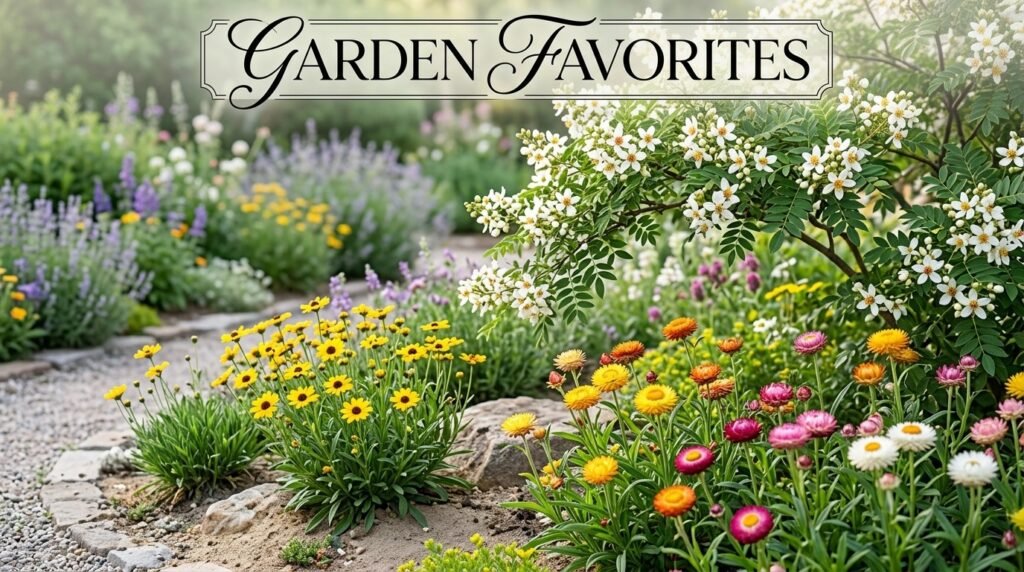
- Xanthoceras sorbifolium — small flowering tree, zones 4-7
- Xerochrysum bracteatum — sunny annual bed or border, zones 8-11
- Xanthisma texanum — dry, sandy soil, full sun
Between them, these three cover trees, annuals, and drought-tolerant perennials. That range makes them a solid starting point for any gardener curious about growing an X flower.
Wild and Wetland Species
Several X flowers only grow in the wild, often in very specific habitats. Xyris species prefer boggy, acidic wetlands across the eastern United States and the tropics. Xerophyllum tenax grows on dry mountain slopes in the Pacific Northwest, far from any wetland. Xerophyta viscosa takes the opposite survival strategy, drying out completely and coming back to life after rain in South Africa. These plants are rarely sold commercially, since they need very specific conditions to thrive.
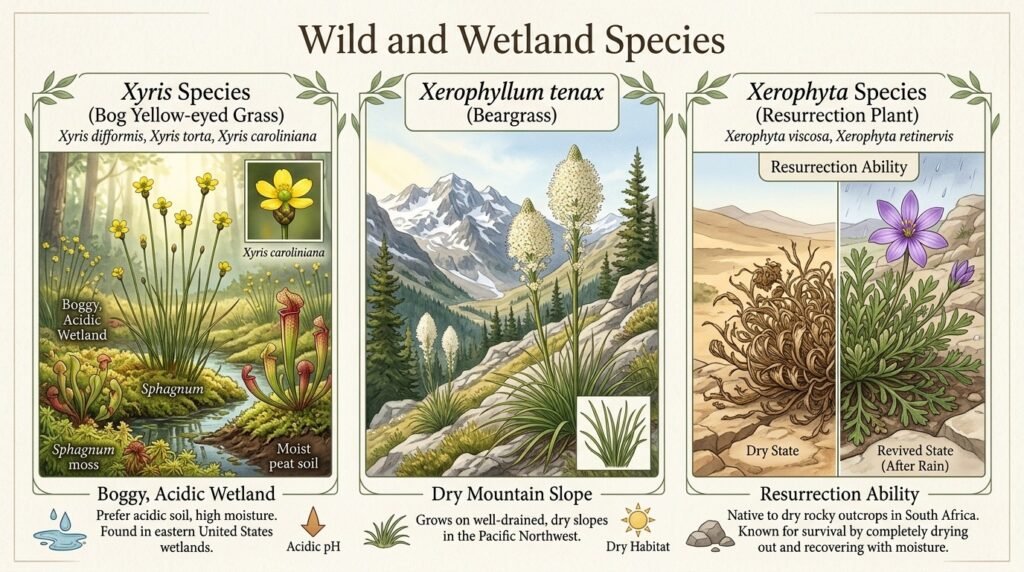
- Xyris difformis, Xyris torta, Xyris caroliniana — boggy wetlands, eastern USA
- Xerophyllum tenax — dry mountain slopes, Pacific Northwest
- Xerophyta viscosa, Xerophyta retinervis — rocky outcrops, South Africa
Botanists sometimes call Xerophyta a resurrection plant for good reason. It can lose almost all its water and still recover fully once rain returns.
Florist and Craft Favorites
The everlasting flowers in this list are the ones florists actually use. Xerochrysum bracteatum keeps its papery petals and bright color for years after drying, making it a staple in dried bouquets. Xeranthemum annuum earned the nickname immortelle for the same reason. Xerochrysum viscosum and Xerochrysum bicolor are less common but offer the same long-lasting texture in smaller, wilder-looking arrangements.
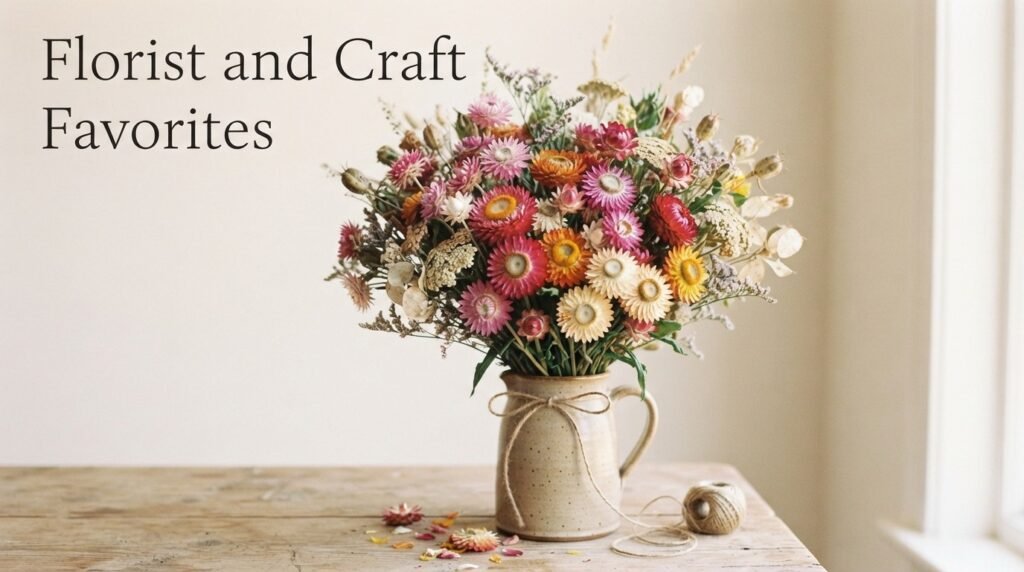
- Xerochrysum bracteatum (strawflower)
- Xeranthemum annuum (immortelle)
- Xerochrysum viscosum (sticky everlasting)
- Xerochrysum bicolor (fringed everlasting)
If you want a bouquet that lasts well past the season, these four are the ones to look for by name.
Rare and Unusual Flowers
A few X flowers are genuinely hard to find outside their native habitat. Xylobium orchids grow deep in Central and South American forests, and most people will only ever see them in botanical collections. Xenoscapa fistulosa is a small South African bulb that even many plant collectors have never heard of. Xanthorrhoea grass trees can take decades to grow a visible trunk, which makes mature specimens rare and valuable in Australian landscaping.
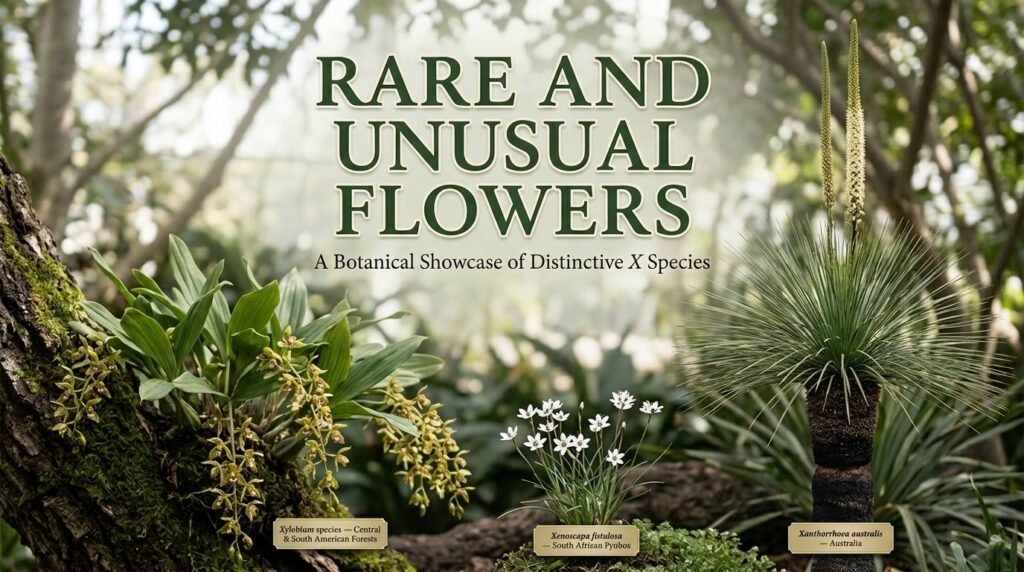
- Xylobium foveatum, Xylobium variegatum, Xylobium colleyi — forest orchids, Central/South America
- Xenoscapa fistulosa — small bulb, South African fynbos
- Xanthorrhoea australis, Xanthorrhoea preissii — slow-growing grass trees, Australia
Grass trees are especially striking once mature, since a single flower spike can tower several feet above the plant’s spiky base.
Caution and Toxicity Notes
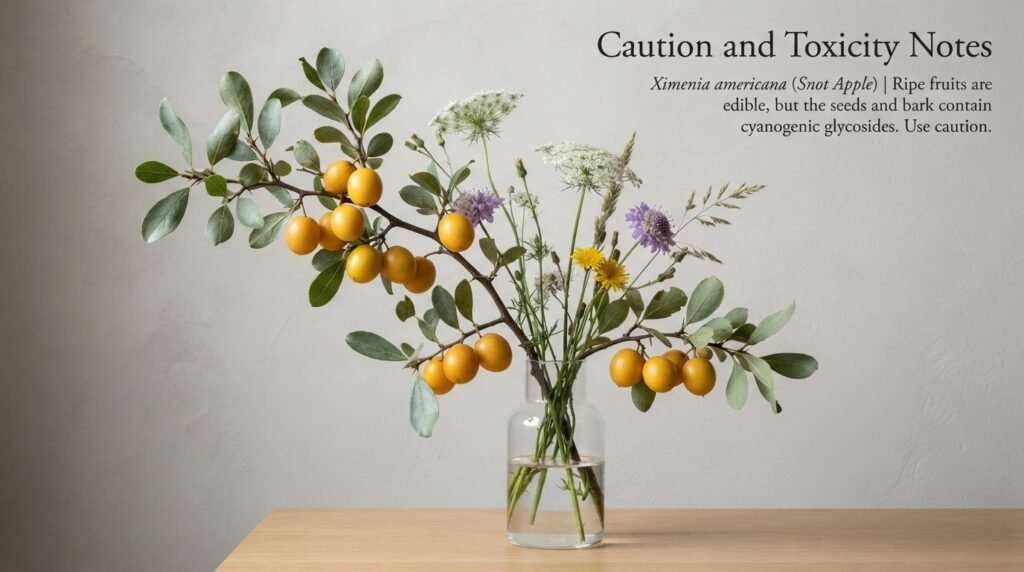
Most flowers on this list are safe around people and pets. Ximenia americana is the clear exception, since its leaves and seeds carry a cyanogenic compound called sambunigrin. The ripe fruit is eaten in parts of Africa, but only in moderation, and the seeds are not recommended for consumption. No other flower in this guide carries a documented toxicity warning, though, as with any wild plant, unfamiliar species should not be eaten without expert identification.
Color-Based Groupings
Yellow. Yellow is the most common color among X flowers. Xanthisma species, most Xyris species, and Xerochrysum viscosum all bloom in bright yellow. This shade suits sunny borders and pairs naturally with the dry, open habitats where many of these plants grow wild.
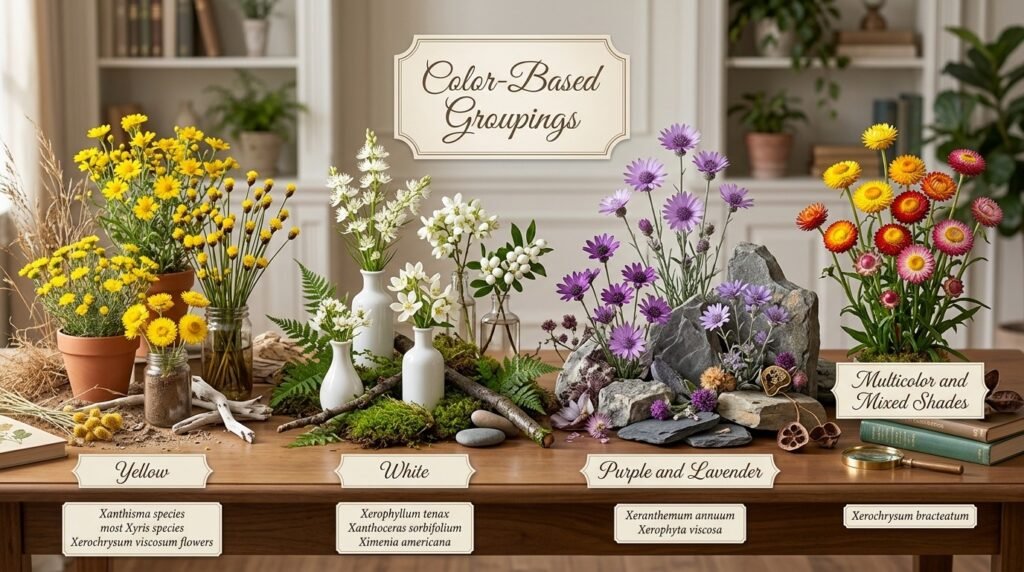
White. White-flowered X plants tend to come from forests or mountain slopes. Xerophyllum tenax, Xanthoceras sorbifolium, and Ximenia americana all produce white blooms. White works well in moon gardens or evening landscapes, where pale petals catch the last light.
Purple and lavender. Purple shows up mostly in the everlasting family. Xeranthemum annuum and Xerophyta viscosa both bloom in shades of purple to lavender. These flowers suit dried arrangements and rock gardens, where their muted color stands out against gray stone.
Multicolor and mixed shades. Xerochrysum bracteatum is the outlier here, since a single planting can produce yellow, orange, red, and pink blooms together. This makes it the best choice if you want variety from just one X flower species.
Life-Cycle Groupings
Knowing whether a flower is an annual, perennial, or woody plant helps you plan your garden correctly. Annuals need replanting every year, but often bloom fast and heavily. Perennials return on their own, while trees and shrubs take years to mature but offer long-term structure.
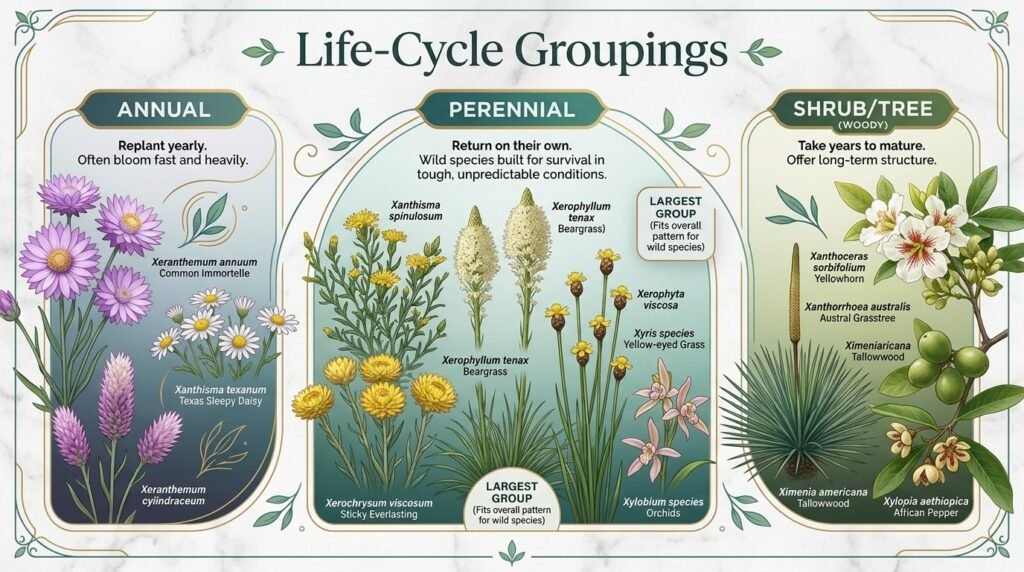
| Life Cycle | Flowers |
| Annual | Xanthisma texanum, Xeranthemum annuum, Xeranthemum cylindraceum |
| Perennial | Xanthisma spinulosum, Xanthisma gracile, Xerochrysum viscosum, Xerochrysum subundulatum, Xerochrysum bicolor, Xerophyllum tenax, Xerophyllum asphodeloides, Xerophyta viscosa, Xerophyta retinervis, Xyris species, Xylobium species |
| Shrub/Tree | Xanthoceras sorbifolium, Xanthorrhoea australis, Xanthorrhoea preissii, Ximenia americana, Xylopia aethiopica, Xylosma congestum |
The perennial category is by far the largest group here. That fits the overall pattern for X flowers, since most are wild species built to survive tough, unpredictable conditions year after year.
Botanical Name Crosswalk
Common names for X flowers are inconsistent, and some plants have no common name at all. Searching by botanical name is the only reliable way to find the right seeds or plants when shopping online. The crosswalk below pairs each common name with its correct scientific name for quick reference.
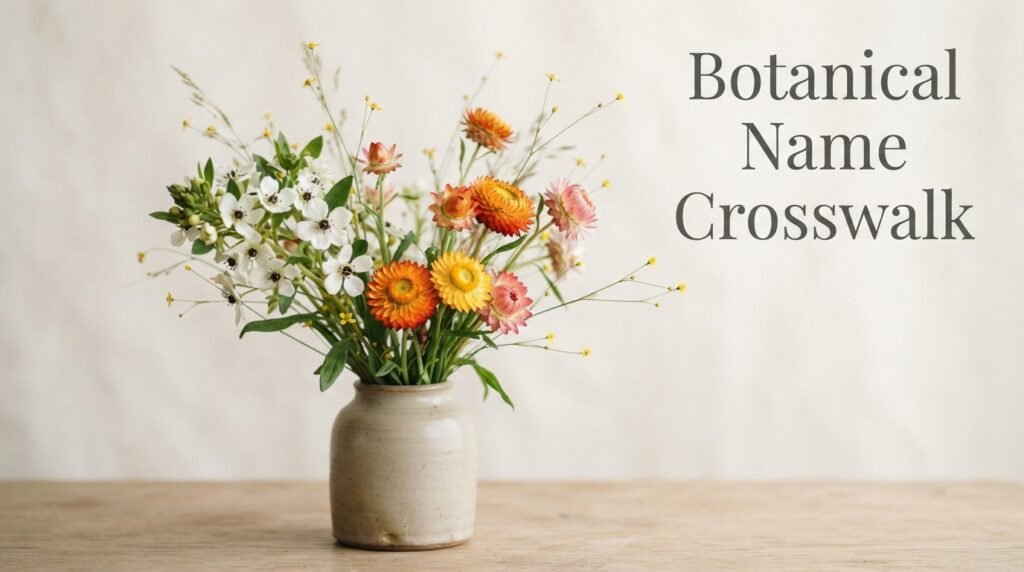
| Common Name | Botanical Name |
| Yellowhorn | Xanthoceras sorbifolium |
| Strawflower | Xerochrysum bracteatum |
| Immortelle | Xeranthemum annuum |
| Bear grass | Xerophyllum tenax |
| Sleepy daisy | Xanthisma texanum |
| Tallow wood | Ximenia americana |
| Grass tree | Xanthorrhoea australis |
| Resurrection plant | Xerophyta viscosa |
| Yellow-eyed grass | Xyris species |
| Grains of Selim | Xylopia aethiopica |
Notice how many entries, like the Xyris grasses and Xylobium orchids, simply do not have a common name in wide use. In those cases, the botanical name is not optional. It is the only name that will reliably lead you to the correct plant.
Flower Meanings and Symbolism
X flowers rarely appear in traditional flower-meaning charts, since most were never part of Victorian floriography. Still, a few carry meaning drawn from how they grow and behave. Xerochrysum bracteatum, the strawflower, has long symbolized permanence and lasting memory, since its dried petals hold their color for years. Xeranthemum annuum shares this symbolism closely, and its common name, immortelle, literally means “the immortal one” in French.
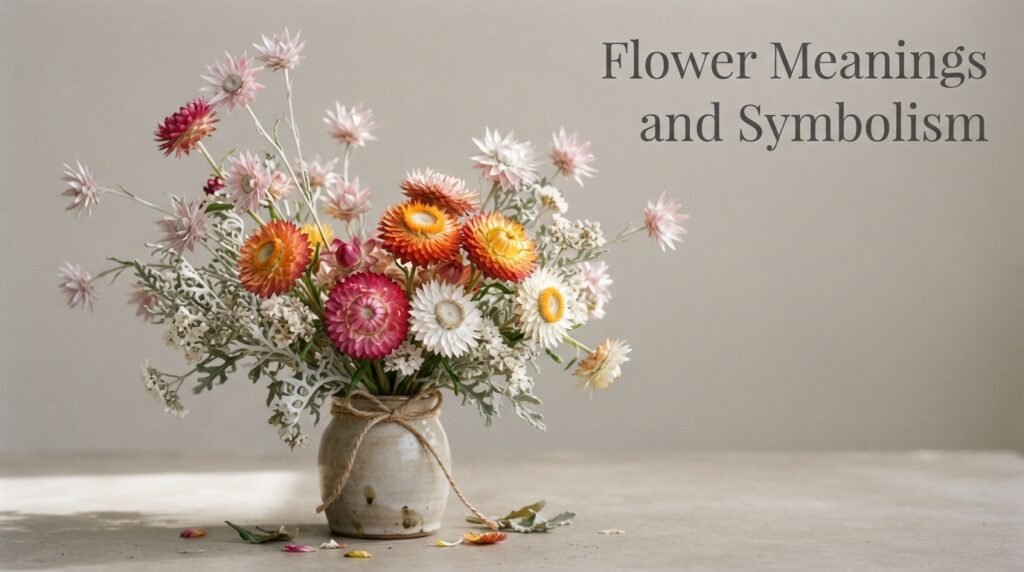
Xerophyta viscosa carries a newer, more scientific kind of symbolism. Its ability to dry out completely and revive after rain has made it a symbol of resilience in conservation writing. Xanthorrhoea grass trees, meanwhile, hold deep cultural meaning for Aboriginal Australians, who have used the plant’s resin, flower stalks, and leaves for tools, food, and ceremony for thousands of years. These stories give the rarest letter in the flower alphabet a surprising amount of depth.
Decision-Flow Table: Which X Flower Should You Grow?
Choosing the right X flower depends mostly on your climate and your goal. This table matches common goals with the flower most likely to succeed. Check your hardiness zone against the earlier comparison table before buying seeds or plants.
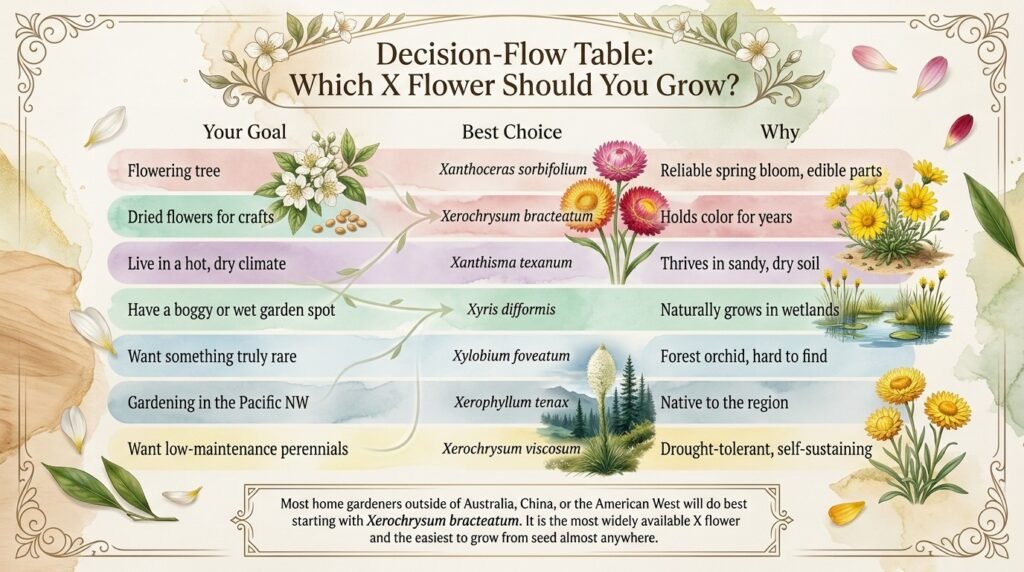
| Your Goal | Best Choice | Why |
| Want a flowering tree | Xanthoceras sorbifolium | Reliable spring bloom, edible parts |
| Want dried flowers for crafts | Xerochrysum bracteatum | Holds color for years |
| Live in a hot, dry climate | Xanthisma texanum | Thrives in sandy, dry soil |
| Have a boggy or wet garden spot | Xyris difformis | Naturally grows in wetlands |
| Want something truly rare | Xylobium foveatum | Forest orchid, hard to find |
| Gardening in the Pacific NW | Xerophyllum tenax | Native to the region |
| Want low-maintenance perennials | Xerochrysum viscosum | Drought-tolerant, self-sustaining |
Most home gardeners outside of Australia, China, or the American West will do best starting with Xerochrysum bracteatum. It is the most widely available X flower and the easiest to grow from seed almost anywhere.
Conclusion
Flowers that start with X are rare, but they are real, and this guide sticks to the ones that check out. From the flowering yellowhorn tree to tiny wetland grasses, each entry here has a verified botanical name and native range. If you want an X flower for your own garden, Xanthoceras sorbifolium and Xerochrysum bracteatum are the safest, easiest places to start.
Frequently Asked Questions
Are there really 80 flowers that start with X?
No. Verified botanical sources support roughly 35 to 40 real X flowers. Lists claiming 80 or more usually include repeated genus names or unverified entries.
What is the most common flower that starts with X?
Xerochrysum bracteatum, the strawflower, is the most widely grown and easiest to find in seed catalogs.
Is Ximenia americana poisonous?
Yes, partly. Its leaves and seeds contain a cyanogenic compound. The ripe fruit is eaten in parts of Africa, but only in small amounts.
Can I grow flowers that start with X indoors?
Most X flowers are outdoor garden or wild species. Xylobium orchids are the closest thing to an indoor option, since they can be grown in warm, humid greenhouse conditions.
What flowers that start with X are native to the United States?
Xerophyllum tenax, Xerophyllum asphodeloides, and several Xyris and Xanthisma species are native to different regions of the US.
Are any X flowers toxic to pets?
Ximenia americana is the main concern due to cyanogenic compounds in its leaves and seeds. Most other X flowers have no documented toxicity to pets.
What does the strawflower symbolize?
Strawflowers symbolize permanence and lasting memory, since their papery petals keep their color long after drying.
Which X flower is best for a dried flower arrangement?
Xerochrysum bracteatum and Xeranthemum annuum are both classic choices for dried arrangements, thanks to their papery, long-lasting petals.
Do any flowers that start with X grow in Australia?
Yes. Xanthorrhoea grass trees, Xerochrysum everlastings, and Xanthosia rotundifolia are all native to Australia.
Is Xanthoceras sorbifolium easy to grow?
Yes, once established. It needs full sun, well-drained soil, and protection from late frosts while young.