

Flowers that start with I bring together tall garden classics and small, rare bulbs alike. This guide picks 25 real flowers, from the well-known Bearded Iris to the rare Blackberry Lily. Each entry includes a checked botanical name, native range, bloom time, and toxicity note. Whether you garden, arrange bouquets, or just enjoy learning plant names, this list gives a clear, useful starting point.
- Quick Answer: Top Flowers That Start With I
- Master Alphabetical List of Flowers That Start With I
- Full Comparison Table of Flowers That Start With I
- Garden Favorites Among Flowers That Start With I
- Indoor Plants Among Flowers That Start With I
- Florist Favorites Among Flowers That Start With I
- Rare Flowers That Start With I
- Flowers That Start With I and Need Caution
- Color-Based Groupings of Flowers That Start With I
- Life-Cycle Groupings of Flowers That Start With I
- Botanical Name Crosswalk for Flowers That Start With I
- Flower Meanings and Symbolism
- Decision Guide: Which Flower That Starts With I Should You Choose?
- Conclusion
- Frequently Asked Questions
This article is built for a few different readers at once. A home gardener can use it to plan a new bed with confidence. A florist can use it to pick fresh I-letter stems for a bouquet. A parent or pet owner can use it to spot flowers that need extra caution. A curious plant lover can simply enjoy how varied this one letter turns out to be.
The 25 flowers below are organized in several useful ways. A master alphabetical list comes first, followed by a full comparison table. After that come category sections for garden favorites, indoor plants, florist picks, rare finds, and toxic plants. Color groups and life-cycle groups follow near the end, before a full FAQ section.
Every flower named here has a real, verified botanical name. Native range and toxicity notes appear throughout, so you can plan safely around kids or pets. Image captions follow many flower descriptions, making it easy to slot in a photo later. By the end, you should be able to pick flowers that start with I for almost any garden goal.
Quick Answer: Top Flowers That Start With I
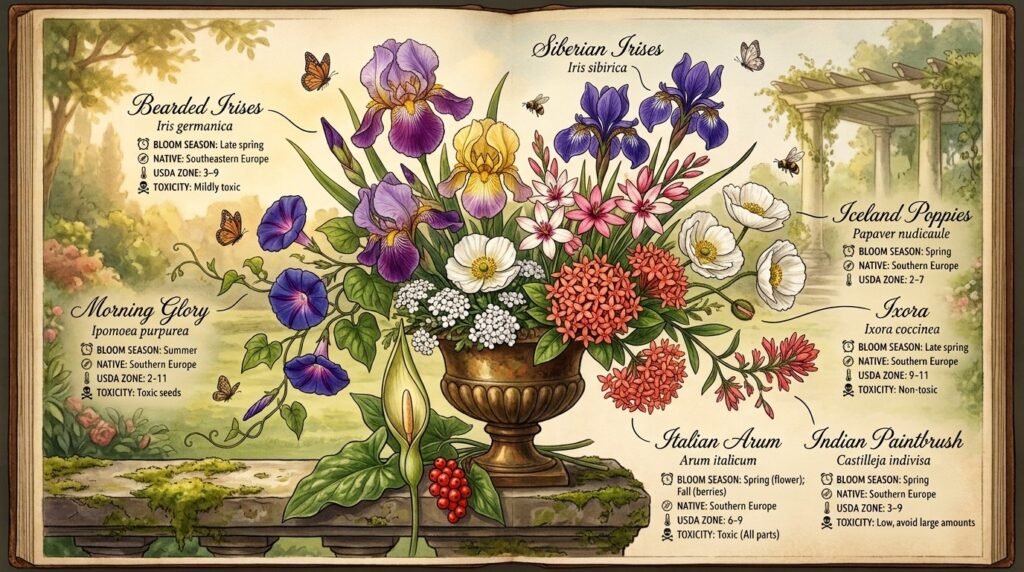
If you only remember a few names, start here. Bearded Iris is the classic pick, loved for ruffled petals and a huge color range. Impatiens is the top shade annual, since it blooms nonstop with very little care. Morning Glory covers a fence or trellis fast with fresh blooms each morning. Iceland Poppy brings tissue-paper petals to cool spring gardens. Ixora is a tropical shrub with dense, rounded flower clusters in hot colors. Indian Pink is a native shade perennial that pulls in hummingbirds all summer. Peruvian Daffodil, also called Ismene, gives fragrant white blooms from a simple bulb. Candytuft rounds out the list with a low, spreading white mat suited to rock gardens.
Master Alphabetical List of Flowers That Start With I
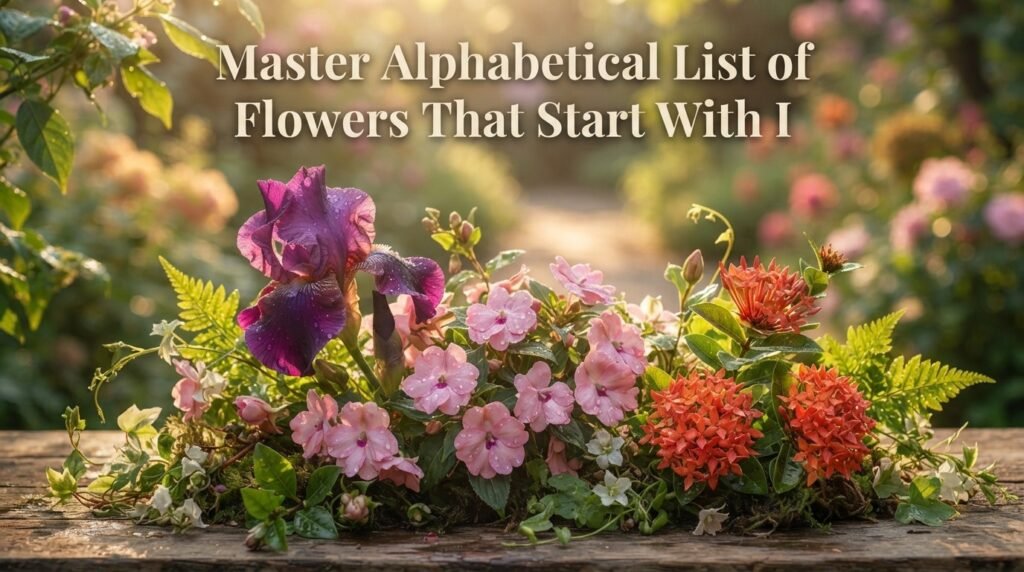
Some flowers here start with I in their common name, like Iris or Impatiens. Others start with I only through a botanical or genus name, like Iberis or Ipheion. Both types appear below, since most searches for this topic mix common and botanical names. Each entry lists the most searched common name first, with its botanical name right beside it.
- Bearded Iris (Iris germanica)
- Siberian Iris (Iris sibirica)
- Dutch Iris (Iris × hollandica)
- Blackberry Lily (Iris domestica)
- Impatiens (Impatiens walleriana)
- Garden Balsam (Impatiens balsamina)
- Ice Plant (Delosperma cooperi)
- Iceland Poppy (Papaver nudicaule)
- Ixora (Ixora coccinea)
- Ixia (Ixia hybrida)
- Morning Glory (Ipomoea purpurea)
- Peruvian Daffodil (Ismene × festalis)
- Indian Pink (Spigelia marilandica)
- Indian Blanket (Gaillardia pulchella)
- Wild Blue Indigo (Baptisia australis)
- Ironweed (Vernonia noveboracensis)
- Candytuft (Iberis sempervirens)
- Italian Arum (Arum italicum)
- Spring Starflower (Ipheion uniflorum)
- Impala Lily (Adenium multiflorum)
- Peruvian Lily (Alstroemeria aurea)
- Indian Hawthorn (Rhaphiolepis indica)
- Indian Paintbrush (Castilleja indivisa)
- Indian Shot (Canna indica)
- Indian Turnip (Arisaema triphyllum)
That is a clean 25, covering everything from spring bulbs to tropical shrubs. Notice how many entries share the genus Iris, which remains the single richest source of I names. The list also mixes true wildflowers, like Indian Paintbrush, with tender tropicals, like Ixora, showing real range in one small letter group.
Full Comparison Table of Flowers That Start With I
The table below lines up six key facts for each of the 25 flowers. Native range shows where a plant grows in the wild, which helps you judge if your climate will suit it. Bloom season and USDA zone guide planting timing, while the toxicity column flags any risk to people or pets. Use this table as a fast reference before reading the fuller sections below.
| Flower | Botanical Name | Native Range | Bloom Season | USDA Zone | Toxicity |
| Bearded Iris | Iris germanica | Southern Europe | Late spring | 3–9 | Mild, toxic if eaten |
| Siberian Iris | Iris sibirica | Central Europe, Russia | Late spring | 3–8 | Mild, toxic if eaten |
| Dutch Iris | Iris × hollandica | Garden hybrid | Late spring | 5–9 | Mild, toxic if eaten |
| Blackberry Lily | Iris domestica | East Asia | Summer | 5–10 | Low, seeds mildly toxic |
| Impatiens | Impatiens walleriana | East Africa | Spring to frost | 10–11, annual elsewhere | Non-toxic |
| Garden Balsam | Impatiens balsamina | South Asia | Summer | Annual, all zones | Non-toxic |
| Ice Plant | Delosperma cooperi | South Africa | Summer | 5–9 | Non-toxic |
| Iceland Poppy | Papaver nudicaule | Subarctic Asia | Spring | 2–7 | Mild, sap irritant |
| Ixora | Ixora coccinea | South Asia | Year-round in tropics | 9–11 | Non-toxic |
| Ixia | Ixia hybrida | South Africa | Late spring | 8–10 | Non-toxic |
| Morning Glory | Ipomoea purpurea | Mexico, Central America | Summer to frost | 2–11, annual | Toxic seeds |
| Peruvian Daffodil | Ismene × festalis | Andes region | Summer | 8–10 | Toxic bulb |
| Indian Pink | Spigelia marilandica | Southeastern United States | Late spring | 5–9 | Toxic, all parts |
| Indian Blanket | Gaillardia pulchella | Central United States | Summer | 3–10 | Non-toxic |
| Wild Blue Indigo | Baptisia australis | Eastern United States | Late spring | 3–9 | Mild, toxic if eaten |
| Ironweed | Vernonia noveboracensis | Eastern United States | Late summer | 5–9 | Non-toxic |
| Candytuft | Iberis sempervirens | Southern Europe | Spring | 3–9 | Non-toxic |
| Italian Arum | Arum italicum | Mediterranean | Spring flower, fall berries | 6–9 | Toxic, all parts |
| Spring Starflower | Ipheion uniflorum | South America | Early spring | 5–9 | Mild, toxic if eaten |
| Impala Lily | Adenium multiflorum | Southern Africa | Winter and spring | 10–11 | Toxic sap |
| Peruvian Lily | Alstroemeria aurea | South America | Summer | 7–10 | Mild, skin irritant |
| Indian Hawthorn | Rhaphiolepis indica | China, Southeast Asia | Spring | 7–10 | Non-toxic |
| Indian Paintbrush | Castilleja indivisa | Central United States | Spring | 3–9 | Low, avoid large amounts |
| Indian Shot | Canna indica | Tropical Americas | Summer to frost | 8–11 | Non-toxic |
| Indian Turnip | Arisaema triphyllum | Eastern North America | Spring | 4–9 | Toxic, all parts |
A few rows stand out from that table right away. Italian Arum and Indian Turnip both carry full-plant toxicity, so keep them well away from curious pets. Indian Shot and Ironweed are the safest picks here, with no listed toxicity at all. Bearded Iris also stands out for sheer range, since it spans six USDA zones from cool to warm climates.
Garden Favorites Among Flowers That Start With I
Garden favorites are the flowers gardeners plant again and again without fail. Bearded Iris leads this group, thanks to its tall stalks and huge color range. Candytuft forms a neat white cushion that works well along path edges and rock walls. Indian Blanket brings hot red-and-yellow rings to dry, sunny beds with little upkeep. Ironweed grows tall and wild, feeding butterflies through the height of late summer.
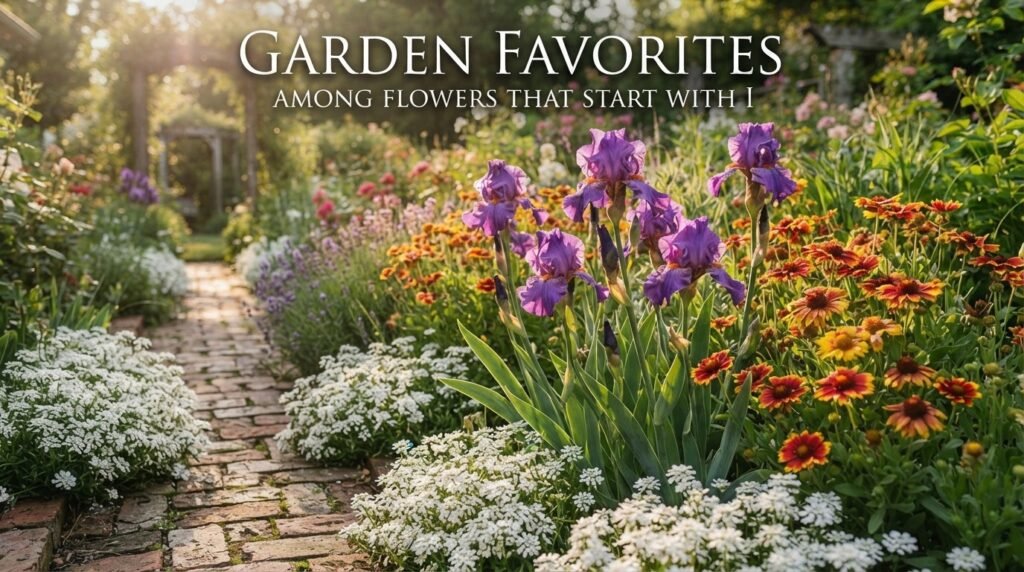
Bearded Iris (Iris germanica) sends up ruffled, velvety blooms each spring in nearly every color but true red. It spreads slowly by rhizome, filling a bed over several seasons. Image caption: Close-up of a purple Bearded Iris in full bloom.
Candytuft (Iberis sempervirens) forms a low, evergreen mound covered in tiny white flower clusters each spring. It handles poor, rocky soil better than most border perennials. Image caption: Low mat of white Candytuft flowers along a garden path.
Indian Blanket (Gaillardia pulchella) opens into fiery red-and-yellow daisies that keep blooming through summer heat. It self-seeds freely, often returning without any replanting. Image caption: Red and yellow Indian Blanket flowers in a sunny border.
Wild Blue Indigo (Baptisia australis) produces tall, pea-shaped blue-purple spikes each late spring. Once established, the deep taproot lets it live for decades with little care. Image caption: Blue-purple Wild Blue Indigo spikes in a native garden bed.
- Bearded Iris — tall spring bloomer with ruffled petals
- Candytuft — low, white, spreading ground cover
- Indian Blanket — drought-tough with fiery red-and-yellow rings
- Wild Blue Indigo — long-lived native with blue-purple spikes
- Ironweed — tall late-summer bloomer loved by monarchs
- Indian Shot — bold red-orange tropical-looking blooms
These six plants share one trait: low upkeep once they settle into the right spot. Bearded Iris and Wild Blue Indigo can both live for decades with barely any attention. Candytuft and Indian Blanket, by contrast, are shorter-lived but reseed freely, refilling their own space each year.
Indoor Plants Among Flowers That Start With I
Indoor flowers need to handle lower light and steady indoor temperatures. Impatiens is the best-known pick here, since it blooms nonstop in a bright window with little fuss. Impatiens forms a chunky, sculptural shape indoors, almost like a small flowering bonsai. Ixora rewards a warm, sunny room with dense clusters of red or orange blooms. Ice Plant works well in a bright succulent dish, opening its daisy-like flowers only in strong light.
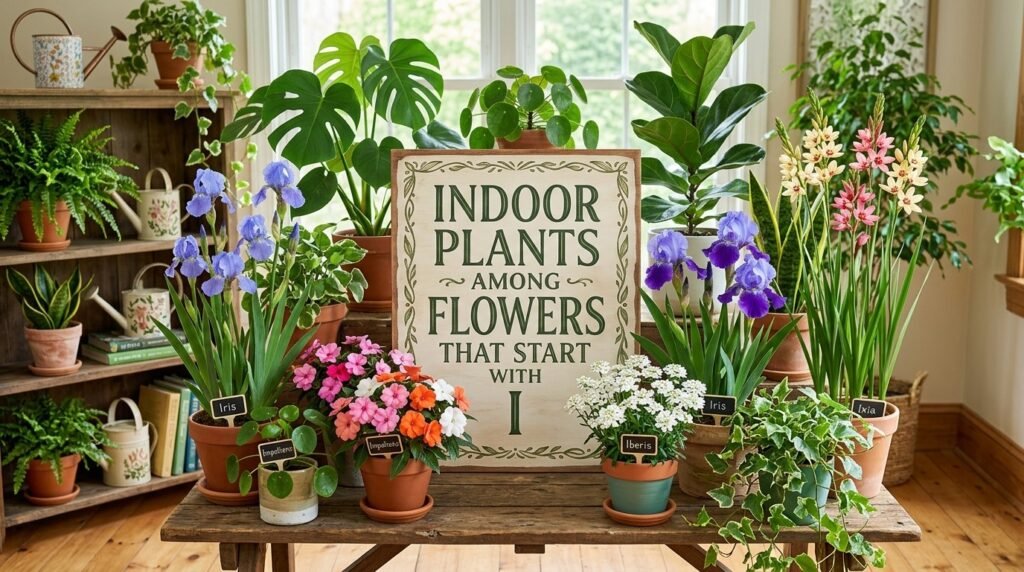
Impatiens (Impatiens walleriana) blooms continuously in shade or bright indirect light, rarely pausing between flushes. It suits a north-facing window better than most flowering houseplants. Image caption: Pink and white Impatiens flowers in a shaded indoor pot.
Impala Lily (Adenium multiflorum) grows a thick, swollen trunk topped with clusters of pink-edged white flowers. Collectors often train it into a bonsai-like shape over several years. Image caption: Impala Lily with pink-edged flowers on a thick trunk.
Ixora (Ixora coccinea) produces dense, rounded flower clusters in red, orange, or yellow year-round in warm rooms. It needs strong light to keep blooming indoors through winter. Image caption: Red Ixora flower cluster on a small potted shrub.
- Impatiens — nonstop shade bloomer for a bright window
- Impala Lily — sculptural, thick-trunked desert-rose relative
- Ixora — dense tropical clusters in hot colors
- Garden Balsam — upright cottage-style blooms in a sunny pot
- Ice Plant — succulent daisies for a bright, dry dish
Impala Lily and Ice Plant both suit collectors who enjoy unusual, sculptural shapes. Ixora needs the most consistent warmth of the group to keep flowering through winter. Impatiens remains the easiest overall, tolerating a much wider range of indoor light levels.
Florist Favorites Among Flowers That Start With I
Florists pick flowers for strong stems, long vase life, and dependable color. Peruvian Daffodil, also called Ismene, gives fragrant white or yellow trumpets that hold up well as cut stems. Peruvian Lily, or Inca Lily, is a florist shop staple thanks to its two-week vase life. Dutch Iris brings tall, elegant lines with crisp blue, purple, or yellow petals. Ixia adds delicate, star-shaped blooms that suit airy, garden-style bouquets.
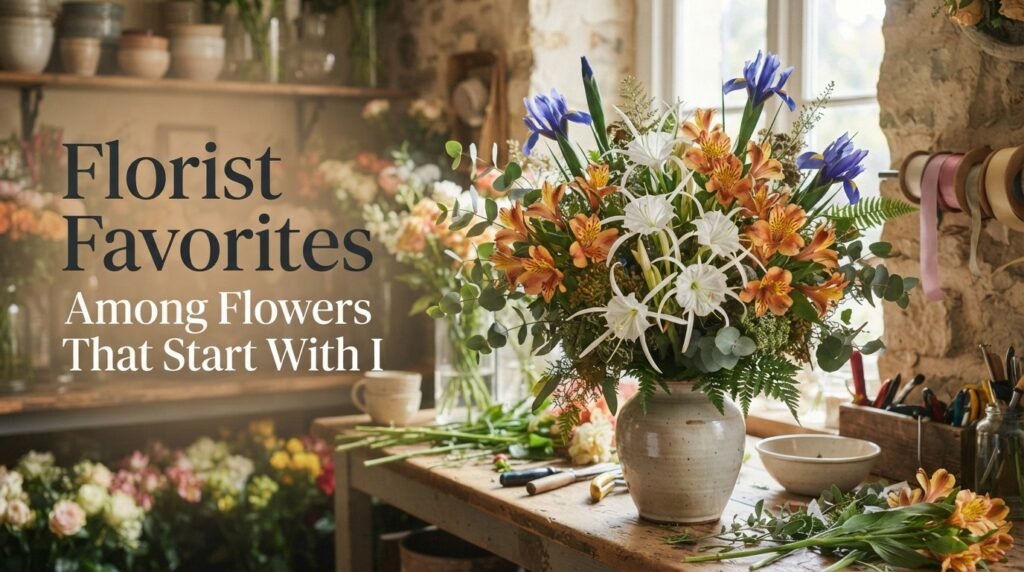
Peruvian Daffodil (Ismene × festalis) opens into large, fragrant white trumpets on a tall summer stem. Florists prize it for both scent and unusual spidery petal shape. Image caption: White Peruvian Daffodil trumpet flower in a summer bouquet.
Peruvian Lily (Alstroemeria aurea) produces clusters of speckled orange or yellow blooms that last two weeks once cut. It remains one of the longest-lasting cut flowers sold today. Image caption: Orange speckled Peruvian Lily blooms in a fresh bouquet.
Dutch Iris (Iris × hollandica) sends up tall, slender stems topped with crisp blue or yellow flowers. Its clean lines suit both formal and modern floral designs. Image caption: Blue Dutch Iris flowers with tall, elegant stems.
- Peruvian Daffodil — fragrant, trumpet-shaped summer blooms
- Peruvian Lily — long vase life, wide color range
- Dutch Iris — tall, elegant lines for formal bouquets
- Ixia — delicate star-shaped blooms for garden-style bunches
- Morning Glory — rarely cut, but grown for arbor and trellis display
Peruvian Lily stands out as the true workhorse here, since florists rely on its long shelf life above all else. Dutch Iris earns its place differently, since its straight, clean stems suit modern minimalist arrangements. Morning Glory is the odd one out, grown more for garden display than the vase, since its blooms close by afternoon.
Rare Flowers That Start With I
A handful of I-flowers rarely show up outside specialist growers or native plant sales. Blackberry Lily is an East Asian relative of true Iris, named for its cluster of shiny black seeds. Spring Starflower is a small South American bulb that naturalizes quietly, often overlooked until it blooms. Indian Hawthorn appears more often in commercial landscaping than home gardens, despite its pretty pink spring flowers. Indian Paintbrush is notoriously hard to grow from seed, since it depends on nearby host plant roots to thrive.
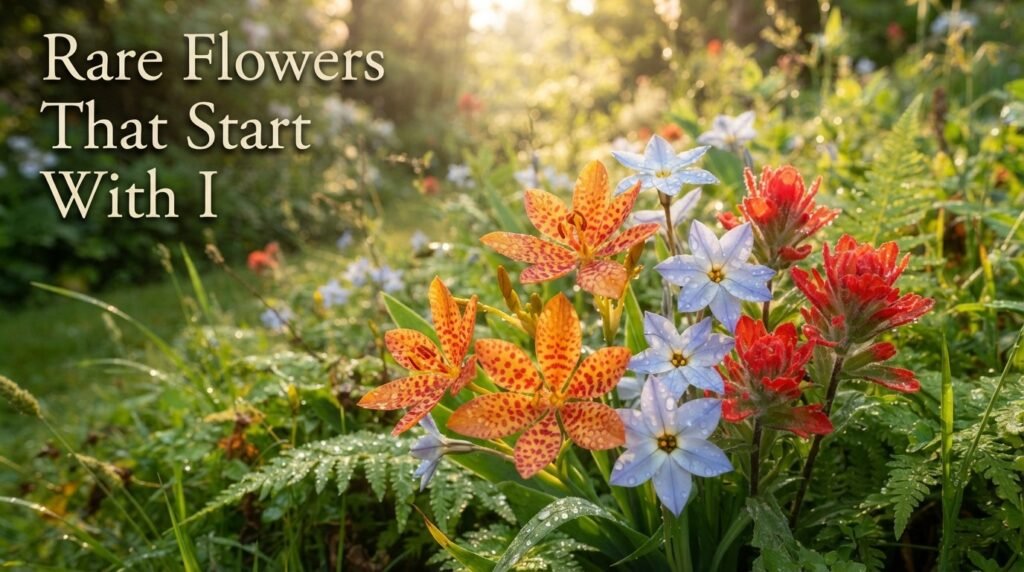
Blackberry Lily (Iris domestica) opens into orange, red-spotted flowers followed by seed pods that split open like blackberries. Few gardeners realize it belongs to the Iris family at all. Image caption: Orange, red-spotted Blackberry Lily flower in summer.
Spring Starflower (Ipheion uniflorum) produces small, star-shaped pale blue flowers above grassy, garlic-scented leaves. It naturalizes easily once planted, spreading slowly each year. Image caption: Pale blue Spring Starflower blooms in early spring.
Indian Paintbrush (Castilleja indivisa) displays bright red bracts rather than true petals, growing in loose clusters across open fields. It is a hemiparasite, drawing some nutrients from nearby grass roots. Image caption: Bright red Indian Paintbrush blooms in a wildflower field.
- Blackberry Lily — orange, spotted Iris relative with black seeds
- Spring Starflower — small pale blue naturalizing bulb
- Indian Hawthorn — pink spring shrub used mostly in landscaping
- Indian Paintbrush — hemiparasitic wildflower, tricky to cultivate
- Siberian Iris — narrow-leaved cousin of Bearded Iris
Blackberry Lily and Spring Starflower share one trait: both are easy to overlook until they suddenly bloom. Indian Paintbrush remains the trickiest of the group, since home gardeners rarely succeed without its host grasses nearby. Siberian Iris is the most forgiving rare pick, tolerating wetter soil than most other Iris types.
Flowers That Start With I and Need Caution
A meaningful group of I-flowers carries real toxicity risk, especially around kids and pets. Italian Arum produces bright red berries in fall that look tempting but are toxic if eaten. Indian Turnip, better known as Jack-in-the-Pulpit, contains sharp calcium oxalate crystals in every part of the plant. Iceland Poppy has a mildly irritating sap, so gloves help during deadheading. Indian Pink, despite its garden-friendly reputation, is fully toxic and was historically used only in carefully measured doses.
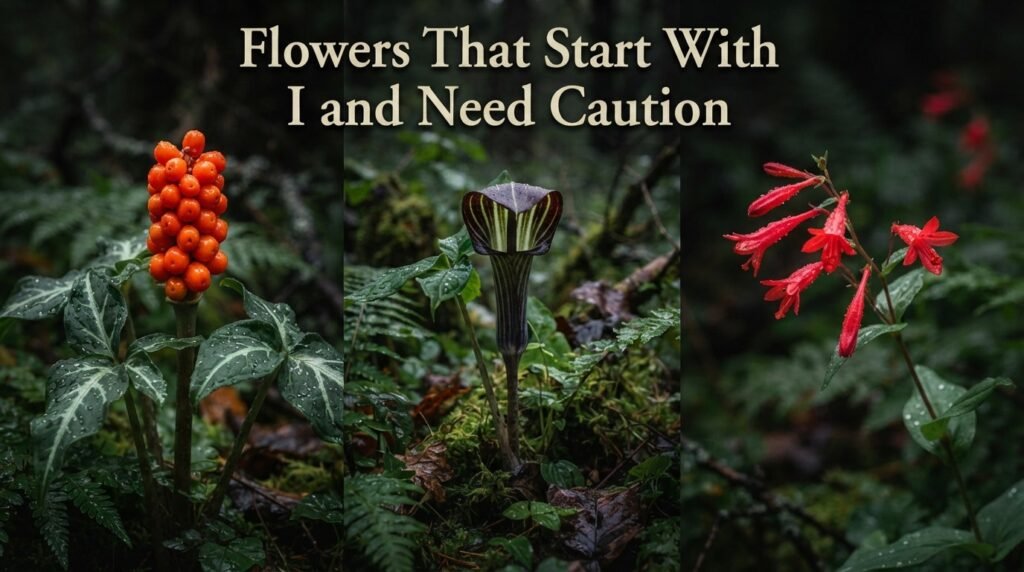
Italian Arum (Arum italicum) produces glossy arrow-shaped leaves in winter and bright red berries in fall. All parts, especially the berries, are toxic if eaten. Image caption: Bright red Italian Arum berries on a fall stem.
Indian Turnip (Arisaema triphyllum) grows a hooded green-and-purple flower structure above three-part leaves. Chewing any part causes intense mouth and throat burning. Image caption: Green and purple Indian Turnip flower in a shaded woodland.
Indian Pink (Spigelia marilandica) sends up scarlet, yellow-throated tubular flowers that hummingbirds visit constantly. Despite its beauty, the entire plant is toxic if ingested. Image caption: Scarlet Indian Pink flowers attracting a hummingbird.
- Italian Arum — toxic red berries; keep away from children
- Indian Turnip — oxalate crystals cause mouth and throat burning
- Iceland Poppy — mildly irritating sap on skin
- Indian Pink — toxic throughout, historically used only in tiny doses
- Impala Lily — toxic milky sap, handle with gloves
Italian Arum and Indian Turnip deserve the most caution here, since both cause immediate, painful irritation if chewed. Iceland Poppy is milder by comparison, mostly affecting skin rather than causing internal harm. Even so, all five of these are best kept out of reach in homes with toddlers or curious pets.
Color-Based Groupings of Flowers That Start With I
Grouping flowers by color helps with planning a themed bed or bouquet. Purple and blue tones show up often across this letter group. Bearded Iris, Wild Blue Indigo, and Spring Starflower all bring cool purple-blue shades that pair well in a calm, layered border.
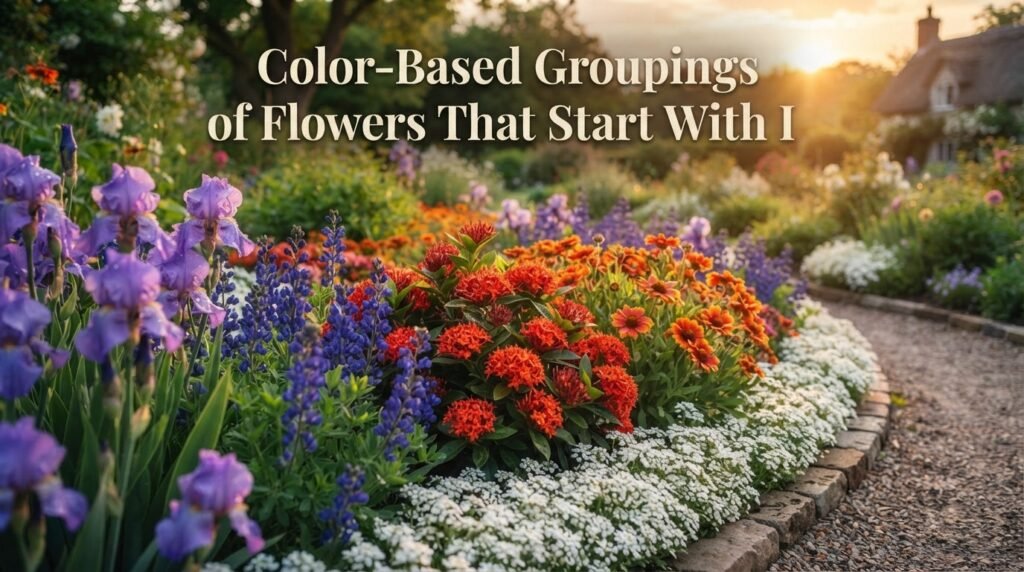
Red and orange flowers add heat and energy to sunny beds. Indian Blanket mixes both colors in a single bloom, while Ixora and Indian Shot lean fully into hot orange-red tones. These work well near a patio, where bold color reads clearly from a seated view.
White flowers bring calm, quiet contrast to any of the groups above. Candytuft and Peruvian Daffodil both bring soft white tones to a bed or bouquet. Dutch Iris also comes in a crisp white form, though its blue variety remains far more popular.
Pink flowers suit softer, romantic garden themes especially well. Indian Hawthorn and Impala Lily both offer gentle pink tones on woody, shrub-like plants. Indian Pink adds a scarlet-and-yellow twist to this group, standing apart from the softer pastel shades nearby.
Life-Cycle Groupings of Flowers That Start With I
Knowing a flower’s life cycle helps you plan how often to replant a bed. Annuals complete their life cycle in one season, so they need fresh seeds or plants each year. Perennials return from the same roots for years, while bulbs store energy underground between blooms. Shrubs take the longest to establish but reward patience with years of repeat flowers.
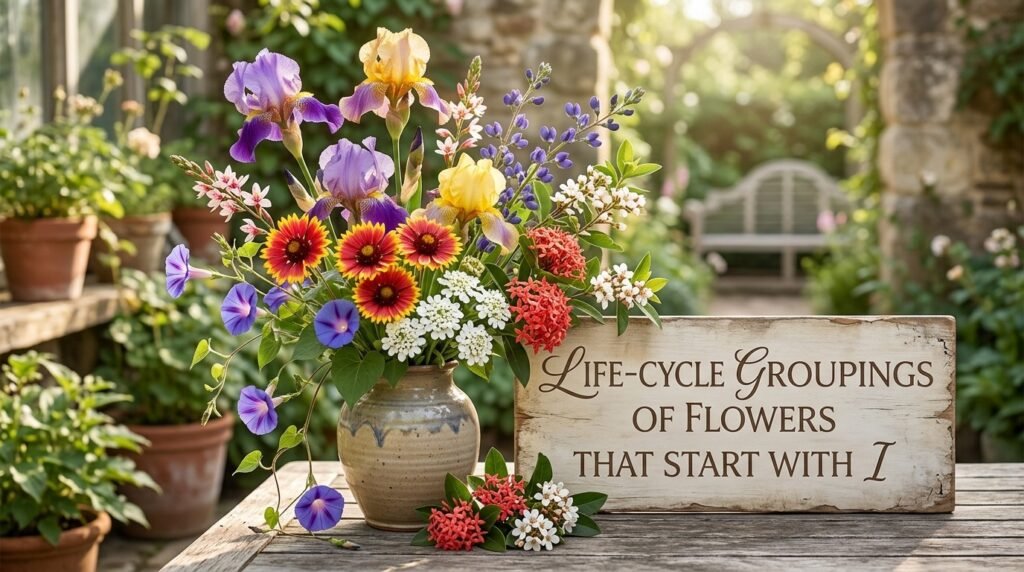
| Life Cycle Type | Example Flowers |
| Annual | Garden Balsam, Indian Blanket, Morning Glory |
| Perennial | Wild Blue Indigo, Ironweed, Candytuft, Indian Pink |
| Bulb or Rhizome | Bearded Iris, Peruvian Daffodil, Spring Starflower, Ixia |
| Shrub or Woody | Ixora, Indian Hawthorn, Impala Lily |
Bulb and rhizome types tend to need the least yearly work once planted correctly. Annuals demand the most attention, since beds need fresh planting each spring. Shrubs like Ixora take the longest to reach full size but need the least replacing over time.
Botanical Name Crosswalk for Flowers That Start With I
Botanical names matter more than most gardeners expect. Common names shift by region, but a botanical name stays fixed everywhere in the world. This matters most when buying online, since a search for the wrong common name can return a completely different plant. The crosswalk below pairs each common name with its correct botanical name and plant family for fast, accurate searching.
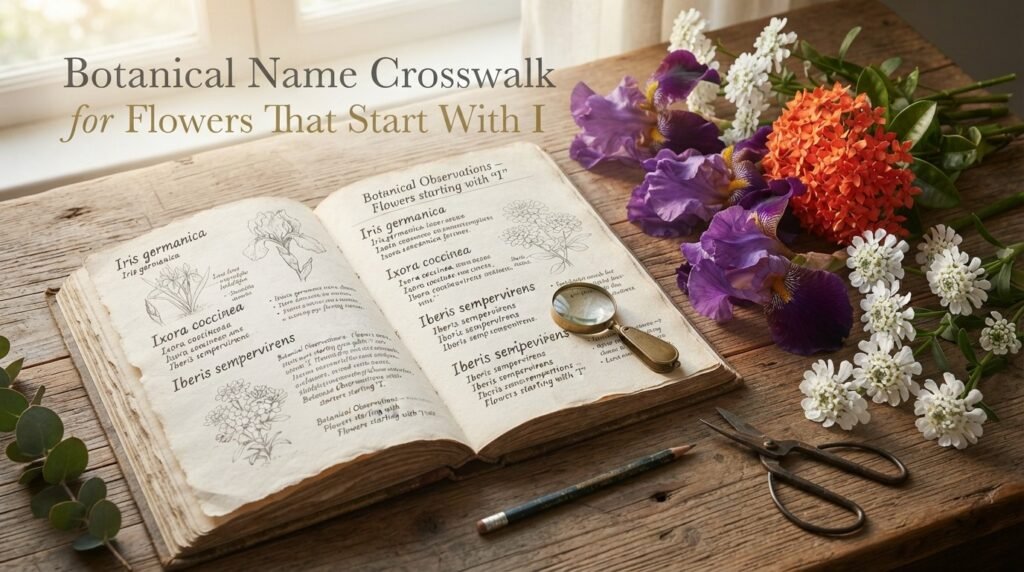
| Common Name | Botanical Name | Plant Family |
| Bearded Iris | Iris germanica | Iridaceae |
| Impatiens | Impatiens walleriana | Balsaminaceae |
| Ice Plant | Delosperma cooperi | Aizoaceae |
| Iceland Poppy | Papaver nudicaule | Papaveraceae |
| Ixora | Ixora coccinea | Rubiaceae |
| Morning Glory | Ipomoea purpurea | Convolvulaceae |
| Peruvian Daffodil | Ismene × festalis | Amaryllidaceae |
| Indian Pink | Spigelia marilandica | Loganiaceae |
| Wild Blue Indigo | Baptisia australis | Fabaceae |
| Candytuft | Iberis sempervirens | Brassicaceae |
| Italian Arum | Arum italicum | Araceae |
| Peruvian Lily | Alstroemeria aurea | Alstroemeriaceae |
| Indian Shot | Canna indica | Cannaceae |
| Indian Turnip | Arisaema triphyllum | Araceae |
This shortlist shows how varied the families really are, even within one letter. Iris and Arum-family plants appear more than once, which explains some shared risks like toxic sap or berries. Fabaceae, the pea family, appears only through Wild Blue Indigo, yet that single entry explains its pea-shaped flower form.
Flower Meanings and Symbolism
Flowers that start with I carry rich symbolism across many cultures. Iris takes its name from the Greek goddess of the rainbow, who was said to carry messages between gods and mortals. Because of that myth, Iris flowers often symbolize hope, faith, and wisdom in modern floral tradition. Purple Iris blooms are common at graduations and other milestone events for this reason.
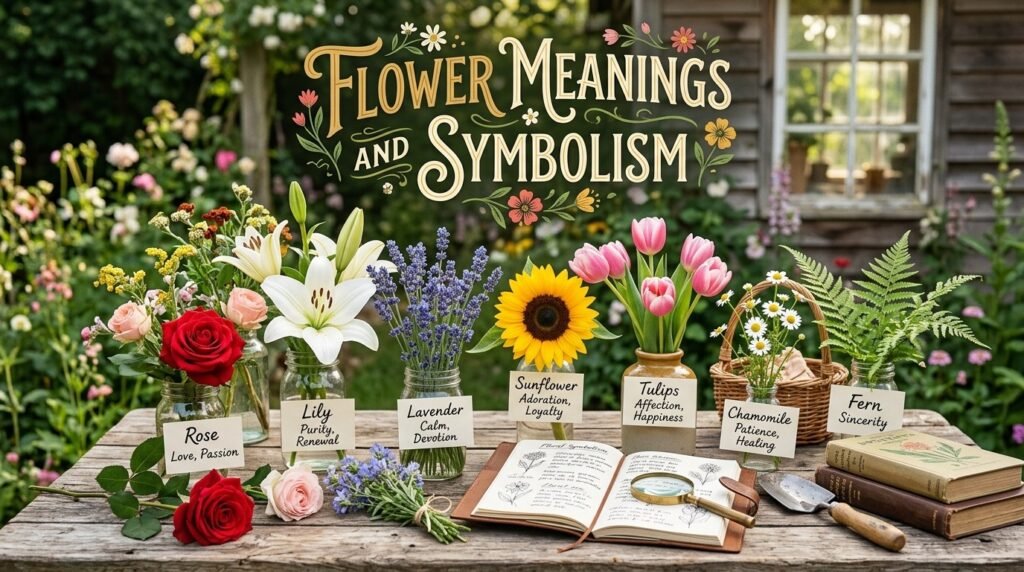
Impatiens carries a gentler meaning tied to its own name, since impatiens seed pods burst open at the lightest touch. Gardeners often link this trait to themes of excitement or eagerness for what comes next. Indian Pink, meanwhile, holds deep meaning in Native American plant traditions, where it was valued as a careful, respected medicine.
Morning Glory adds another layer of symbolism through its short daily bloom. Each flower opens at dawn and closes by afternoon, so many cultures link it to fleeting love or a single unforgettable day. Peruvian Lily, by contrast, is often given as a symbol of friendship, since its layered petals were once said to represent devotion between friends.
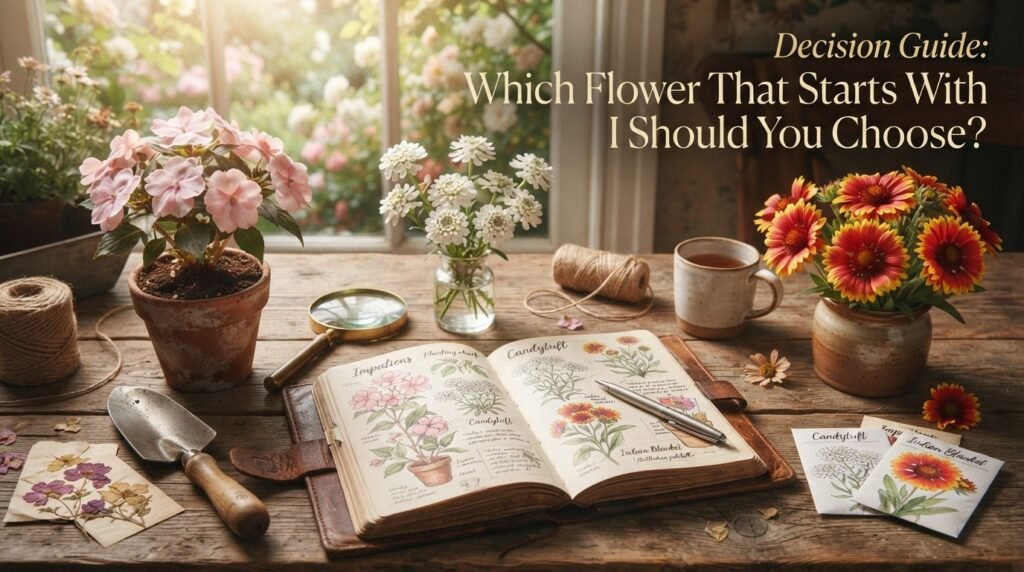
Decision Guide: Which Flower That Starts With I Should You Choose?
Choosing the right flower often comes down to where it will grow and who will be near it. The table below matches common situations to a flower pick from this list, along with a short reason for the match. Use it as a starting point, then check the full comparison table above for growing details.
| Your Situation | Recommended Flower | Why It Fits |
| Shady garden bed | Indian Pink | Thrives in partial shade, draws hummingbirds |
| Sunny dry border | Indian Blanket | Drought-tough with long bloom time |
| Indoor bright window | Impatiens | Blooms indoors with minimal care |
| Cut flower bouquet | Peruvian Lily | Long vase life, wide color choice |
| Native pollinator bed | Ironweed | Feeds monarchs through late summer |
| Household with pets | Ironweed | Non-toxic and pollinator-friendly |
| Rock garden | Candytuft | Compact, spreading, low maintenance |
| Fence or trellis cover | Morning Glory | Fast-climbing vine, quick coverage |
Notice how Indian Pink appears twice in this guide, once for shade and once in the caution section above. That is not a contradiction, since a plant can be both garden-worthy and toxic if eaten. The same logic applies to Impala Lily, a striking indoor pick that still needs careful, gloved handling.
Conclusion
Flowers that start with I range from tall garden Iris to tiny rare bulbs and rare wildflowers. This guide covered 25 of them, with real botanical names, native range, and toxicity for each. Whether you want a shady perennial, a florist favorite, or a safe pick for pets, there is an I-flower here to fit. Keep this guide handy the next time you plan a new bed or bouquet.
Frequently Asked Questions
What are some common flowers that start with I? Iris, Impatiens, Ice Plant, and Iceland Poppy are the most common picks. All four are widely sold at garden centers. Iris remains the single most recognized name on this list.
How many flowers that start with I are covered in this guide? This guide covers 25 verified flowers starting with I. They range from tall perennials to tiny rare bulbs. Many share the genus Iris, while others come from entirely different plant families.
Which flowers that start with I are toxic to pets?
Italian Arum, Indian Turnip, Indian Pink, and Impala Lily all carry a real toxicity risk. Keep these away from dogs and cats. Bearded Iris rhizomes are also mildly toxic if chewed.
Is Iris safe to plant around children?
Iris rhizomes are mildly toxic if eaten in large amounts. Most children will not eat enough to cause serious harm. Even so, it is wise to discourage tasting any garden plant.
Which I-flower blooms the longest?
Impatiens blooms from spring until the first frost with steady care. Indian Blanket comes close behind it with a long summer bloom window. Both need regular water to keep flowering that long.
What is the tallest flower that starts with I?
Ironweed often reaches five to seven feet tall in good soil. Bearded Iris and Wild Blue Indigo both grow shorter, closer to three feet. Ironweed suits the back row of a border.
Can I grow flowers that start with I indoors?
Yes, Impatiens, Impala Lily, and Ixora all adapt well to bright indoor rooms. Bright, indirect light suits most of them. Impatiens needs the warmest, sunniest spot of the three.