

Flowers that start with B form one of the largest and most varied groups in the entire alphabet. This guide brings together 100 real flowers, from the delicate Baby’s Breath to the bold Bird of Paradise. Each entry includes a checked botanical name, native range, bloom time, and toxicity note. Whether you garden, arrange bouquets, or just love plant names, this list has something new on nearly every line.
- Quick Answer: Top Flowers That Start With B
- Master Alphabetical List of Flowers That Start With B
- Full Comparison Table of Flowers That Start With B
- Garden Favorites Among Flowers That Start With B
- Indoor Plants Among Flowers That Start With B
- Florist Favorites Among Flowers That Start With B
- Rare Flowers That Start With B
- Flowers That Start With B and Need Caution
- Color-Based Groupings of Flowers That Start With B
- Life-Cycle Groupings of Flowers That Start With B
- Botanical Name Crosswalk for Flowers That Start With B
- Flower Meanings and Symbolism
- Decision Guide: Which Flower That Starts With B Should You Choose?
- Conclusion
- Frequently Asked Questions
This article is built for several kinds of readers at once. A home gardener can use it to fill a bed with reliable, colorful choices. A florist can use it to find fresh B-letter stems for a bouquet. A parent or pet owner can use it to spot risky plants like Bleeding Heart or Baneberry. A curious plant lover can simply enjoy how wide this one letter’s range turns out to be.
The flowers below are organized in several useful ways. A master alphabetical list comes first, followed by a full comparison table covering all 100 entries. After that come category sections for garden favorites, indoor plants, florist picks, rare finds, and toxic plants, each with real photo captions built in. Color groups and life-cycle groups follow near the end, before a full FAQ section.
Quick Answer: Top Flowers That Start With B
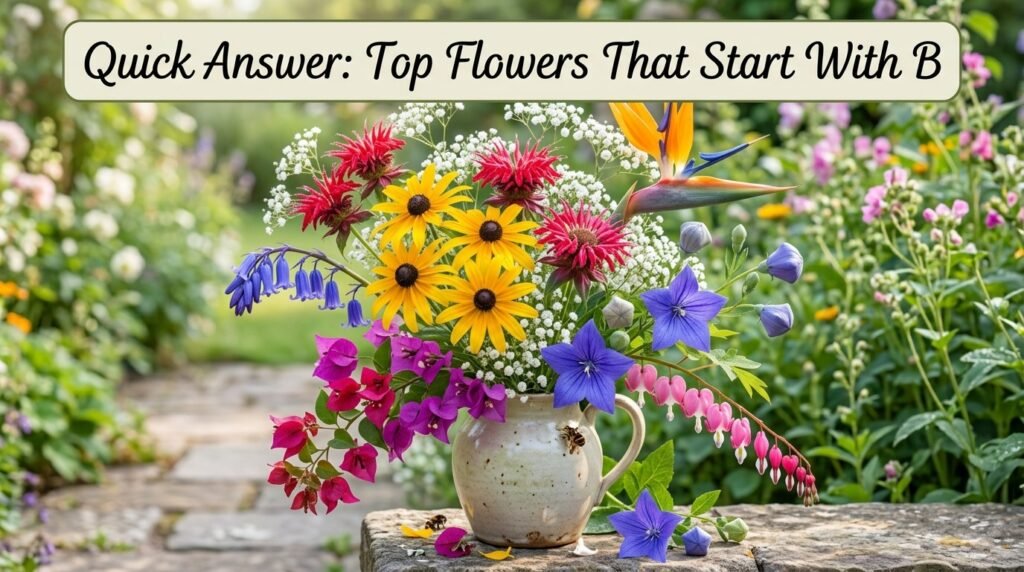
If you only remember a few names, start here. Black-Eyed Susan is a garden classic, prized for cheerful yellow petals and tough, easy care. Bee Balm draws hummingbirds and bees all summer with its shaggy red or pink blooms. Baby’s Breath remains the top filler flower in florist bouquets worldwide. Bird of Paradise brings a bold, tropical shape that few other flowers can match. Bluebell carpets shaded woodlands across Western Europe each spring. Bougainvillea covers walls and fences in vivid papery color through warm months. Balloon Flower earns its name from puffed buds that pop open into star-shaped blooms. Bleeding Heart rounds out the list as a shade-garden favorite, though every part of it is toxic.
Master Alphabetical List of Flowers That Start With B
Some flowers here start with B in their common name, like Bluebell or Butterfly Bush. Others start with B only through a botanical or genus name, like Bomarea or Brunnera. Both types appear below, since most searches for this topic mix common and botanical names.
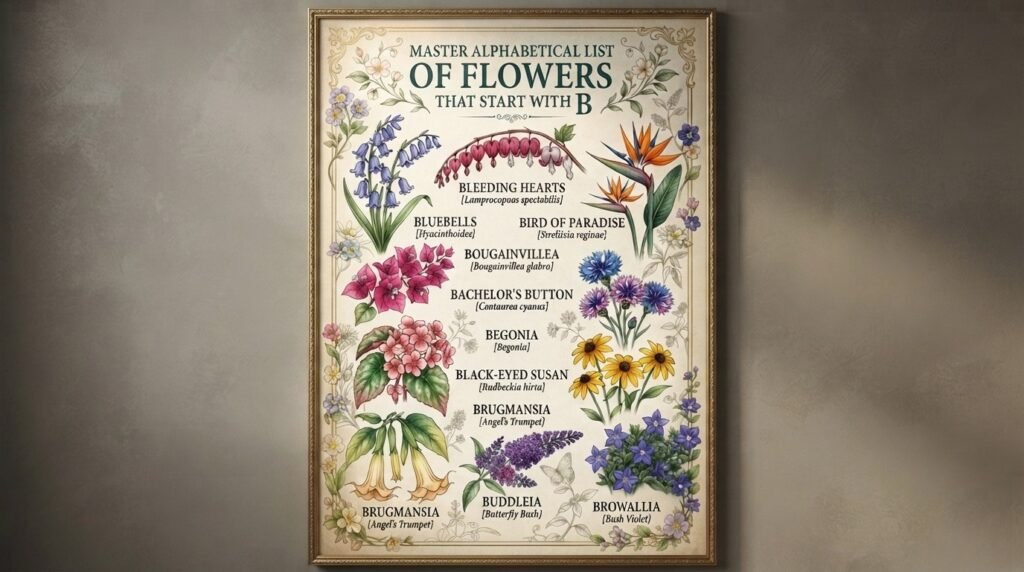
- Baby’s Breath (Gypsophila paniculata)
- Bachelor’s Button (Centaurea cyanus)
- Balloon Flower (Platycodon grandiflorus)
- Bee Balm (Monarda didyma)
- Wax Begonia (Begonia semperflorens)
- Bellflower (Campanula rotundifolia)
- Bird of Paradise (Strelitzia reginae)
- Black-Eyed Susan (Rudbeckia hirta)
- Bleeding Heart (Lamprocapnos spectabilis)
- Bluebell (Hyacinthoides non-scripta)
- Bougainvillea (Bougainvillea glabra)
- Blanket Flower (Gaillardia aristata)
- Butterfly Bush (Buddleja davidii)
- Butterfly Weed (Asclepias tuberosa)
- Buttercup (Ranunculus acris)
- Baby Blue Eyes (Nemophila menziesii)
- Balsam (Impatiens balsamina)
- Busy Lizzie (Impatiens walleriana)
- Wild Bergamot (Monarda fistulosa)
- Bishop’s Flower (Ammi majus)
- Bittersweet Nightshade (Solanum dulcamara)
- Black Cohosh (Actaea racemosa)
- Blazing Star (Liatris spicata)
- Blue Star (Amsonia tabernaemontana)
- Blue Flax (Linum lewisii)
- Plume Poppy (Bocconia frutescens)
- Borage (Borago officinalis)
- Bottlebrush (Callistemon citrinus)
- Bouvardia (Bouvardia longiflora)
- Brazilian Verbena (Verbena bonariensis)
- Bridal Wreath (Spiraea prunifolia)
- Scotch Broom (Cytisus scoparius)
- Siberian Bugloss (Brunnera macrophylla)
- Bugleweed (Ajuga reptans)
- Butter and Eggs (Linaria vulgaris)
- Buttonbush (Cephalanthus occidentalis)
- Baby Sun Rose (Aptenia cordifolia)
- Bells of Ireland (Moluccella laevis)
- Bindweed (Convolvulus arvensis)
- Bird’s Eye Primrose (Primula farinosa)
- Blood Flower (Asclepias curassavica)
- Blue Lace Flower (Trachymene coerulea)
- Blue Passionflower (Passiflora caerulea)
- Bluebonnet (Lupinus texensis)
- Blue-Eyed Grass (Sisyrinchium angustifolium)
- Himalayan Blue Poppy (Meconopsis betonicifolia)
- Bomarea (Bomarea multiflora)
- Boneset (Eupatorium perfoliatum)
- Bottle Gentian (Gentiana andrewsii)
- Bower Vine (Pandorea jasminoides)
- Brodiaea (Brodiaea elegans)
- Bromeliad (Guzmania lingulata)
- Brown-Eyed Susan (Rudbeckia triloba)
- Bulbine (Bulbine frutescens)
- Bunchberry (Cornus canadensis)
- Great Burnet (Sanguisorba officinalis)
- Butter Daisy (Melampodium divaricatum)
- Butterfly Iris (Dietes iridioides)
- Bat-Faced Cuphea (Cuphea llavea)
- Beach Sunflower (Helianthus debilis)
- Bear’s Breeches (Acanthus mollis)
- Bee Orchid (Ophrys apifera)
- Bellwort (Uvularia grandiflora)
- Wood Betony (Stachys officinalis)
- Golden Bidens (Bidens ferulifolia)
- Black-Eyed Susan Vine (Thunbergia alata)
- Blue Marguerite (Felicia amelloides)
- Blue Sage (Salvia farinacea)
- Bog Rosemary (Andromeda polifolia)
- Bottlebrush Buckeye (Aesculus parviflora)
- Boronia (Boronia megastigma)
- Bouncing Bet (Saponaria officinalis)
- Brazilian Fireworks (Porphyrocoma pohliana)
- Brompton Stock (Matthiola incana)
- Bulbous Buttercup (Ranunculus bulbosus)
- Button Snakeroot (Eryngium yuccifolium)
- Byzantine Gladiolus (Gladiolus communis subsp. byzantinus)
- Bletilla (Bletilla striata)
- Baneberry (Actaea rubra)
- Bloodroot (Sanguinaria canadensis)
- Barberton Daisy (Gerbera jamesonii)
- Basket Flower (Centaurea americana)
- Beach Morning Glory (Ipomoea pes-caprae)
- Bristly Locust (Robinia hispida)
- Broad-Leaved Bellflower (Campanula latifolia)
- Bugbane (Actaea simplex)
- Bush Violet (Browallia speciosa)
- Butterfly Ginger (Hedychium coronarium)
- Baboon Flower (Babiana stricta)
- Barrenwort (Epimedium grandiflorum)
- Common Bugloss (Anchusa officinalis)
- Blue Throatwort (Trachelium caeruleum)
- Bird’s Foot Trefoil (Lotus corniculatus)
- Beardtongue (Penstemon barbatus)
- Blue Sea Holly (Eryngium planum)
- Beauty Bush (Kolkwitzia amabilis)
- Bunny Tails (Lagurus ovatus)
- Bracted Honeysuckle (Lonicera involucrata)
- Beggar’s Tick (Bidens alba)
- Bergenia (Bergenia crassifolia)
That is a full 100 flowers, one of the largest lists in this entire alphabet series. Notice how many entries share a small handful of large genera, including Campanula, Rudbeckia, and Bidens, since each one branches into several distinct common names.
Full Comparison Table of Flowers That Start With B
The table below lines up six key facts for each of the 100 flowers on this list. Native range shows where a plant grows wild, which helps you judge if your climate will suit it. Bloom season and USDA zone guide planting timing, while the toxicity column flags any risk to people or pets.
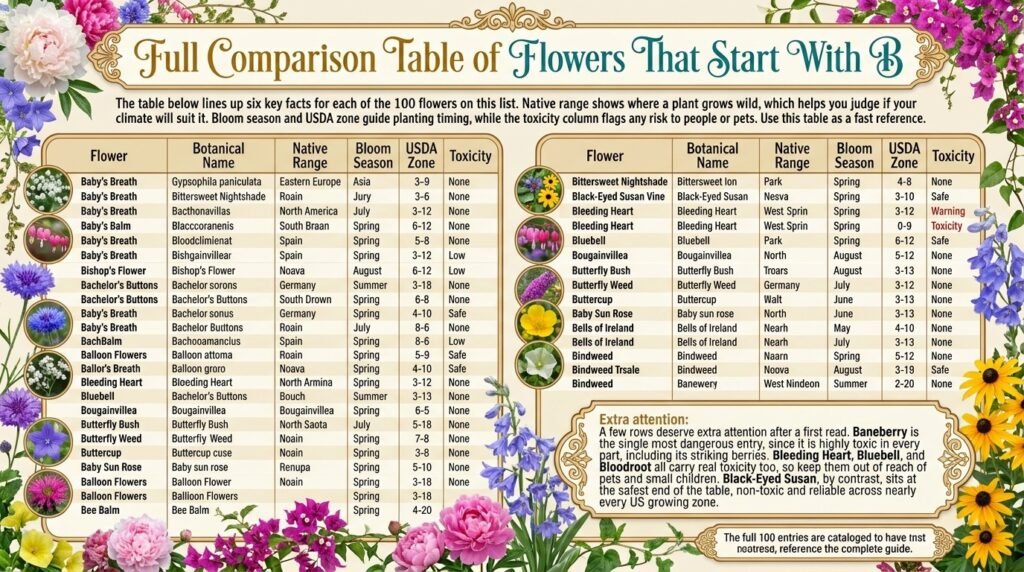
| Flower | Botanical Name | Native Range | Bloom Season | USDA Zone | Toxicity |
| Baby’s Breath | Gypsophila paniculata | Eastern Europe, Asia | Summer | 3–9 | Mild; toxic if eaten |
| Bachelor’s Button | Centaurea cyanus | Europe | Summer | 2–11, annual | Non-toxic |
| Balloon Flower | Platycodon grandiflorus | East Asia | Summer | 3–8 | Mild, toxic if eaten |
| Bee Balm | Monarda didyma | Eastern North America | Summer | 4–9 | Non-toxic |
| Wax Begonia | Begonia semperflorens | Brazil | Spring to frost | 10–11, annual | Mild, toxic to pets |
| Bellflower | Campanula rotundifolia | Europe, North America | Summer | 3–7 | Non-toxic |
| Bird of Paradise | Strelitzia reginae | South Africa | Spring to summer | 9–11 | Mild, toxic if eaten |
| Black-Eyed Susan | Rudbeckia hirta | North America | Summer to fall | 3–9 | Non-toxic |
| Bleeding Heart | Lamprocapnos spectabilis | China, Japan, Korea | Spring | 3–9 | Toxic, all parts |
| Bluebell | Hyacinthoides non-scripta | Western Europe | Spring | 4–9 | Toxic, all parts |
| Bougainvillea | Bougainvillea glabra | South America | Spring to fall | 9–11 | Mild, sap irritant |
| Blanket Flower | Gaillardia aristata | North America | Summer to fall | 3–10 | Non-toxic |
| Butterfly Bush | Buddleja davidii | China | Summer to fall | 5–9 | Non-toxic |
| Butterfly Weed | Asclepias tuberosa | North America | Summer | 3–9 | Mild toxic |
| Buttercup | Ranunculus acris | Europe, Asia | Spring to summer | 3–7 | Toxic |
| Baby Blue Eyes | Nemophila menziesii | California, United States | Spring | 2–11, annual | Non-toxic |
| Balsam | Impatiens balsamina | South Asia | Summer | Annual, all zones | Non-toxic |
| Busy Lizzie | Impatiens walleriana | East Africa | Spring to frost | 10–11, annual | Non-toxic |
| Wild Bergamot | Monarda fistulosa | North America | Summer | 3–9 | Non-toxic |
| Bishop’s Flower | Ammi majus | Mediterranean | Summer | 7–10, annual | Mild, photosensitizing |
| Bittersweet Nightshade | Solanum dulcamara | Europe, Asia | Summer | 4–8 | Toxic |
| Black Cohosh | Actaea racemosa | Eastern North America | Summer | 3–8 | Toxic |
| Blazing Star | Liatris spicata | Eastern North America | Summer to fall | 3–9 | Non-toxic |
| Blue Star | Amsonia tabernaemontana | Eastern United States | Late spring | 3–9 | Mild, sap irritant |
| Blue Flax | Linum lewisii | Western North America | Late spring | 4–9 | Non-toxic |
| Plume Poppy | Bocconia frutescens | Central and South America | Summer | 9–11 | Toxic sap |
| Borage | Borago officinalis | Mediterranean | Summer | 2–11, annual | Non-toxic, edible |
| Bottlebrush | Callistemon citrinus | Australia | Spring to summer | 8–11 | Non-toxic |
| Bouvardia | Bouvardia longiflora | Mexico | Summer to fall | 9–11 | Non-toxic |
| Brazilian Verbena | Verbena bonariensis | South America | Summer to frost | 7–11 | Non-toxic |
| Bridal Wreath | Spiraea prunifolia | China | Spring | 4–8 | Non-toxic |
| Scotch Broom | Cytisus scoparius | Western Europe | Spring | 5–8 | Toxic |
| Siberian Bugloss | Brunnera macrophylla | Caucasus, Western Asia | Spring | 3–8 | Non-toxic |
| Bugleweed | Ajuga reptans | Europe | Spring | 3–9 | Mild toxic |
| Butter and Eggs | Linaria vulgaris | Europe, Asia | Summer | 3–9 | Mild, toxic in quantity |
| Buttonbush | Cephalanthus occidentalis | North America | Summer | 5–9 | Mild toxic |
| Baby Sun Rose | Aptenia cordifolia | South Africa | Summer | 9–11 | Non-toxic |
| Bells of Ireland | Moluccella laevis | Western Asia | Summer | 2–11, annual | Non-toxic |
| Bindweed | Convolvulus arvensis | Europe, Asia | Summer | 3–9 | Mild toxic |
| Bird’s Eye Primrose | Primula farinosa | Europe | Spring | 3–7 | Non-toxic |
| Blood Flower | Asclepias curassavica | South America | Summer to fall | 8–11 | Toxic |
| Blue Lace Flower | Trachymene coerulea | Australia | Summer | 9–11, annual | Non-toxic |
| Blue Passionflower | Passiflora caerulea | South America | Summer to fall | 6–9 | Mild toxic |
| Bluebonnet | Lupinus texensis | Texas, United States | Spring | 3–9, annual | Toxic |
| Blue-Eyed Grass | Sisyrinchium angustifolium | North America | Late spring | 4–9 | Non-toxic |
| Himalayan Blue Poppy | Meconopsis betonicifolia | Himalayas, China | Early summer | 6–8 | Mild toxic |
| Bomarea | Bomarea multiflora | Andes region | Summer | 9–11 | Non-toxic |
| Boneset | Eupatorium perfoliatum | Eastern North America | Late summer | 3–8 | Mild toxic |
| Bottle Gentian | Gentiana andrewsii | Eastern North America | Late summer to fall | 3–7 | Non-toxic |
| Bower Vine | Pandorea jasminoides | Australia | Summer | 9–11 | Non-toxic |
| Brodiaea | Brodiaea elegans | Western North America | Late spring | 6–9 | Non-toxic |
| Bromeliad | Guzmania lingulata | Tropical Americas | Year-round indoors | 10–12 | Non-toxic |
| Brown-Eyed Susan | Rudbeckia triloba | Eastern North America | Summer to fall | 3–8 | Non-toxic |
| Bulbine | Bulbine frutescens | South Africa | Spring to fall | 9–11 | Non-toxic |
| Bunchberry | Cornus canadensis | North America | Late spring | 2–7 | Non-toxic |
| Great Burnet | Sanguisorba officinalis | Europe, Asia | Summer | 4–8 | Non-toxic |
| Butter Daisy | Melampodium divaricatum | Mexico, Central America | Summer to frost | 2–11, annual | Non-toxic |
| Butterfly Iris | Dietes iridioides | South Africa | Spring to fall | 8–11 | Non-toxic |
| Bat-Faced Cuphea | Cuphea llavea | Mexico | Summer to frost | 8–11, annual | Non-toxic |
| Beach Sunflower | Helianthus debilis | Southeastern United States | Summer to fall | 8–11 | Non-toxic |
| Bear’s Breeches | Acanthus mollis | Mediterranean | Summer | 7–10 | Non-toxic |
| Bee Orchid | Ophrys apifera | Europe | Late spring | 6–9 | Non-toxic |
| Bellwort | Uvularia grandiflora | Eastern North America | Mid spring | 3–9 | Non-toxic |
| Wood Betony | Stachys officinalis | Europe | Summer | 4–8 | Non-toxic |
| Golden Bidens | Bidens ferulifolia | Mexico, Southwestern United States | Summer to frost | 8–11, annual | Non-toxic |
| Black-Eyed Susan Vine | Thunbergia alata | Eastern Africa | Summer to fall | 9–11, annual | Mild toxic |
| Blue Marguerite | Felicia amelloides | South Africa | Spring to fall | 9–11, annual | Non-toxic |
| Blue Sage | Salvia farinacea | Mexico, Texas | Summer to fall | 8–10, annual | Non-toxic |
| Bog Rosemary | Andromeda polifolia | Northern Hemisphere, boreal | Spring | 2–6 | Toxic |
| Bottlebrush Buckeye | Aesculus parviflora | Southeastern United States | Summer | 4–8 | Toxic |
| Boronia | Boronia megastigma | Australia | Winter to spring | 9–11 | Mild toxic |
| Bouncing Bet | Saponaria officinalis | Europe | Summer | 3–8 | Mild toxic |
| Brazilian Fireworks | Porphyrocoma pohliana | Brazil | Fall to winter | 9–11 | Non-toxic |
| Brompton Stock | Matthiola incana | Southern Europe | Spring | 7–10, biennial | Non-toxic |
| Bulbous Buttercup | Ranunculus bulbosus | Europe | Spring | 4–8 | Toxic |
| Button Snakeroot | Eryngium yuccifolium | Central and Eastern United States | Summer | 4–9 | Non-toxic |
| Byzantine Gladiolus | Gladiolus communis subsp. byzantinus | Mediterranean | Late spring | 6–9 | Mild toxic |
| Bletilla | Bletilla striata | China, Japan | Late spring | 5–9 | Non-toxic |
| Baneberry | Actaea rubra | North America | Late spring | 3–7 | Highly toxic |
| Bloodroot | Sanguinaria canadensis | Eastern North America | Early spring | 3–8 | Toxic |
| Barberton Daisy | Gerbera jamesonii | South Africa | Spring to fall | 8–11, annual | Non-toxic |
| Basket Flower | Centaurea americana | Central United States, Mexico | Summer | 3–9, annual | Non-toxic |
| Beach Morning Glory | Ipomoea pes-caprae | Pantropical coastlines | Summer to fall | 9–11 | Mild toxic |
| Bristly Locust | Robinia hispida | Southeastern United States | Late spring | 6–9 | Toxic seeds |
| Broad-Leaved Bellflower | Campanula latifolia | Europe | Summer | 4–8 | Non-toxic |
| Bugbane | Actaea simplex | Asia | Fall | 3–8 | Toxic |
| Bush Violet | Browallia speciosa | South America | Summer to frost | 10–11, annual | Non-toxic |
| Butterfly Ginger | Hedychium coronarium | South and Southeast Asia | Summer to fall | 8–11 | Non-toxic |
| Baboon Flower | Babiana stricta | South Africa | Spring | 8–10 | Non-toxic |
| Barrenwort | Epimedium grandiflorum | East Asia | Spring | 4–8 | Non-toxic |
| Common Bugloss | Anchusa officinalis | Europe | Summer | 4–8 | Mild toxic |
| Blue Throatwort | Trachelium caeruleum | Mediterranean | Summer | 8–10, annual | Non-toxic |
| Bird’s Foot Trefoil | Lotus corniculatus | Europe, Asia | Summer | 3–8 | Mild toxic |
| Beardtongue | Penstemon barbatus | Southwestern United States, Mexico | Summer | 4–8 | Non-toxic |
| Blue Sea Holly | Eryngium planum | Europe, Asia | Summer | 4–9 | Non-toxic |
| Beauty Bush | Kolkwitzia amabilis | China | Late spring | 4–8 | Non-toxic |
| Bunny Tails | Lagurus ovatus | Mediterranean | Summer | 8–11, annual | Non-toxic |
| Bracted Honeysuckle | Lonicera involucrata | Western North America | Spring | 4–8 | Mild, toxic berries |
| Beggar’s Tick | Bidens alba | North and Central America | Summer to fall | 8–11 | Non-toxic |
| Bergenia | Bergenia crassifolia | Siberia, Mongolia | Spring | 3–8 | Mild toxic |
Garden Favorites Among Flowers That Start With B
Garden favorites are the flowers gardeners plant season after season without fail. Black-Eyed Susan leads this group, since it blooms for months and tolerates poor soil with ease. Bee Balm draws hummingbirds and bees from the moment its shaggy blooms open each summer. Blanket Flower brings hot red-and-yellow rings to dry, sunny beds with almost no upkeep. Butterfly Bush rounds things out as a shrub that pulls in butterflies from across the yard.
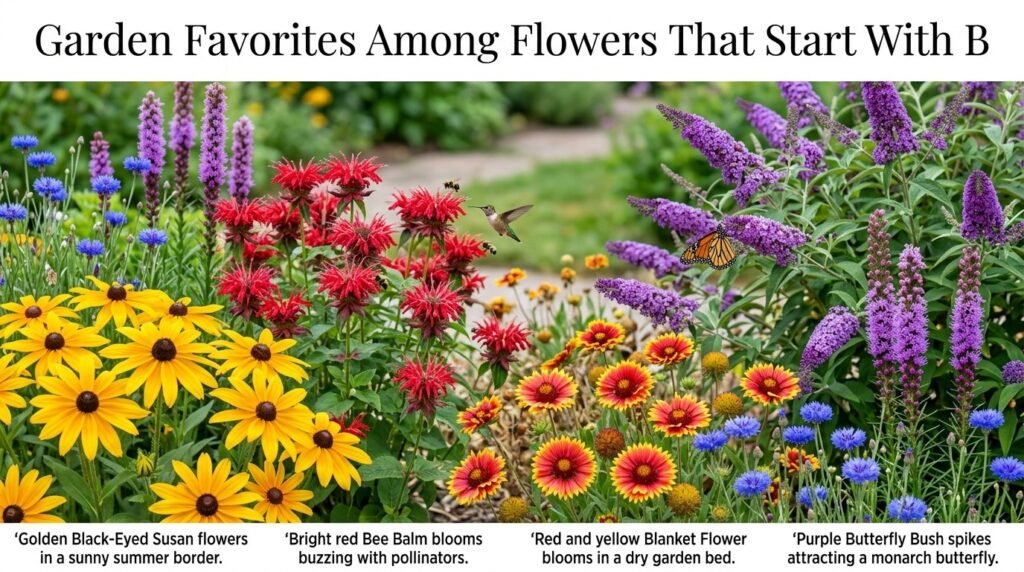
Black-Eyed Susan (Rudbeckia hirta) opens into golden-yellow petals around a dark brown center from midsummer into fall. It self-seeds easily, often returning without any replanting. Image caption: Golden Black-Eyed Susan flowers in a sunny summer border.
Bee Balm (Monarda didyma) sends up shaggy, tubular red or pink flowers that hummingbirds visit constantly. Its crushed leaves release a strong, minty scent similar to bergamot. Image caption: Bright red Bee Balm blooms buzzing with pollinators.
Blanket Flower (Gaillardia aristata) blooms in fiery red-and-yellow rings that keep flowering through summer heat. It handles drought and poor soil better than most border perennials. Image caption: Red and yellow Blanket Flower blooms in a dry garden bed.
Butterfly Bush (Buddleja davidii) grows into a large shrub covered in long, cone-shaped purple flower spikes. Butterflies and bees swarm it from midsummer through the first fall frost. Image caption: Purple Butterfly Bush spikes attracting a monarch butterfly.
Indoor Plants Among Flowers That Start With B
Indoor flowers need to handle lower light and steady room temperatures. Wax Begonia is a strong choice, since its glossy leaves and small blooms thrive in a bright but shaded spot. Bird of Paradise makes a dramatic statement plant, with tropical orange-and-blue blooms shaped like a bird’s crest. Bromeliad adds long-lasting color from a rosette of leaves that needs very little watering. Bletilla, a hardy ground orchid, rounds out the group with a surprisingly easy indoor bloom.
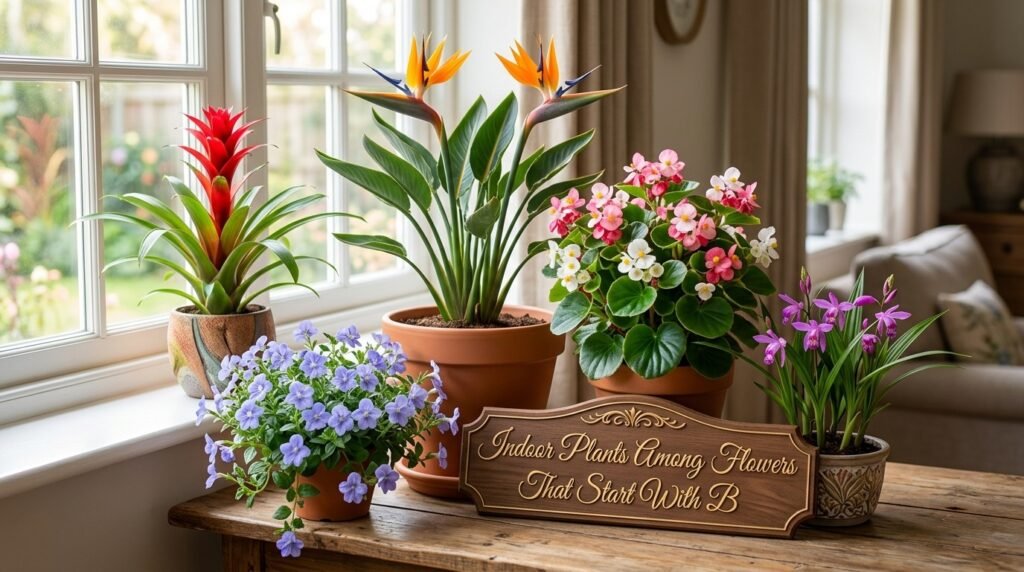
Wax Begonia (Begonia semperflorens) produces small red, pink, or white flowers above glossy, rounded leaves nearly year-round. It tolerates both bright and partly shaded indoor spots well. Image caption: Pink Wax Begonia blooms above glossy green leaves.
Bird of Paradise (Strelitzia reginae) forms a bold, upright plant topped with orange-and-blue crane-shaped flowers. It needs a large pot and several years to reach flowering size indoors. Image caption: Orange and blue Bird of Paradise flower in a bright room.
Bromeliad (Guzmania lingulata) holds a bright red or orange flower spike at its center for weeks at a time. It needs very little soil, since it draws much of its water through its leaves. Image caption: Red Bromeliad flower spike on a windowsill.
- Wax Begonia — glossy leaves, small blooms nearly year-round
- Bird of Paradise — dramatic tropical statement plant
- Bromeliad — long-lasting color, low watering needs
- Bush Violet — soft blue-purple blooms for a shaded room
- Bletilla — surprisingly hardy ground orchid for a bright pot
Bird of Paradise and Bletilla both reward patience, since neither blooms quickly from a young plant. Wax Begonia and Bush Violet are far more forgiving, flowering within weeks of planting. Bromeliad remains the lowest-maintenance of the group, tolerating real neglect between waterings.
Florist Favorites Among Flowers That Start With B
Florists choose flowers for strong stems, long vase life, and dependable color. Baby’s Breath is the most widely used filler flower in the entire cut-flower industry. Balloon Flower adds an unusual puffed bud stage that opens into a star-shaped bloom in the vase. Bouvardia offers clustered white or pink blooms often used in wedding bouquets. Barberton Daisy, better known as Gerbera Daisy, brings some of the boldest, cleanest color of any cut flower.
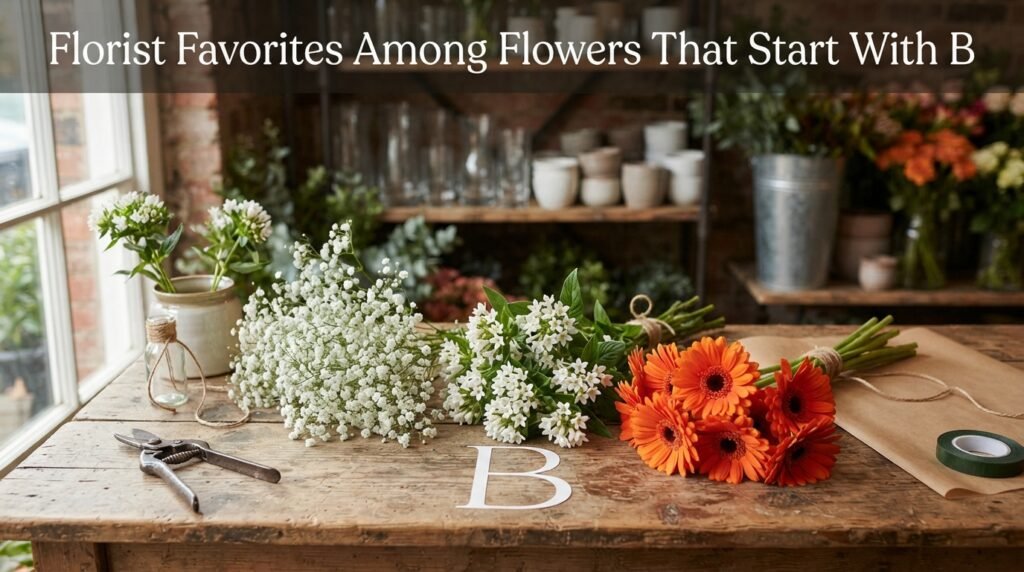
Baby’s Breath (Gypsophila paniculata) produces a cloud of tiny white flowers on thin, branching stems. Florists use it to soften and fill space around larger focal blooms. Image caption: A cloud of tiny white Baby’s Breath flowers.
Bouvardia (Bouvardia longiflora) grows in clusters of small, star-shaped, fragrant white or pink flowers. It remains a popular choice for bridal bouquets due to its soft color and scent. Image caption: Clustered white Bouvardia flowers in a bridal bouquet.
Barberton Daisy (Gerbera jamesonii) opens into large, flat blooms in nearly every bright color available. Its long, sturdy stems make it one of the easiest daisies to arrange. Image caption: Bold orange Barberton Daisy flower in a vase.
- Baby’s Breath — classic filler flower for nearly any bouquet
- Balloon Flower — puffed buds that open into star shapes
- Bouvardia — fragrant clusters favored for weddings
- Barberton Daisy — bold, flat blooms in bright colors
- Bells of Ireland — unusual green bell-shaped spikes for texture
Baby’s Breath and Bells of Ireland both work as supporting players, adding texture rather than a focal point. Bouvardia and Barberton Daisy instead take center stage in most arrangements. Balloon Flower sits between the two, useful both as an accent and a quiet focal bloom.
Rare Flowers That Start With B
A handful of B-flowers rarely show up outside specialist growers or native plant sales. Himalayan Blue Poppy is famous among gardeners for its true-blue color and its reputation as difficult to grow outside cool, damp climates. Baboon Flower is a South African bulb sold mostly through specialty catalogs, prized for unusual purple-blue blooms. Blue Throatwort remains uncommon in home gardens despite its cloud of small, star-shaped purple flowers. Bergenia is easy to overlook until its pink spring blooms rise above thick, leathery leaves.
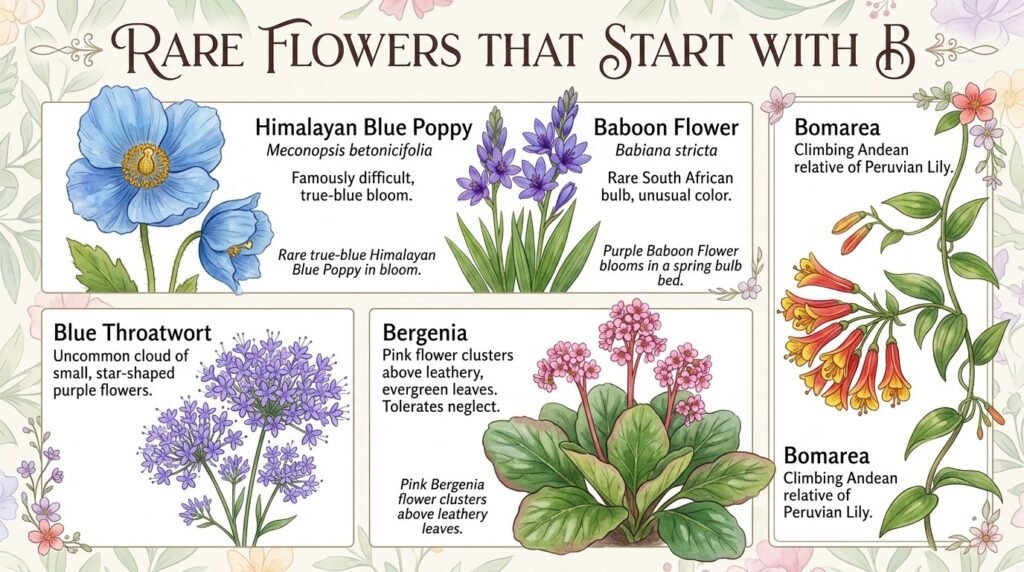
Himalayan Blue Poppy (Meconopsis betonicifolia) produces papery, true-blue petals around a golden center in early summer. It needs cool, moist, acidic soil that is hard to replicate outside its native range. Image caption: Rare true-blue Himalayan Blue Poppy in bloom.
Baboon Flower (Babiana stricta) sends up short spikes of purple, blue, or red flowers from a small South African bulb. Its common name comes from baboons that were once seen digging up the corms to eat. Image caption: Purple Baboon Flower blooms in a spring bulb bed.
Bergenia (Bergenia crassifolia) holds thick, leathery leaves year-round and pink flower clusters each spring. It tolerates cold winters better than most other flowering ground covers. Image caption: Pink Bergenia flower clusters above leathery leaves.
- Himalayan Blue Poppy — famously difficult true-blue bloom
- Baboon Flower — rare South African bulb, unusual color
- Blue Throatwort — uncommon cloud of small purple stars
- Bomarea — climbing Andean relative of Peruvian Lily
- Bracted Honeysuckle — rare native shrub with dark berries
Himalayan Blue Poppy and Baboon Flower both demand very specific growing conditions that most home gardens cannot easily provide. Blue Throatwort and Bomarea instead simply remain hard to find, rather than hard to grow. Bergenia is the most forgiving of the group, tolerating neglect far better than its rarity would suggest.
Flowers That Start With B and Need Caution
A meaningful group of B-flowers carries real toxicity risk, especially around kids and pets. Baneberry produces bright, eye-catching berries that are highly toxic if eaten in any amount.
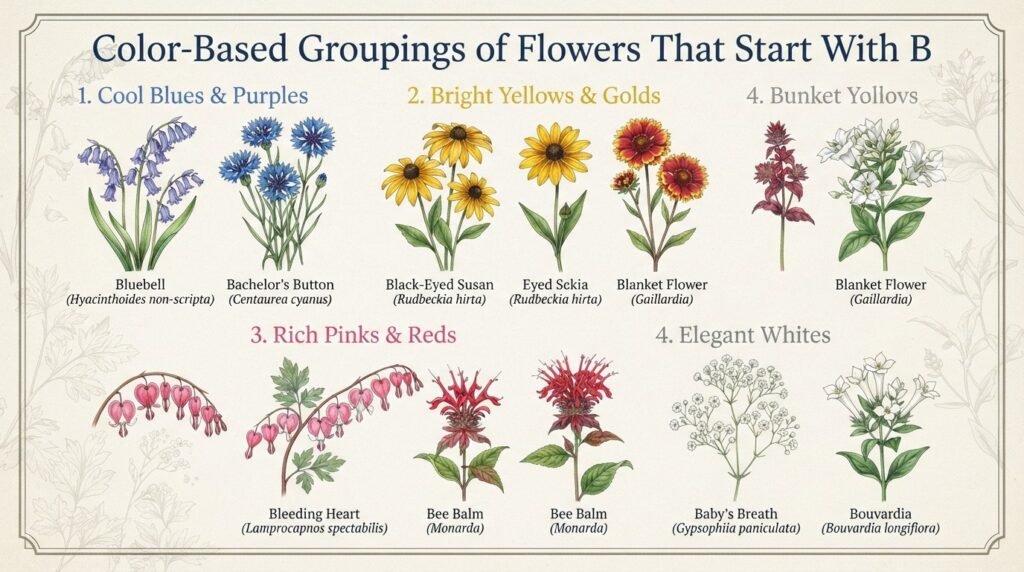
Bleeding Heart contains toxic alkaloids throughout the plant, most concentrated in the roots. Bluebell bulbs closely resemble edible alliums but carry real cardiac-affecting toxins instead. Bloodroot gets its name from a red sap that is toxic and can irritate skin on contact.
Baneberry (Actaea rubra) produces small white spring flowers followed by shiny red or white berries in summer. Every part of the plant, especially the berries, is highly toxic if eaten. Image caption: Bright red Baneberry berries on a woodland stem.
Bleeding Heart (Lamprocapnos spectabilis) forms rows of heart-shaped pink or white flowers along an arching stem each spring. The entire plant, especially the roots, is toxic if ingested. Image caption: Pink heart-shaped Bleeding Heart flowers on an arching stem.
Bluebell (Hyacinthoides non-scripta) carpets shaded woodlands with nodding, fragrant blue flowers each spring. Its bulb closely resembles an edible onion but is toxic if eaten. Image caption: Carpet of blue Bluebell flowers in a spring woodland.
- Baneberry — highly toxic berries; keep children and pets away
- Bleeding Heart — toxic alkaloids throughout, most concentrated in roots
- Bluebell — toxic bulb resembling edible alliums
- Bloodroot — toxic red sap, irritates skin on contact
- Bittersweet Nightshade — toxic berries, common in hedgerows
- Bog Rosemary — toxic nectar and foliage, grayanotoxin risk
Baneberry deserves the most caution here, since even a few berries can cause serious illness. Bleeding Heart and Bluebell both look harmless enough to tempt curious children or pets. Even so, all six of these are best kept out of reach in homes with toddlers or grazing animals nearby.
Color-Based Groupings of Flowers That Start With B
Grouping flowers by color helps with planning a themed bed or bouquet. Blue and purple tones dominate this letter more than almost any other. Bluebell, Bachelor’s Button, Blue Star, and Himalayan Blue Poppy all bring cool blue-purple shades that pair beautifully in a calm, layered border.
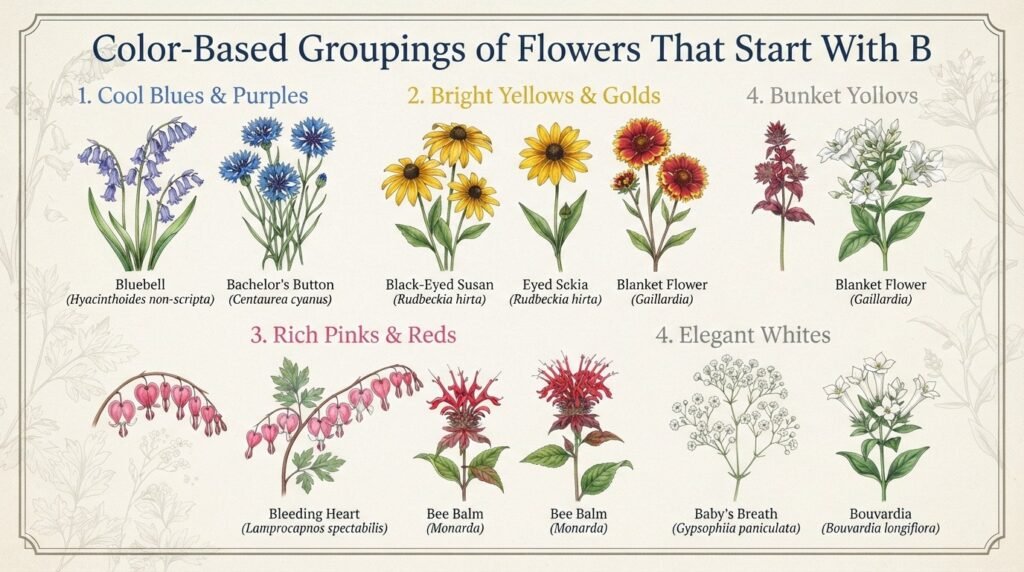
Yellow and gold flowers bring warmth and stand out from a distance. Black-Eyed Susan, Butter Daisy, and Blanket Flower all lean into bright gold and yellow tones, making them easy to spot from across a garden. These work well near a patio, where bold color reads clearly from a seated view.
Pink and red flowers suit romantic or high-energy garden themes equally well. Bee Balm and Blood Flower both bring fiery red tones that draw hummingbirds from a distance. Bleeding Heart softens that energy with a gentler pink, and Barberton Daisy adds a bold, flat red bloom nearby.
White flowers add calm, quiet contrast to any of the groups above. Baby’s Breath, Bells of Ireland, and Bird’s Eye Primrose all bring soft white or cream tones to a bed or bouquet. Bouvardia adds fragrance to this group, making it a favorite choice near patios and entryways.
Life-Cycle Groupings of Flowers That Start With B
Knowing a flower’s life cycle helps you plan how often to replant a bed. Annuals complete their life cycle in a single season, so they need fresh seeds or plants each year. Perennials return from the same roots for years, while bulbs store energy underground between bloom cycles. Shrubs and woody vines take the longest to establish but reward patience with repeat yearly blooms.
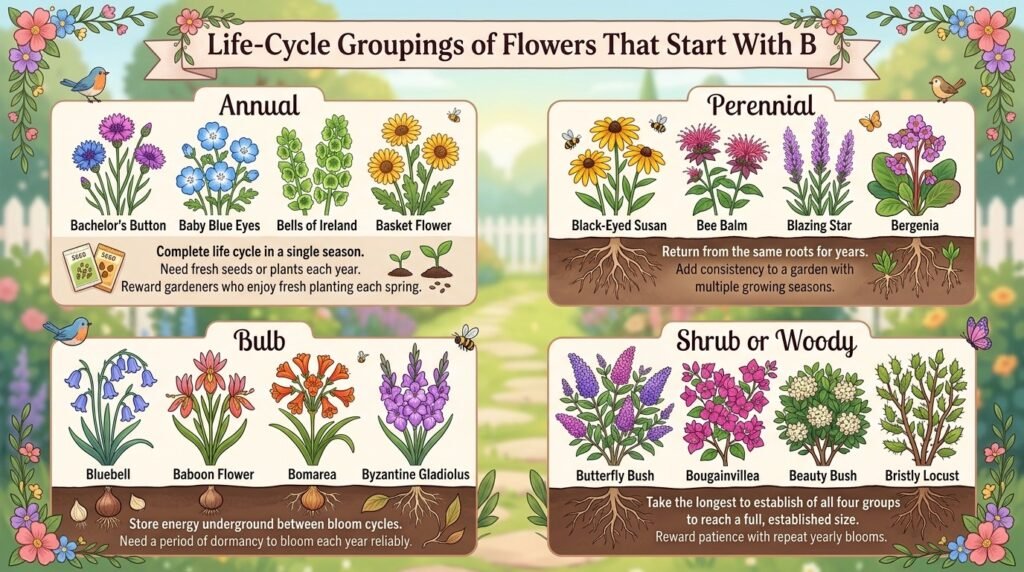
| Life Cycle Type | Example Flowers |
| Annual | Bachelor’s Button, Baby Blue Eyes, Bells of Ireland, Basket Flower |
| Perennial | Black-Eyed Susan, Bee Balm, Blazing Star, Bergenia |
| Bulb | Bluebell, Baboon Flower, Bomarea, Byzantine Gladiolus |
| Shrub or Woody | Butterfly Bush, Bougainvillea, Beauty Bush, Bristly Locust |
Annuals like Bachelor’s Button and Basket Flower reward gardeners who enjoy fresh planting each spring. Bulb types such as Bluebell and Bomarea need a period of dormancy to bloom each year reliably. Shrubs and woody plants take the longest of all four groups to reach a full, established size.
Botanical Name Crosswalk for Flowers That Start With B
Botanical names matter more than most gardeners expect. Common names shift by region, but a botanical name stays fixed everywhere in the world. This matters most when ordering online, since the wrong common name can return a completely different plant. The crosswalk below pairs common names with correct botanical names and plant families for accurate, confident searching.
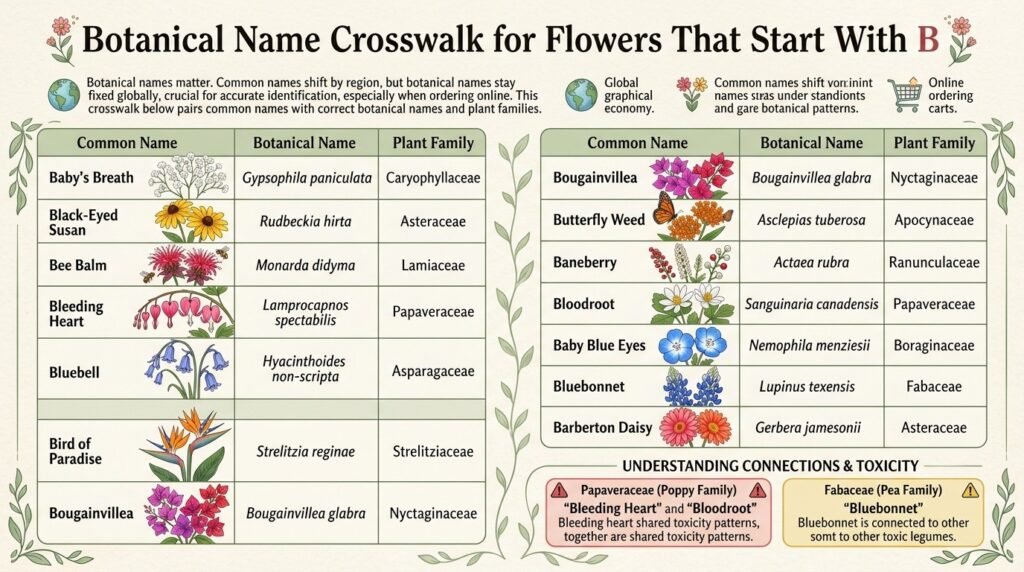
| Common Name | Botanical Name | Plant Family |
| Baby’s Breath | Gypsophila paniculata | Caryophyllaceae |
| Black-Eyed Susan | Rudbeckia hirta | Asteraceae |
| Bee Balm | Monarda didyma | Lamiaceae |
| Bleeding Heart | Lamprocapnos spectabilis | Papaveraceae |
| Bluebell | Hyacinthoides non-scripta | Asparagaceae |
| Bird of Paradise | Strelitzia reginae | Strelitziaceae |
| Bougainvillea | Bougainvillea glabra | Nyctaginaceae |
| Butterfly Weed | Asclepias tuberosa | Apocynaceae |
| Baneberry | Actaea rubra | Ranunculaceae |
| Bloodroot | Sanguinaria canadensis | Papaveraceae |
| Baby Blue Eyes | Nemophila menziesii | Boraginaceae |
| Bluebonnet | Lupinus texensis | Fabaceae |
| Barberton Daisy | Gerbera jamesonii | Asteraceae |
This shortlist shows how varied the plant families really are, even within one letter. Bleeding Heart and Bloodroot both sit in the same poppy family, which explains their shared toxicity pattern. Bluebonnet stands apart in the pea family, connecting it to other toxic legumes despite its cheerful spring color.
Flower Meanings and Symbolism
Flowers that start with B carry rich symbolism across many cultures. Bee Balm has long been linked to healing and comfort, since Indigenous communities in North America used it in traditional remedies. Its bright red color also draws a strong link to energy and attraction, fitting for a flower that hummingbirds cannot resist. Black-Eyed Susan, by contrast, is often tied to encouragement and justice, sometimes given as a message of support during hard times.
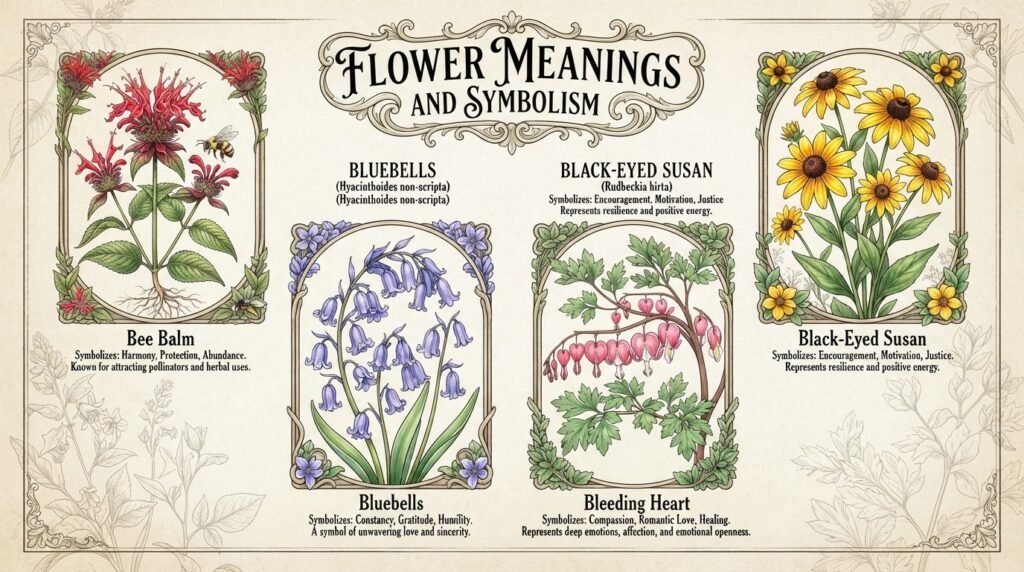
Bluebell holds a gentler, more wistful meaning across British and Irish folklore. Old stories warned that walking through a bluebell wood could lead someone astray, giving the flower a quiet, mysterious reputation. Baby’s Breath, on the other hand, symbolizes everlasting love and purity, which is exactly why it appears in so many wedding bouquets around the world.
Bleeding Heart carries perhaps the most literal symbolism of any flower on this list. Its heart-shaped blooms are widely read as a symbol of love, loss, or emotional vulnerability. That contrast between beauty and real toxicity gives Bleeding Heart a symbolism that feels earned rather than simply decorative.
Decision Guide: Which Flower That Starts With B Should You Choose?
Choosing the right flower often depends on where it will grow and who will be near it. The table below matches common situations to a flower pick from this list, along with a short reason for the match. Use it as a starting point, then check the full comparison table above for growing details.
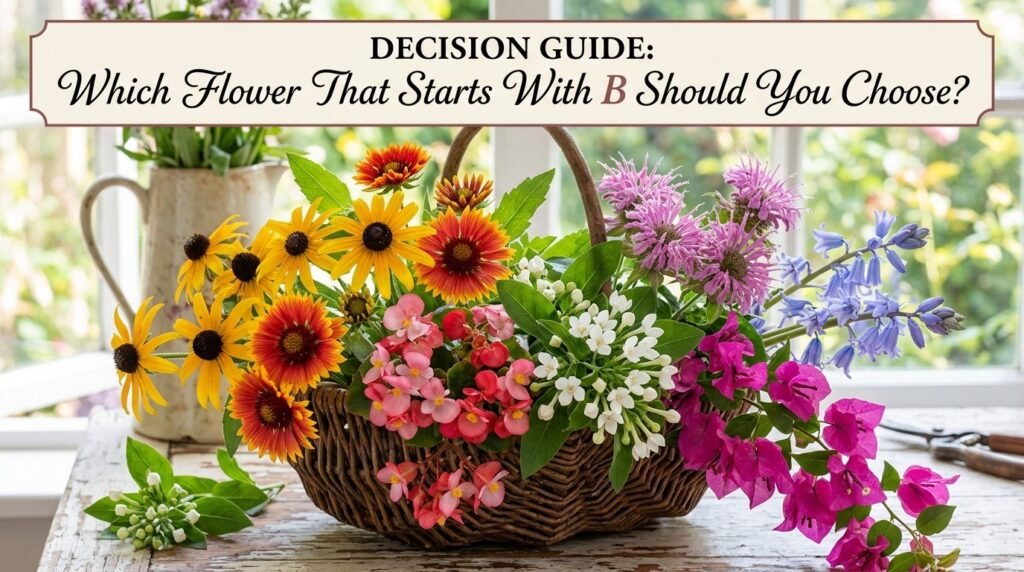
| Your Situation | Recommended Flower | Why It Fits |
| Sunny summer border | Black-Eyed Susan | Tough, reliable, long bloom time |
| Hot, dry rock garden | Blanket Flower | Drought-tough with fiery color |
| Indoor bright room | Wax Begonia | Blooms nearly year-round indoors |
| Fragrant cut flowers | Bouvardia | Sweet scent, wedding-ready blooms |
| Native pollinator bed | Bee Balm | Feeds hummingbirds and bees all summer |
| Household with pets | Black-Eyed Susan | Non-toxic and easy to grow |
| Shaded woodland bed | Bluebell | Naturalizes well in shade, but toxic if eaten |
| Fence or trellis cover | Bougainvillea | Fast-growing, vivid warm-climate color |
Notice that Black-Eyed Susan appears twice in this table, once for sunny borders and once for pet-safe homes. That overlap is not an accident, since the same traits that make it easy to grow also make it low-risk indoors and out. Bluebell, by contrast, is stunning in a shaded bed but needs careful placement, since it appears again in the caution section above.
Conclusion
Flowers that start with B offer more variety than almost any other letter in this series. This guide covered 100 of them, complete with botanical names, native range, and toxicity notes. Whether you want a tough summer perennial, a fragrant florist favorite, or a flower to avoid around pets, this list has a fit. Keep it close the next time you plan a garden bed or a bouquet built around beautiful, unusual blooms.
Frequently Asked Questions
What are some common flowers that start with B?
Black-Eyed Susan, Bluebell, Bee Balm, and Baby’s Breath are the most common picks. All four appear regularly in gardens and florist shops. Black-Eyed Susan remains one of the most widely grown of the group.
Are there really 100+ flowers that start with B?
Yes, this guide lists 100 verified flowers starting with B. They range from tiny woodland natives to bold tropical shrubs. Many share large genera, including Campanula, Rudbeckia, and Bidens.
Which flowers that start with B are toxic to pets?
Baneberry, Bleeding Heart, Bluebell, and Bloodroot all carry a real toxicity risk. Baneberry is the most dangerous of the group. Keep all four away from pets and children who chew on plants.
Is Black-Eyed Susan safe to plant around children?
Yes, Black-Eyed Susan is considered non-toxic and safe for most gardens. It causes no major harm if touched or tasted lightly. It remains one of the safest flowers on this entire list.
Which B-flower blooms the longest?
Black-Eyed Susan blooms from early summer until the first frost. Butterfly Bush comes close behind it with steady, pollinator-friendly flowers. Both need occasional deadheading to keep flowering that long.
What is the tallest flower that starts with B?
Bougainvillea can climb well over ten feet on a strong support. Among freestanding perennials, Butterfly Bush often reaches six feet tall. Bougainvillea suits a large trellis or sunny fence line.