

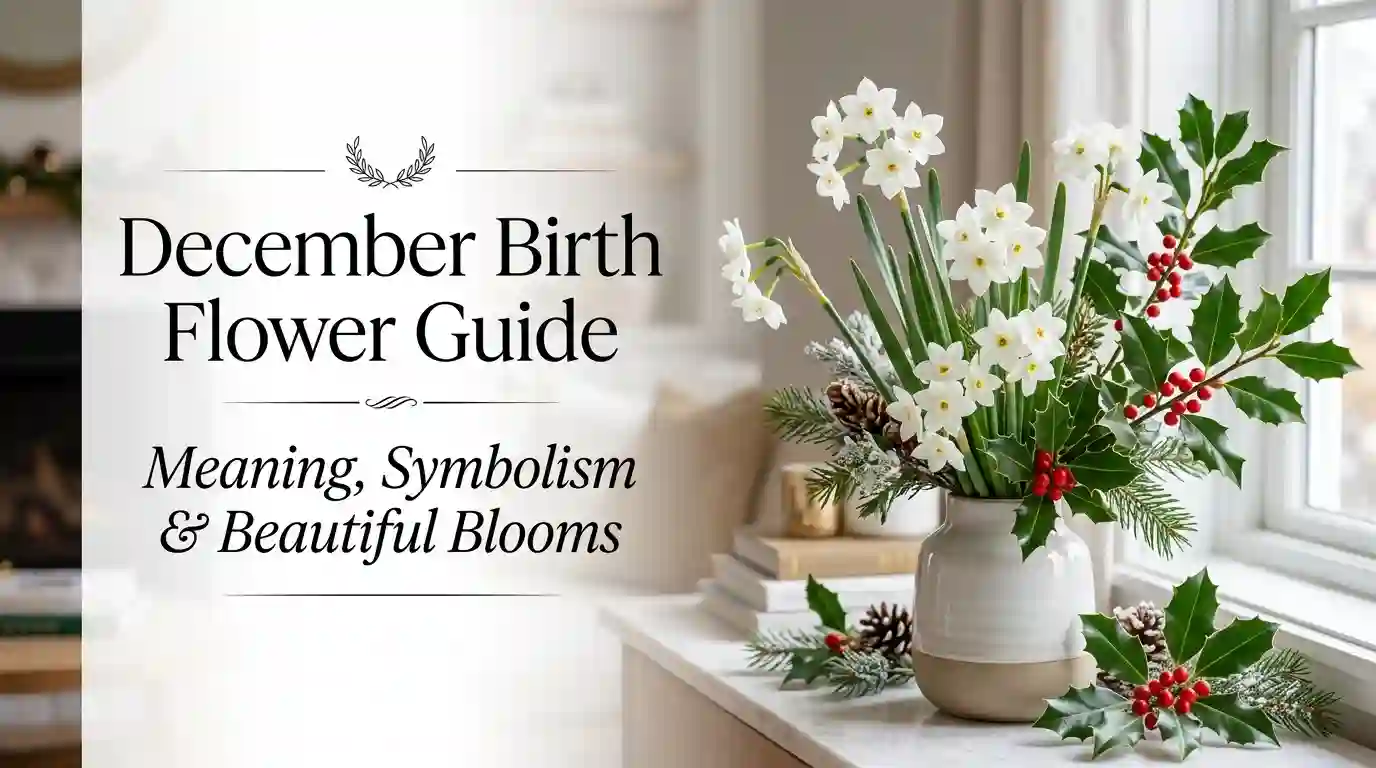
Quick Answer: The December birth flower is actually two flowers, not one. Narcissus (especially the fragrant paperwhite) represents hope, renewal, and new beginnings. Holly, with its glossy leaves and bright red berries, represents protection, strength, and quiet resilience through winter. Together, they capture December perfectly: one soft and hopeful, one bold and enduring.
- What Is a Birth Flower?
- December’s Birth Flower(s): Overview
- History and Origin of Narcissus
- History and Origin of Holly
- Meaning and Symbolism of Narcissus
- Meaning and Symbolism of Holly
- Color Varieties and Their Meanings (Both Flowers)
- How to Grow Narcissus
- How to Grow Holly Gift Ideas Using December’s Birth Flowers
- Famous People Born in December and Their Connection to the Flowers
- December Birthstone (Brief Mention)
- Fun Facts About Narcissus and Holly
- Conclusion
- FAQs
December carries more symbolism than almost any other month. It closes out the year, ushers in the holidays, and asks all of us to reflect a little before we look ahead. It makes sense, then, that the December birth flower comes in a pair. Narcissus blooms indoors during the darkest weeks of the year, filling a room with fragrance when almost nothing else is flowering. Holly does the opposite. It thrives outside, right through frost and snow, glossy and green when everything around it has gone bare. If you were born in December, or you’re shopping for someone who was, this guide walks through both flowers in full: their history, their meaning, their colors, and how to grow each one at home.
Image caption: Paperwhite narcissus and holly branches arranged together, the two December birth flowers.
What Is a Birth Flower?
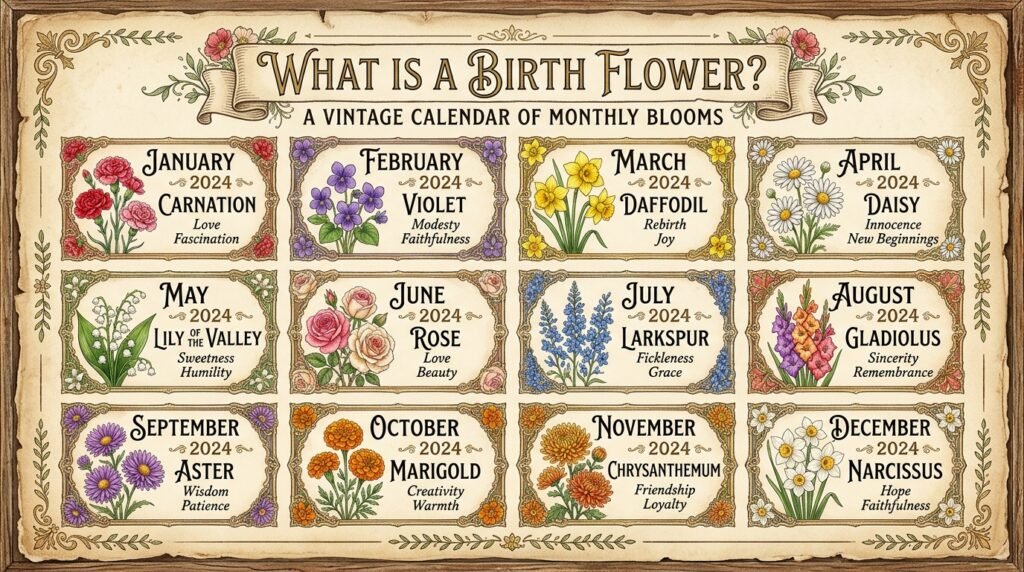
A birth flower is a specific bloom tied to your birth month, much like a birthstone. The tradition traces back centuries, with roots in Roman festivals, medieval European herbals, and the Victorian “language of flowers,” where certain blooms carried coded meanings that people used to express feelings they couldn’t say out loud. By the 1800s, floral calendars assigning a flower to each month had become popular across Europe and America, and gift-givers began choosing birth-month flowers the same way they chose birthstones. Some months settled on a single flower. Others, like December, ended up with two, likely because no single bloom could capture everything the month represents.
December’s Birth Flower(s): Overview
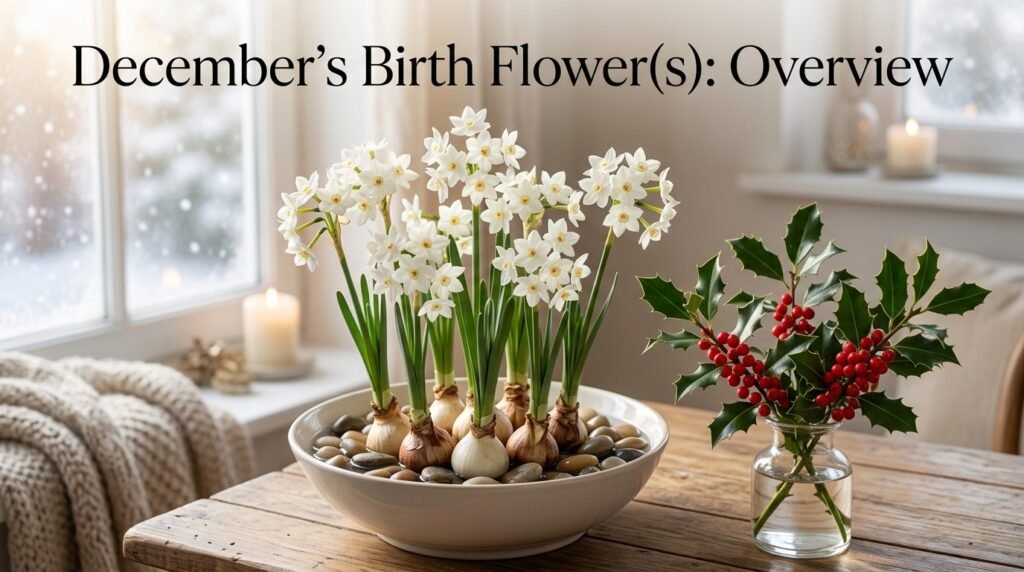
Narcissus (Paperwhite)
The narcissus most closely tied to December is the paperwhite, botanically known as Narcissus papyraceus. It produces clusters of small, star-shaped white blooms on slender stems, each one carrying a sweet, unmistakable fragrance. Unlike its spring-blooming daffodil cousins, the paperwhite flowers indoors in winter are often forced into bloom from a bare bulb in just three to four weeks. Its clean white petals and golden-yellow cup give it a quiet, elegant look that fits the December birth flower’s role as a symbol of hope during the darkest stretch of the year.
Holly
Holly, or Ilex aquifolium, could not look more different from its December counterpart. It’s an evergreen shrub or small tree, not a delicate bulb flower, known for its leathery, spiny, dark green leaves and clusters of vivid red berries. Small greenish-white flowers do appear on the plant, though not until late spring, and they’re easy to miss next to the plant’s bold foliage and berries. Holly’s toughness, staying green and fruiting straight through frost, has made it a lasting symbol of endurance and protection, and a natural second-birth flower for December.
History and Origin of Narcissus
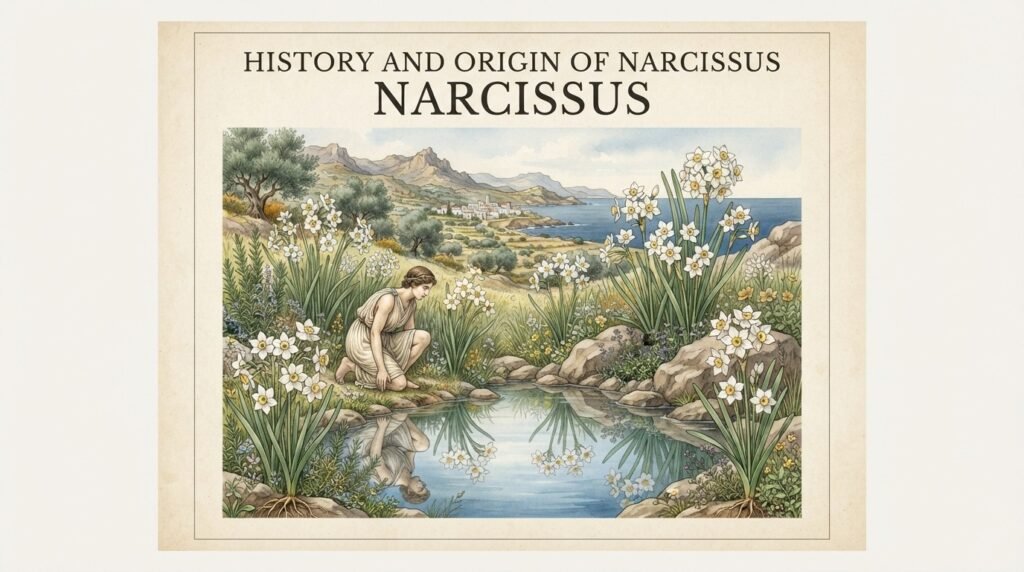
Narcissus takes its name directly from Greek mythology, and the story behind it is famously tragic. A beautiful young man named Narcissus, the myth goes, fell so deeply in love with his own reflection in a pool of water that he could not look away. He eventually wasted away on the spot, and in his place grew the flower that still carries his name today. Whether or not that story explains the plant’s origin, the flower itself has a real and much older history in the Mediterranean, where the wild paperwhite has grown for thousands of years across coastal Spain, Portugal, and North Africa.
Its connection to December likely comes down to biology as much as legend. Paperwhites are unusual among bulb flowers because they don’t need a cold dormancy period before blooming, which means growers can force them into flower indoors during the coldest, darkest weeks of the year. Victorian households embraced this trick enthusiastically, forcing paperwhite bulbs in bowls of water and pebbles to bring fragrant, living color into the home right around the winter holidays. That practice cemented narcissus as the December birth flower for anyone born during this dim, in-between stretch of the calendar.
History and Origin of Holly
Holly’s history runs just as deep, though its story belongs more to folklore and ritual than to a single myth. Ancient Celtic communities across the British Isles considered holly a sacred plant, believing its sharp, spined leaves could ward off evil spirits and its evergreen nature symbolized eternal life through the harshest part of winter. Druids reportedly brought holly branches indoors during the coldest months, both for decoration and as a kind of protective charm for the household.
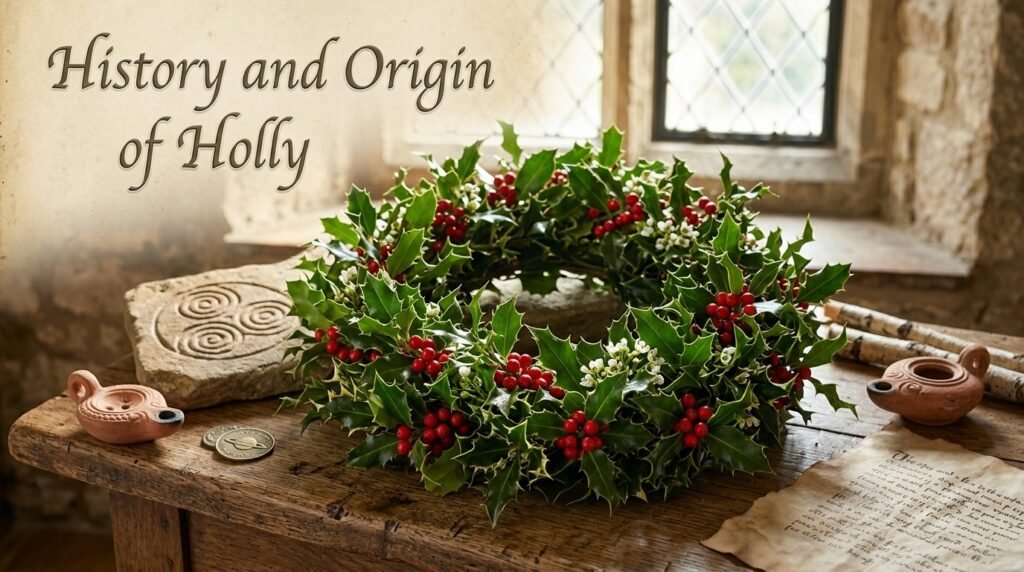
The Romans had their own December tradition tied to holly, using its branches during Saturnalia, a midwinter festival held in honor of Saturn, the god of agriculture. Wreaths and garlands of holly were exchanged as gifts and hung in homes to mark the celebration, a custom that later blended almost seamlessly into Christmas traditions across Europe. That long, unbroken thread, from Celtic ritual to Roman festival to modern Christmas wreath, is exactly why holly earned its place as a December birth flower. Few other plants have stayed so visually and symbolically tied to this single month for so many centuries.
Meaning and Symbolism of Narcissus
As the December birth flower most associated with new beginnings, narcissus carries a cluster of hopeful meanings that make it a popular gift regardless of the occasion. Its symbolism includes:
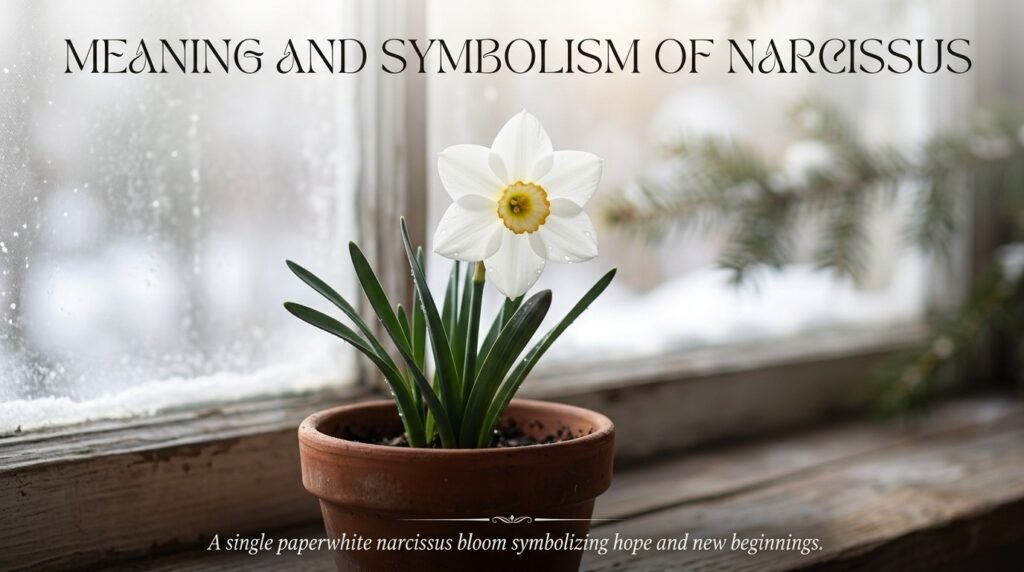
- Renewal and rebirth — tied to its ability to bloom indoors during the darkest part of winter
- Hope — often given as encouragement during difficult transitions or new chapters
- Faithfulness and respect — a traditional meaning drawn from older Victorian flower-language guides
- Good wishes — commonly included in gifts meant to celebrate a fresh start
- Purity — linked to its clean white petals and simple, uncomplicated form
Whether given for a December birthday, a New Year’s celebration, or simply as a mid-winter pick-me-up, narcissus consistently points toward optimism. It’s a small flower with a large emotional job, forced into bloom precisely when people need a reminder that brighter days are already on their way.
Meaning and Symbolism of Holly
Holly’s symbolism leans in a sturdier, more protective direction, which fits its evergreen, thorn-edged appearance. As the second December birth flower, its core meanings include:
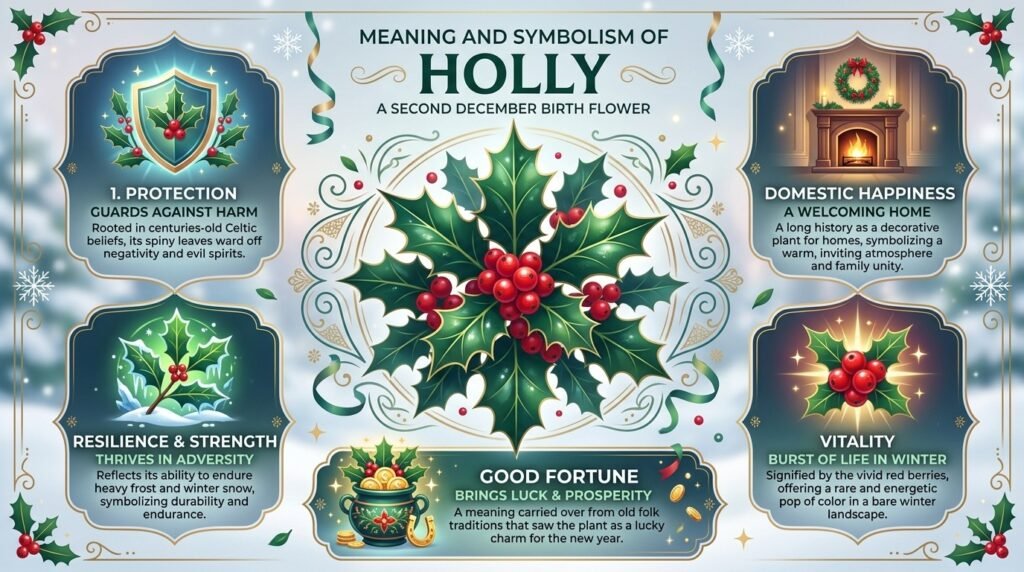
- Protection — rooted in centuries-old Celtic belief that its spiny leaves guarded against harm
- Domestic happiness — tied to its long history as a welcoming, decorative plant for the home
- Resilience and strength — reflecting its ability to thrive outdoors through frost and snow
- Vitality — drawn from its vivid red berries, a rare burst of color in an otherwise bare winter landscape
- Good fortune — a meaning carried over from older folk traditions surrounding the plant
Where narcissus offers softness and hope, holly offers backbone. Together, the two December birth flowers strike a balance that feels distinctly suited to the month itself, a season that asks people to be both tender and strong all at once.
Color Varieties and Their Meanings (Both Flowers)
Neither December birth flower comes in a wide rainbow of colors, but the color variations that do exist carry their own distinct meanings worth knowing before you buy or plant either one. The table below breaks down the most common color forms of narcissus and holly, along with what each one traditionally represents in flower-meaning guides. Reading across both columns side by side makes it easy to see how the two flowers echo each other, leaning toward purity and brightness even in their more limited color range.
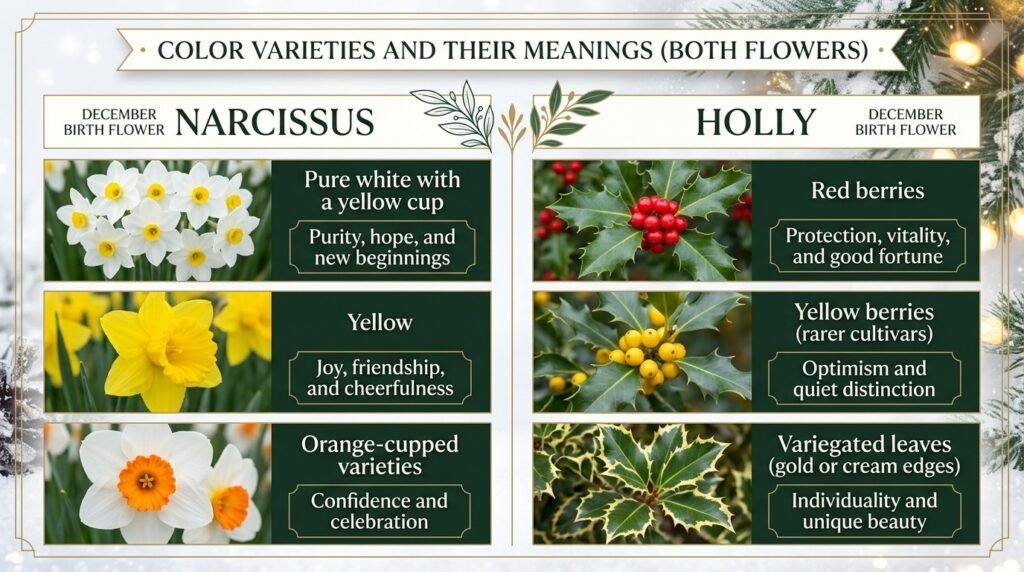
| Flower | Color Variety | Symbolic Meaning |
| Narcissus (Paperwhite) | Pure white with a yellow cup | Purity, hope, and new beginnings |
| Narcissus (broader genus) | Yellow | Joy, friendship, and cheerfulness |
| Narcissus (broader genus) | Orange-cupped varieties | Confidence and celebration |
| Holly | Red berries | Protection, vitality, and good fortune |
| Holly | Yellow berries (rarer cultivars) | Optimism and quiet distinction |
| Holly | Variegated leaves (gold or cream edges) | Individuality and unique beauty |
The classic white paperwhite remains the most recognizable version of the December birth flower, and its meaning of purity and hope is the one most gift guides point to first. Holly’s red-berried form is by far the most common and symbolically loaded variety, though the rarer yellow-berried cultivars offer a softer, less traditional option for anyone who wants the same plant with a gentler meaning attached.
How to Grow Narcissus
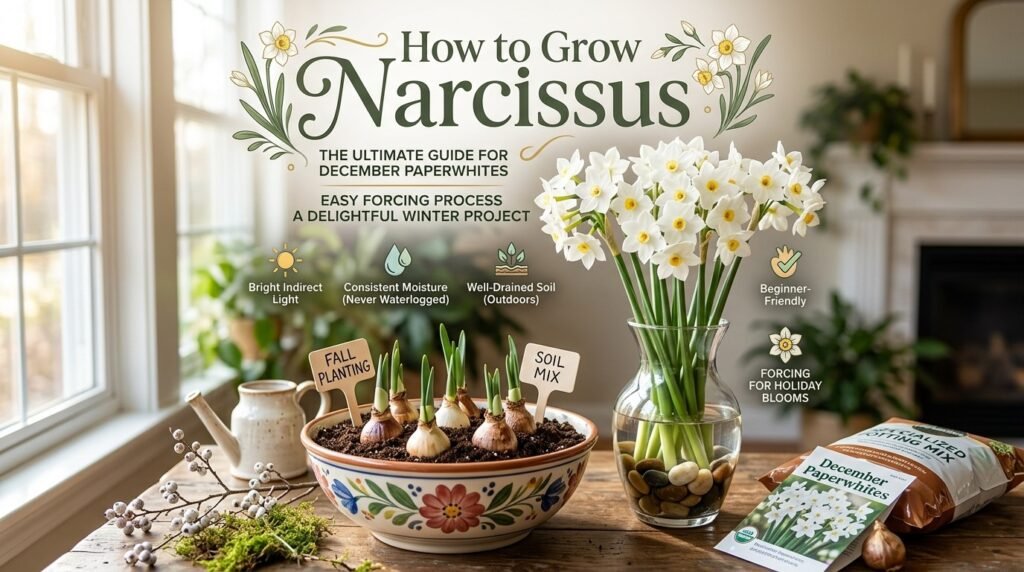
Growing narcissus, particularly the paperwhite variety associated with December, is one of the easiest winter projects available to any gardener. It needs bright, indirect light if grown indoors, or full sun to partial shade if planted outside in a mild climate. Well-drained soil matters most outdoors, since soggy conditions can rot the bulb before it has a chance to establish. Water moderately, keeping the soil or growing medium consistently moist but never waterlogged, whether the bulb sits in soil or simply in a bowl of water and stones. Most gardeners plant or start paperwhite bulbs in fall, timing the forcing process so blooms open right around the December holidays, and the difficulty level here is genuinely beginner-friendly, requiring little more than a bulb, some light, and about a month of patience.
How to Grow Holly Gift Ideas Using December’s Birth Flowers

Because December’s birth flowers cover such different moods, gift-givers actually have more creative room here than with a single-flower month. A living paperwhite bulb kit, ready to force into bloom, makes a thoughtful, low-maintenance gift that keeps giving for weeks as the flowers slowly open. A small potted holly shrub works beautifully for anyone with a garden, offering color and structure that lasts through the entire winter season, not just a single bloom cycle. Mixed arrangements that pair fresh narcissus stems with clipped holly branches capture both December birth flowers in a single gift, and they photograph beautifully for a birthday card or table centerpiece. For something longer-lasting, jewelry or art featuring both flowers together lets a December-born recipient carry their full birth-flower pairing with them well beyond the winter season.
Famous People Born in December and Their Connection to the Flowers
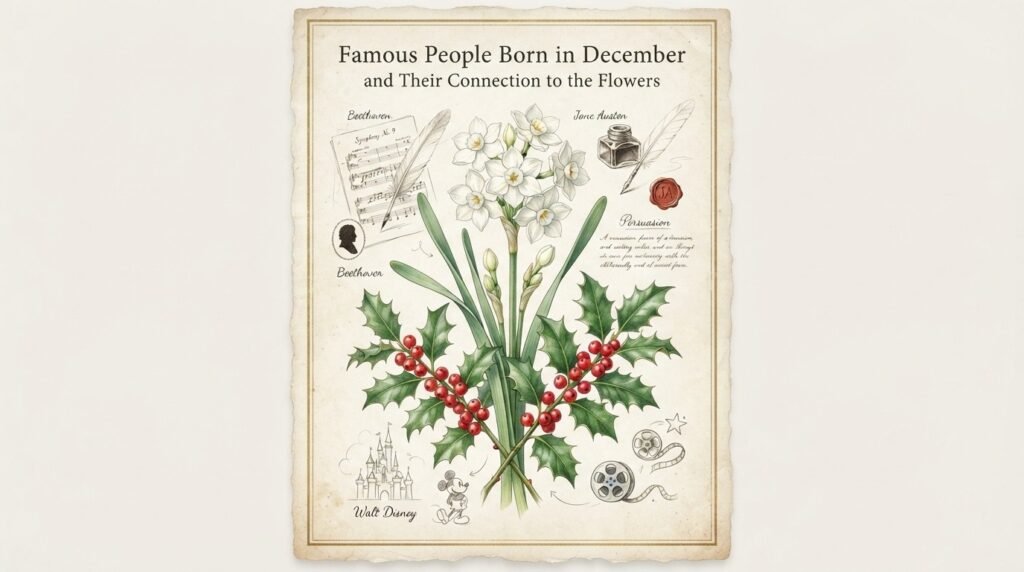
Several well-known figures share a December birthday, and the symbolism of narcissus and holly maps onto their stories in interesting ways. Composer Ludwig van Beethoven, born in mid-December, built a body of work defined by resilience through adversity, a theme that echoes Holly’s symbolism of strength and endurance. Author Jane Austen, born December 16th, is remembered for stories centered on new beginnings and personal renewal, themes that align closely with Narcissus and its message of hope. Walt Disney, born in early December, built an entire legacy around imagination and fresh starts, another natural echo of the narcissus symbolism tied to his birth month. These connections are more poetic than scientific, of course, but they’re part of why birth flowers remain a popular way to add personal meaning to a December birthday.
December Birthstone (Brief Mention)
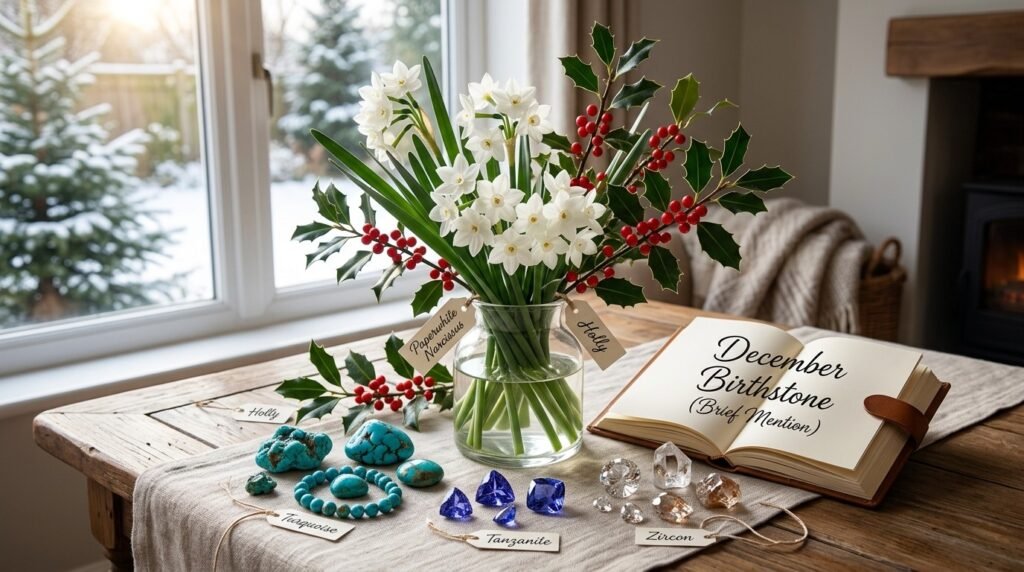
Alongside its two birth flowers, December also claims a well-known birthstone: turquoise, prized for centuries across multiple cultures for its striking blue-green color and its own symbolism of protection and good fortune. Modern birthstone lists have added tanzanite and zircon as alternate December stones, giving people born this month several ways to mark their birthday with meaningful color, whether in gemstone form or in the December birth flower itself.
Fun Facts About Narcissus and Holly
- Paperwhite narcissus can be forced into bloom without any soil at all, using nothing more than water and decorative stones.
- The genus name Narcissus comes directly from Greek mythology, making it one of the few common flowers named after a specific mythological figure.
- Holly berries are toxic to humans and pets if eaten in quantity, so they’re best admired rather than handled by curious kids or animals.
- Ilex aquifolium, the classic Christmas holly, can grow into a tree reaching 30 to 50 feet tall in the right conditions, far larger than most people picture.
- Ancient Romans exchanged holly branches during the midwinter festival of Saturnalia, a tradition that helped shape modern Christmas customs.
- Narcissus is also the national flower of Wales, worn traditionally on St. David’s Day each spring.
Conclusion
The December birth flower isn’t just one bloom, and that’s exactly what makes it special. Narcissus brings fragrance, hope, and a literal light in the darkest weeks of the year, while holly brings structure, protection, and quiet strength that lasts straight through winter. Whether you’re shopping for a December birthday, planning your own garden, or just curious about the story behind the season, this pairing captures the month better than any single flower could. As one old flower-meaning guide put it, hope and endurance make the truest kind of company in winter, and few flowers illustrate that idea as clearly as narcissus and holly do together.
FAQs
What is the birth flower for December?
December has two birth flowers: narcissus, specifically the paperwhite variety, and holly. Together, they represent hope and renewal alongside protection and resilience.
What does narcissus symbolize as a December birth flower?
Narcissus symbolizes hope, renewal, and new beginnings, along with faithfulness and good wishes in older flower-language traditions. Its ability to bloom indoors during the darkest weeks of winter reinforces this hopeful meaning.
What does holly symbolize as a December birth flower?
Holly symbolizes protection, resilience, and domestic happiness, rooted in centuries of Celtic and Roman winter tradition. Its evergreen leaves and bright red berries have long represented strength through harsh conditions.
Is holly easy to grow at home?
Holly is a moderate-difficulty plant that grows slowly but lives for decades once established. It prefers full to partial sun and well-drained soil, and it can struggle in especially hot, humid climates.
Is narcissus easy to grow indoors?
Yes, narcissus, particularly the paperwhite variety, is one of the easiest bulbs to grow indoors. It can be forced into bloom in just three to four weeks using only water and decorative stones.
Why does December have two birth flowers instead of one?
Many birth-flower traditions assign two flowers to a single month, and December’s pairing reflects the season’s dual nature. Narcissus represents hope and renewal, while holly represents protection and endurance, together capturing the full spirit of the December birth flower tradition.
Are holly berries safe to keep around pets or children?
No, holly berries are toxic if ingested in quantity and can cause vomiting, diarrhea, and stomach upset in both children and pets. They’re best enjoyed as decoration rather than handled or eaten.