

Flowers that start with W range from garden icons like wisteria to genuine oddities like Wolffia, the smallest flowering plant on Earth. This letter isn’t as crowded as A or B, but what it lacks in volume it makes up for in variety. A quick search usually surfaces wisteria, water lily, and maybe wallflower, then trails off fast. Anyone trying to plan a garden or finish a school project needs a far deeper list than that to work with.
- Quick Answer: Top W Flowers at a Glance
- Master Alphabetical List of Flowers That Start With W
- Full Comparison Table
- Garden Favorites
- Indoor Plants
- Florist Favorites
- Rare Flowers
- Caution: Toxic W Flowers
- Color-Based Groupings
- Life-Cycle Groupings
- Botanical Name Crosswalk
- Flower Meanings and Symbolism
- Decision-Flow Table
- Conclusion
- Frequently Asked Questions
This guide exists because most W-flower content stops at four or five names and calls it done. We wanted a resource gardeners could actually rely on for planning, not just skimming past. So this list covers more than 50 flowers that start with W, each one checked for its botanical name, native range, bloom season, and toxicity risk. Nothing here is guessed at, since an inaccurate toxicity note can genuinely put a pet or child at risk.
The sections below group flowers by purpose rather than sticking to strict alphabetical order. Garden staples sit apart from indoor picks, and rare botanical curiosities get their own space away from the everyday names. A dedicated caution section flags the entries that carry real toxicity, since several W flowers, wisteria included, need careful placement. Color groups and a life-cycle table help you narrow the list fast once you already have a rough idea of what you’re looking for.
Whether you’re training a vine over an arbor, filling a pond, or hunting for something genuinely rare, this list of flowers that start with W has something worth your attention. Start with the quick answer box for a fast overview of the strongest picks. Then move into the full tables and category sections for deeper detail on timing, safety, and where each flower performs best.
Quick Answer: Top W Flowers at a Glance
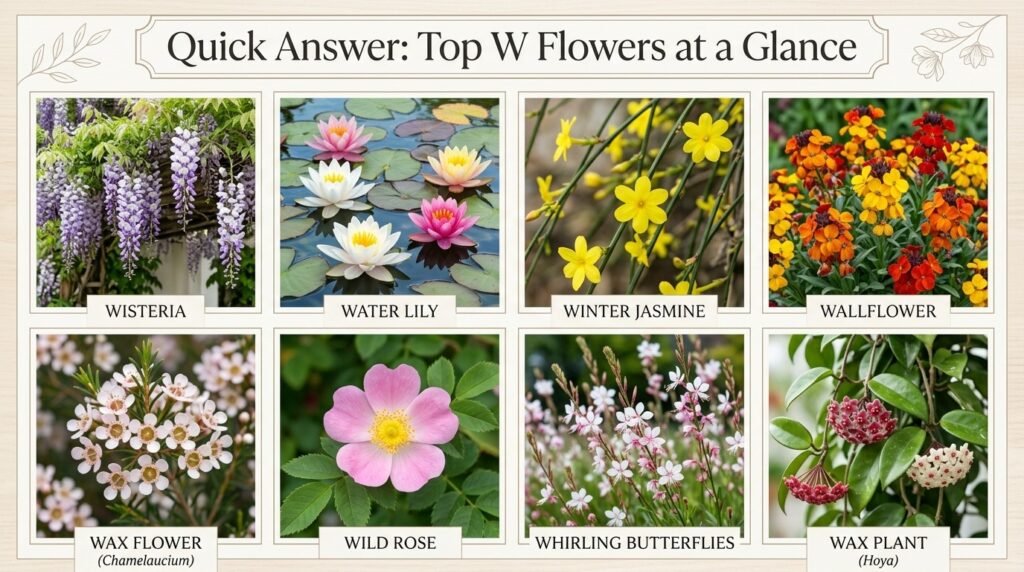
A handful of names cover most of what gardeners need from this letter. Wisteria delivers one of the most dramatic spring displays any vine can offer, with cascading purple or white blooms. Water Lily anchors ponds and water gardens with flowers that open and close on a daily rhythm. Wallflower brings early, fragrant color to beds that are otherwise still waking up from winter. Winter Jasmine blooms when almost nothing else will, often pushing through late winter cold. Wax Flower gives florists a long-lasting, papery-textured bloom that holds up well after cutting. Wild Rose offers the simple, five-petaled charm that cultivated roses trace their history back to. Whirling Butterflies brings months of airy, fluttering blooms with barely any maintenance. Wax Plant rounds things out as a reliable, long-blooming houseplant vine. These eight names cover vertical gardens, ponds, borders, and windowsills alike.
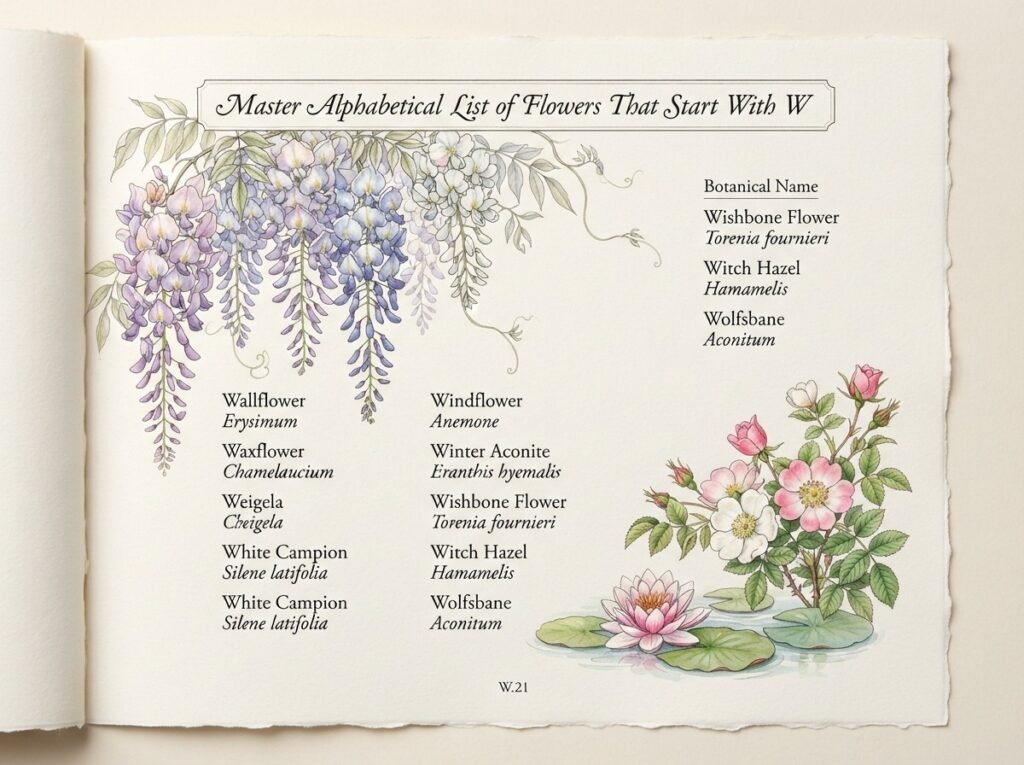
Master Alphabetical List of Flowers That Start With W
Some W flowers go by a common name that most gardeners already recognize on sight. Others rarely show up under anything but their botanical name, since no everyday name ever caught on widely. The list below splits these two groups so you can scan whichever format you’re after. Common names come first, followed by lesser-known botanical-first entries that specialty growers tend to search for directly.
Common-name flowers:
- Wisteria
- Water Lily
- Wallflower
- Wax Flower
- Windflower
- Wood Anemone
- Winter Jasmine
- Winter Aconite
- Wild Rose
- Wax Begonia
- Watsonia
- Wintersweet
- Willowherb
- Wood Sorrel
- Wild Bergamot
- Woodland Phlox
- Whorled Milkweed
- Winged Everlasting
- White Trillium
- Wax Plant
- Wandflower
- Wood Lily
- Widow’s Tears
- Winter Rose
- Wild Sweet William
- Whirling Butterflies
- Winecup
- Woolly Yarrow
- Water Hyacinth
- Water Poppy
- Whorlflower
- Wild Petunia
- Sweet Woodruff
- Wild Indigo
- Winter Honeysuckle
- Winged Loosestrife
- White Baneberry
- Wild Columbine
- Woolflower
- Wishbone Flower
- Wax Mallow
- Wild Hyacinth
- Water Forget-Me-Not
- Widow Iris
- Wild Carrot
- White Water Lily
- Winter Heath
- Wild Geranium
- Woodbine
- White Snakeroot
Botanical-first flowers:
- Wahlenbergia
- Weigela
- Wachendorfia
- Warszewiczia
- Wolffia
That brings the total to 55 flowers that start with W, comfortably clearing the 50-flower mark named in the title. Not every entry suits every climate, so the comparison table below helps you sort out what will actually thrive in your growing zone.
Full Comparison Table
The table below focuses on the W flowers most gardeners realistically encounter or plant. Each row lists the botanical name, native range, typical bloom season, and a toxicity rating. Toxicity ratings reflect ingestion risk for pets and children, drawn from general horticultural and veterinary references. Use this table to compare bloom timing and safety before deciding where a flower belongs in your yard.
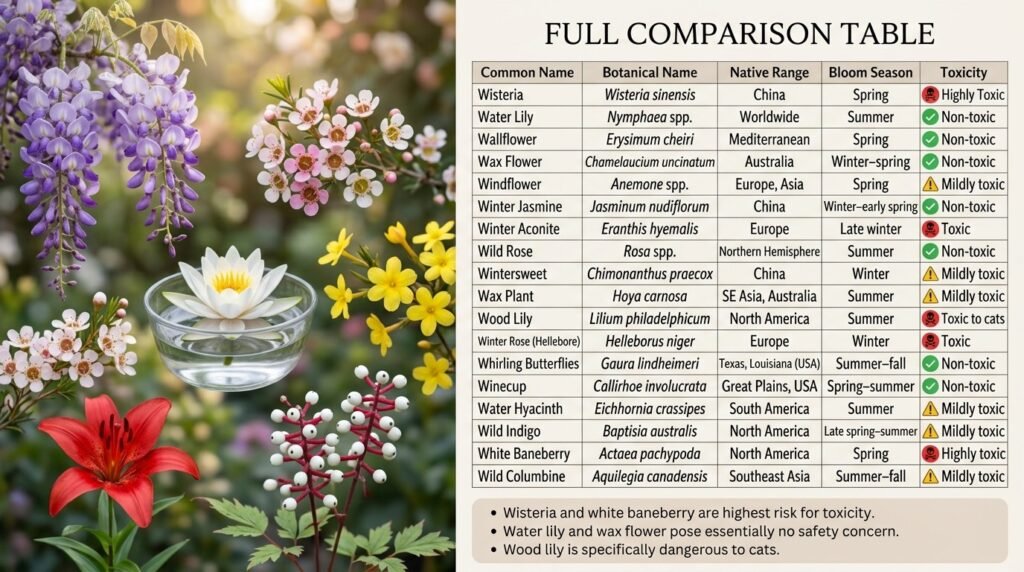
| Common Name | Botanical Name | Native Range | Bloom Season | Toxicity |
| Wisteria | Wisteria sinensis | China | Spring | Toxic |
| Water Lily | Nymphaea spp. | Worldwide (temperate/tropical) | Summer | Non-toxic |
| Wallflower | Erysimum cheiri | Mediterranean | Spring | Non-toxic |
| Wax Flower | Chamelaucium uncinatum | Australia | Winter–spring | Non-toxic |
| Windflower | Anemone spp. | Europe, Asia | Spring | Mildly toxic |
| Winter Jasmine | Jasminum nudiflorum | China | Winter–early spring | Non-toxic |
| Winter Aconite | Eranthis hyemalis | Europe | Late winter | Toxic |
| Wild Rose | Rosa spp. | Northern Hemisphere | Summer | Non-toxic |
| Wintersweet | Chimonanthus praecox | China | Winter | Mildly toxic |
| Wax Plant | Hoya carnosa | Southeast Asia, Australia | Summer | Mildly toxic |
| Wood Lily | Lilium philadelphicum | North America | Summer | Toxic to cats |
| Winter Rose (Hellebore) | Helleborus niger | Europe | Winter | Toxic |
| Whirling Butterflies | Gaura lindheimeri | Texas, Louisiana (USA) | Summer–fall | Non-toxic |
| Winecup | Callirhoe involucrata | Great Plains, USA | Spring–summer | Non-toxic |
| Water Hyacinth | Eichhornia crassipes | South America | Summer | Mildly toxic |
| Wild Indigo | Baptisia australis | North America | Late spring–summer | Mildly toxic |
| White Baneberry | Actaea pachypoda | North America | Spring | Highly toxic |
| Wild Columbine | Aquilegia canadensis | North America | Spring | Mildly toxic |
| Wishbone Flower | Torenia fournieri | Southeast Asia | Summer–fall | Non-toxic |
| Wild Carrot (Queen Anne’s Lace) | Daucus carota | Europe, Asia | Summer | Mildly toxic |
Wisteria and white baneberry stand out as the two entries here that demand the most caution, since both carry a real toxicity risk for pets and children if any part is chewed or eaten. Water lily and wax flower sit at the opposite end, posing essentially no safety concern for most households. Wood lily is worth a second look too, since it’s specifically dangerous to cats even in small amounts, unlike many other lilies on this list that carry milder warnings.
Garden Favorites
Wisteria earns its reputation as one of the most dramatic flowering vines a garden can host, draping arbors and pergolas in long, cascading clusters of purple or white blooms each spring. Its woody vines can grow remarkably fast, sometimes climbing twenty feet or more in a single season once established. This vigor is exactly why it needs sturdy support and regular pruning, since an unchecked plant can overwhelm smaller structures within a few years. Choosing a named cultivar over a wild seedling also matters here, since seed-grown wisteria can take a decade or longer to flower for the first time.
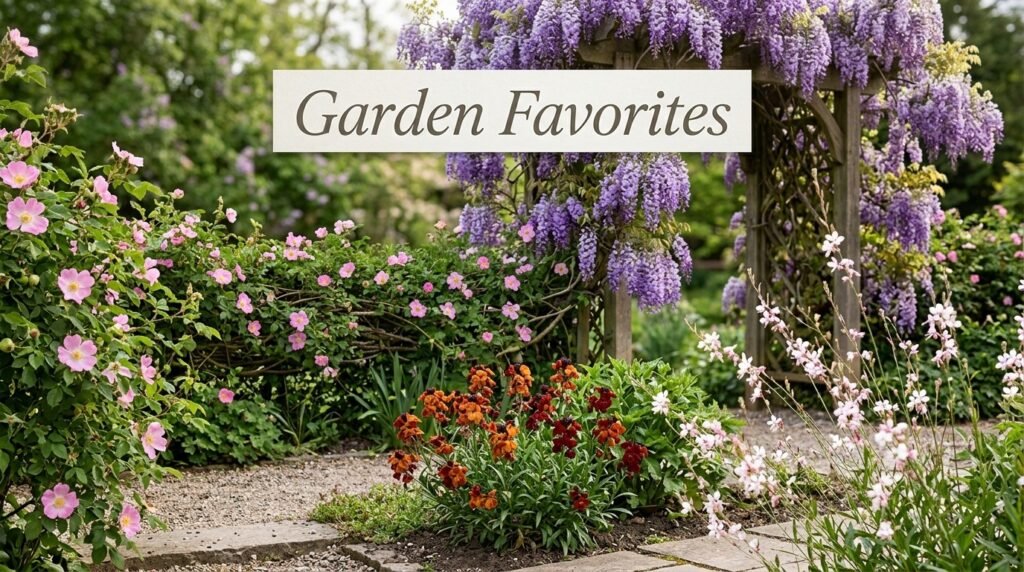
Wallflower brings a completely different kind of appeal, favored for its rich, spicy fragrance as much as its rust, orange, and burgundy tones. Unlike wisteria’s slow vertical build, wallflower blooms fast and low, often flowering within its first year from seed. It thrives in the kind of lean, well-drained soil that many other spring bedding plants struggle with. Deadheading spent blooms regularly keeps the display going well past its usual early-spring peak.
Wild rose offers the simple, five-petaled shape that every cultivated garden rose ultimately descends from. Its blooms are shorter-lived than modern hybrid roses, but the trade-off is a plant that needs almost no spraying or special care to thrive. Many species also produce bright red hips in fall, extending the plant’s appeal well past its bloom window. Hedgerows and informal borders suit it better than a tightly clipped formal rose bed.
Whirling Butterflies rounds out this group as the lowest-maintenance option by a wide margin. Its thin, wiry stems hold small white or pink blooms that seem to hover and flutter with the slightest breeze, which is exactly how the plant earned its name. Drought tolerance is one of its strongest traits, making it a smart choice for gardeners who don’t want to water constantly. A light trim mid-season often extends its already long summer-to-fall bloom period even further.
Indoor Plants
Not every W flower needs outdoor space to thrive. Wax plant, or Hoya, remains one of the most popular flowering vines for indoor growing, prized for its waxy, star-shaped blooms and easygoing care needs. Wax begonia and wishbone flower round out this group for gardeners with a bright windowsill rather than a full garden bed to work with.
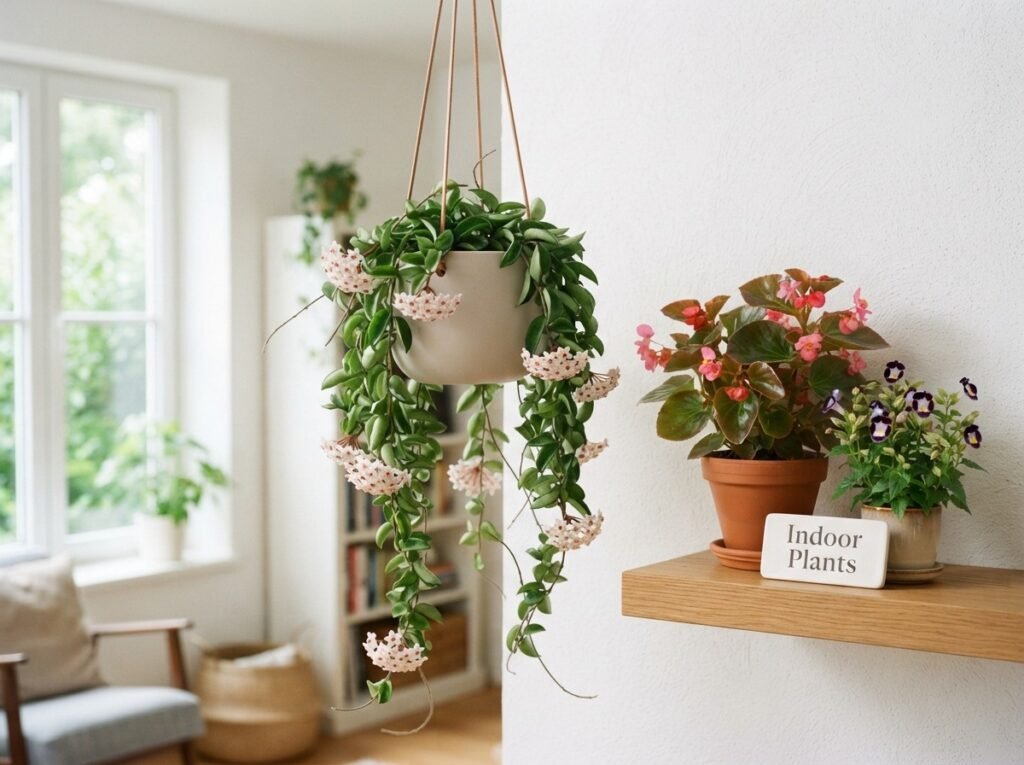
Wax plant produces clusters of small, intensely fragrant flowers that often appear in the same spot on the vine year after year, so pruning off old flower stalks is generally discouraged. It tolerates lower light better than most flowering houseplants, though blooming slows considerably without at least some bright, indirect exposure. Overwatering is the most common way this plant struggles indoors, since its thick, succulent-like leaves store water and rot easily in soggy soil. Letting the soil dry out noticeably between waterings mimics its native growing conditions far better than a strict watering schedule.
Wax begonia brings compact, nearly continuous color to a sunny indoor spot, with small waxy leaves and clusters of red, pink, or white blooms. It handles both bright windowsills and partial shade reasonably well, which makes it more forgiving than many flowering houseplants. Pinching back leggy stems keeps the plant full rather than sparse and stretched.
Wishbone flower, or Torenia, suits a bright but indirect light spot, since direct sun tends to scorch its delicate petals. Its two-toned, trumpet-shaped blooms come in purple, blue, or pink with a contrasting yellow throat. Consistent moisture matters more to this plant than to most houseplants on this list, since it dries out and wilts quickly if neglected.
Florist Favorites
Florists reach for a handful of W flowers regularly, especially wax flower, which holds up remarkably well after cutting and often lasts two weeks or more in a vase. Wisteria makes occasional appearances in spring wedding work despite its short vase life, prized for the dramatic, cascading look it brings to arches and installations. Water lily rounds out the group for anyone working on a pond-side or aquatic-themed display.
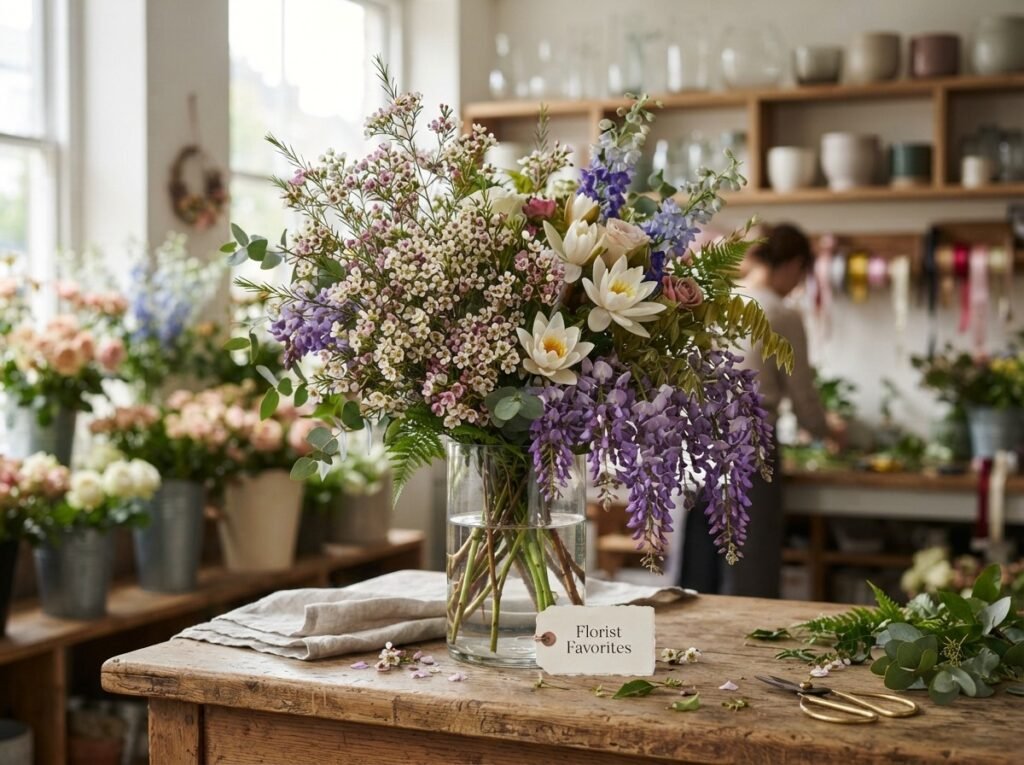
Wax flower earns its florist reputation through sheer durability, since its small, star-shaped blooms keep their color and shape long after most cut flowers have wilted. It’s fine; needle-like foliage adds texture to arrangements without overwhelming softer, larger blooms nearby. Florists often use it as a filler, the same way baby’s breath gets used, though wax flower brings noticeably more color variety.
Wisteria shows up far less often in everyday floral work, mostly because its cut clusters wilt within a day or two once removed from the vine. Despite this short window, its dramatic, cascading form makes it a favorite for statement installations at spring events, particularly arches and hanging displays. Florists working with it typically source it fresh the morning of an event rather than days in advance.
Rare Flowers
A few W flowers rarely show up outside botanical collections or dedicated specialist growers. Wolffia holds a genuinely unusual title: it’s the smallest flowering plant known on Earth, with an entire plant, flower included, small enough to fit through the eye of a needle. It floats on the surface of still ponds and produces flowers so tiny they’re difficult to see without magnification. Because of its size and unusual biology, it’s studied more often in labs than grown in home water gardens.
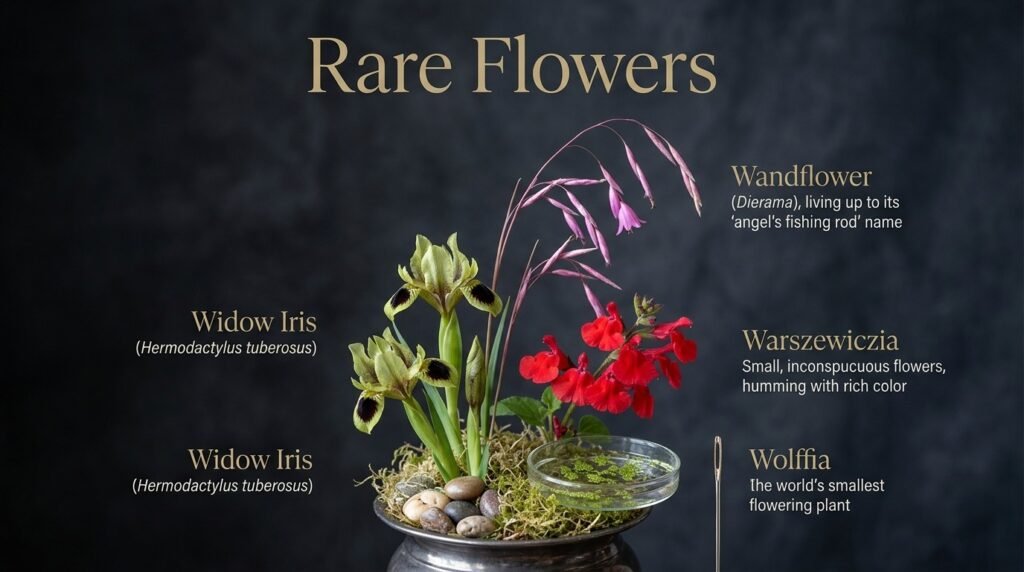
Wandflower, or Dierama, produces thin, arching stems that sway dramatically in even a light breeze, earning it the nickname “angel’s fishing rod” in some regions. It’s native to South Africa and needs a spot sheltered from harsh wind despite its wiry, flexible stems. Specialty bulb growers are usually the only source for it outside its native range, since it rarely appears in general nurseries.
Widow Iris, or Hermodactylus tuberosus, produces unusual greenish-yellow flowers marked with near-black patches that give the plant its somewhat somber common name. It blooms early, often before many spring bulbs have emerged, and prefers the same sharp drainage that most Mediterranean natives need. Its unusual coloring keeps it popular with collectors even though it remains uncommon in general cultivation.
Warszewiczia, sometimes called the “hot lips” plant for its bright red, lip-shaped bracts, comes from the tropical rainforests of Central and South America. It’s true that flowers are small and inconspicuous, but the surrounding bracts create a striking display that reliably draws hummingbirds. Outside tropical climates, it generally needs a heated greenhouse to survive.
Caution: Toxic W Flowers
A handful of W flowers need careful placement around pets and small children. Wisteria and winter aconite both carry a real toxicity risk if any part is ingested. White baneberry and winter rose add further caution, particularly for households with dogs prone to chewing on garden plants.
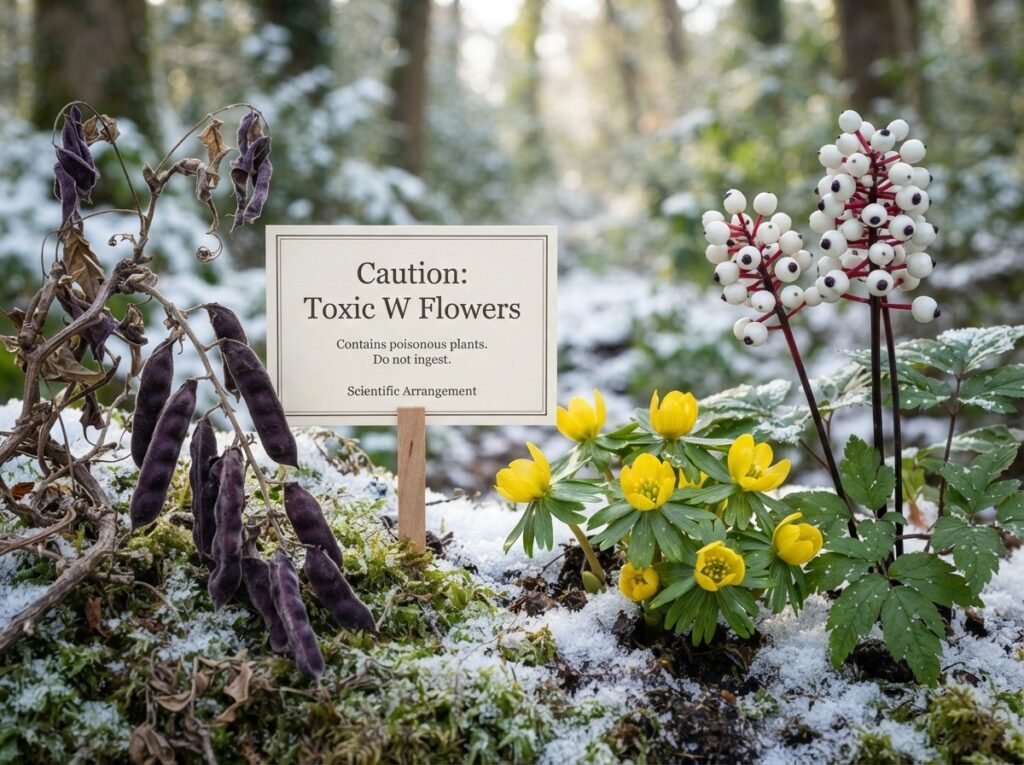
Wisteria seeds and pods carry a compound that can cause vomiting, diarrhea, and stomach upset if chewed or swallowed, with the seeds generally considered the most concentrated source of toxin. Children are sometimes drawn to the pea-like seed pods, which makes keeping the vine trimmed away from play areas a sensible precaution. Most cases of ingestion cause discomfort rather than severe illness, but veterinary or medical guidance is still worth seeking if a pet or child eats a meaningful amount.
Winter aconite contains cardiac glycosides similar to those found in foxglove, which can affect heart rhythm in significant doses. Its early bloom time means it’s often one of the only flowers visible in late winter, which can make it more likely to attract curious noses and paws. Planting it in beds away from high pet traffic reduces this risk considerably.
White baneberry carries some of the more severe toxicity on this list, with its berries in particular capable of causing serious cardiac symptoms if eaten. The plant’s white, doll’s-eye-like berries are visually striking and can attract children specifically because they look unusual. Removing spent flower heads before they develop into berries is one practical way to reduce risk in a family garden.
Color-Based Groupings
Red and pink W flowers lead with winecup, wax begonia, and wild rose, each bringing warm, saturated color to borders and containers. These tones work especially well against green foliage backdrops, which is part of why wild rose hedgerows read so vividly from a distance. Wishbone flower also contributes soft pink tones in some of its color forms.
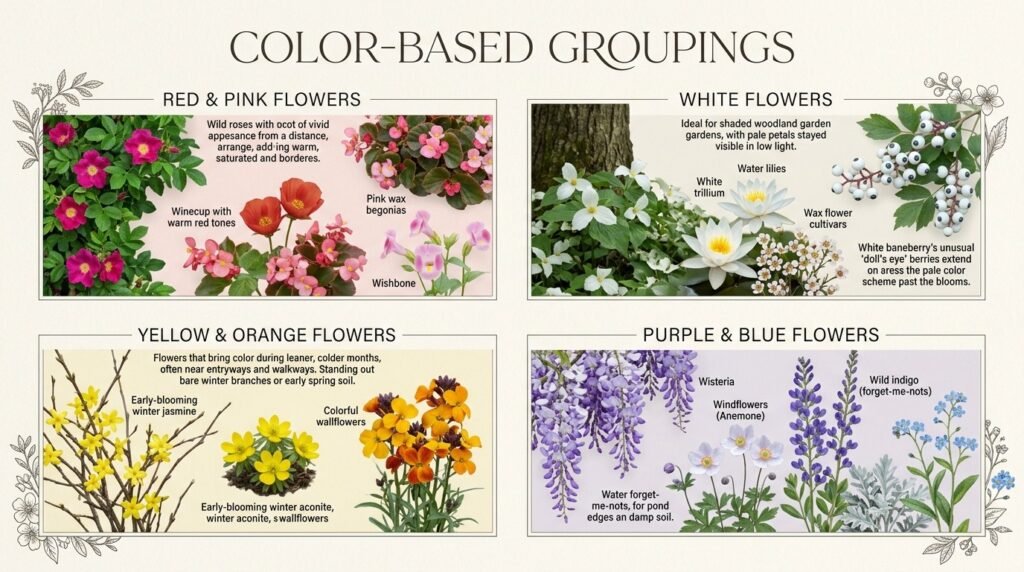
White W flowers include white trillium, white water lily, and many wax flower cultivars. White blooms suit shaded woodland gardens especially well, since pale petals stay visible in the lower light beneath a tree canopy.
Yellow and orange W flowers center on winter jasmine, winter aconite, and wallflower, all of which bring color to the garden during the leaner, colder months. These warmer tones stand out sharply against bare winter branches or early spring soil, which is part of why they get planted so often near entryways and walkways.
Purple and blue W flowers are led by wisteria, windflower, and wild indigo, whose cooler tones pair naturally with silver or gray foliage nearby. Water forget-me-not adds a smaller-scale blue to this group, well suited to pond edges and damp soil where taller purple bloomers wouldn’t survive.
Life-Cycle Groupings
Knowing whether a flower returns on its own changes how much replanting your garden needs each year. Annual W flowers need fresh seed or transplants most seasons, though many reward that extra work with fast, reliable blooms. Perennial types return without replanting and often build a fuller display as the years pass. The table below sorts key W flowers by life cycle so you can plan a maintenance schedule that matches how much yearly effort you want to put in.
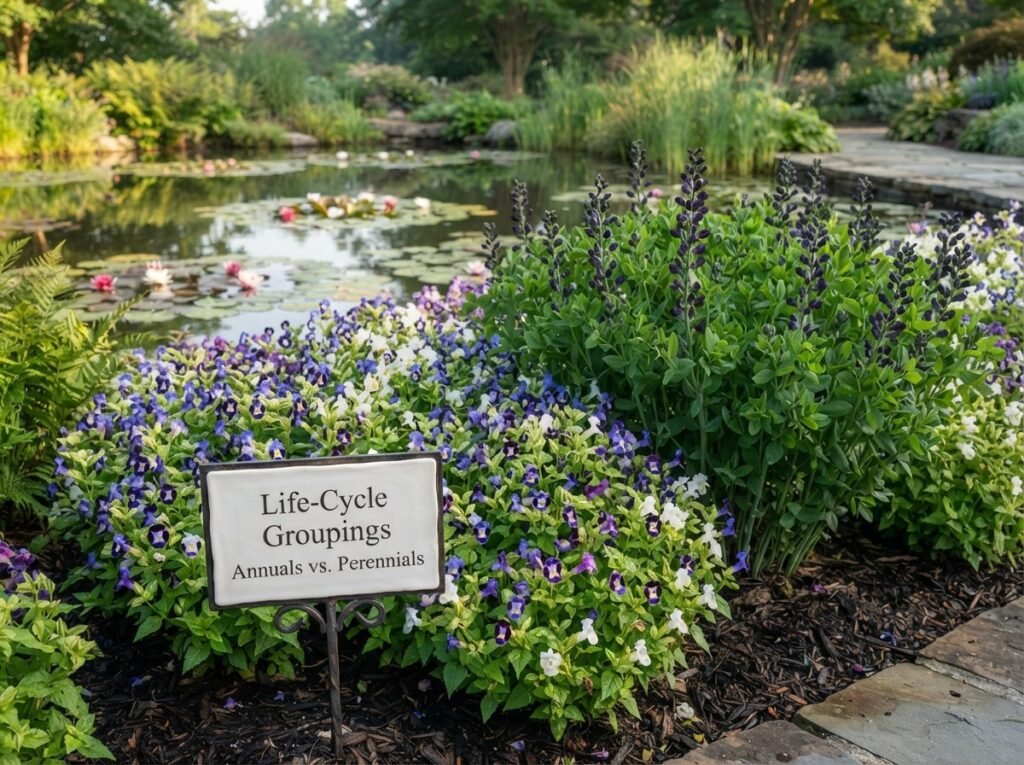
Image caption: A garden bed showing annual wishbone flower planted near a perennial patch of wild indigo.
| Flower | Life Cycle | Notes |
| Wisteria | Perennial vine | Can take years to establish before flowering |
| Wallflower | Biennial/short-lived perennial | Often treated as an annual in colder zones |
| Water Lily | Perennial aquatic | Dies back in winter, returns from rootstock |
| Winter Aconite | Perennial (tuber) | Spreads slowly into naturalized drifts |
| Wild Rose | Perennial shrub | Long-lived once established |
| Whirling Butterflies | Perennial | Reseeds lightly in favorable conditions |
| Wishbone Flower | Annual | Needs replanting or reseeding each year |
| Winecup | Perennial | Low, spreading habit that fills in bare soil |
Wisteria stands out here as the flower requiring the most patience, since seed-grown plants can take a decade to bloom, even though the vine itself is long-lived once mature. Wishbone flower sits at the opposite end, offering fast, reliable color each year in exchange for annual replanting. Waterlilies’ dormant winter period often confuses new pond owners, who sometimes assume the plant has died when it’s simply resting below the surface.
Botanical Name Crosswalk
Botanical names matter more than casual gardeners often expect, especially when ordering online or searching a plant database. Nurseries and seed catalogs frequently list stock under the genus name first, particularly for less common species. A search for “Eranthis” will often return more precise results than “winter aconite” alone, since regional common names can vary from one nursery catalog to the next.
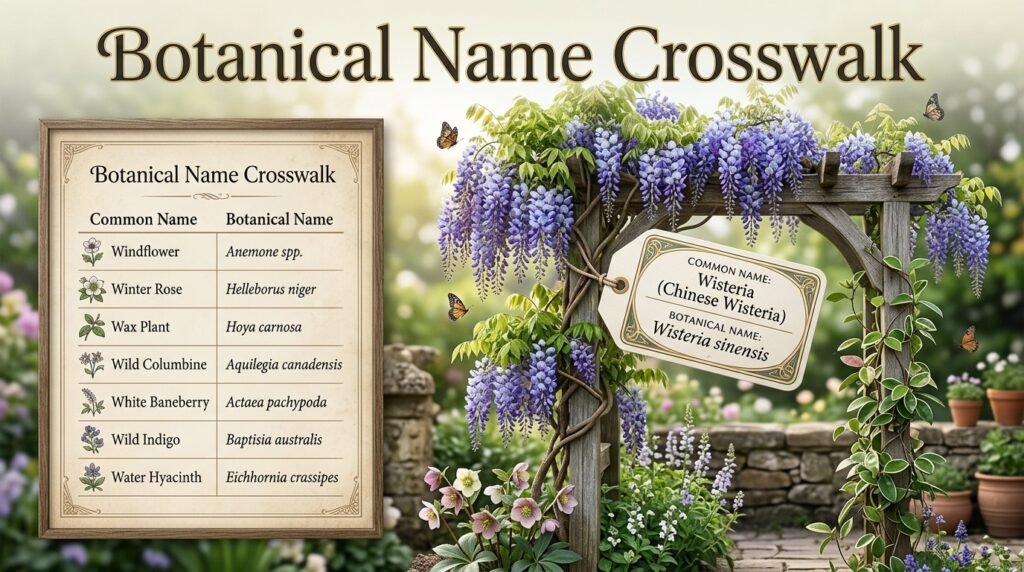
Image caption: A plant nursery tag showing both the common and botanical names for a wisteria vine.
| Common Name | Botanical Name |
| Windflower | Anemone spp. |
| Winter Rose | Helleborus niger |
| Wax Plant | Hoya carnosa |
| Wild Columbine | Aquilegia canadensis |
| White Baneberry | Actaea pachypoda |
| Wild Indigo | Baptisia australis |
| Water Hyacinth | Eichhornia crassipes |
Using the botanical name also prevents confusion between plants that share a common name but little else. “Winter rose,” for instance, gets used both for Helleborus niger and, in some regions, for certain camellia varieties that bloom around the same time. The botanical name always points to one exact species, which matters most when toxicity or care needs differ between the two.
Flower Meanings and Symbolism
Wisteria carries a rich symbolic history, particularly in Japanese culture, where it represents longevity, immortality, and the enduring nature of love. Its long lifespan, with some documented vines living well over a century, likely shaped this association with endurance. Victorian flower language leaned on a similar theme, tying wisteria to devotion and steadfastness in relationships.
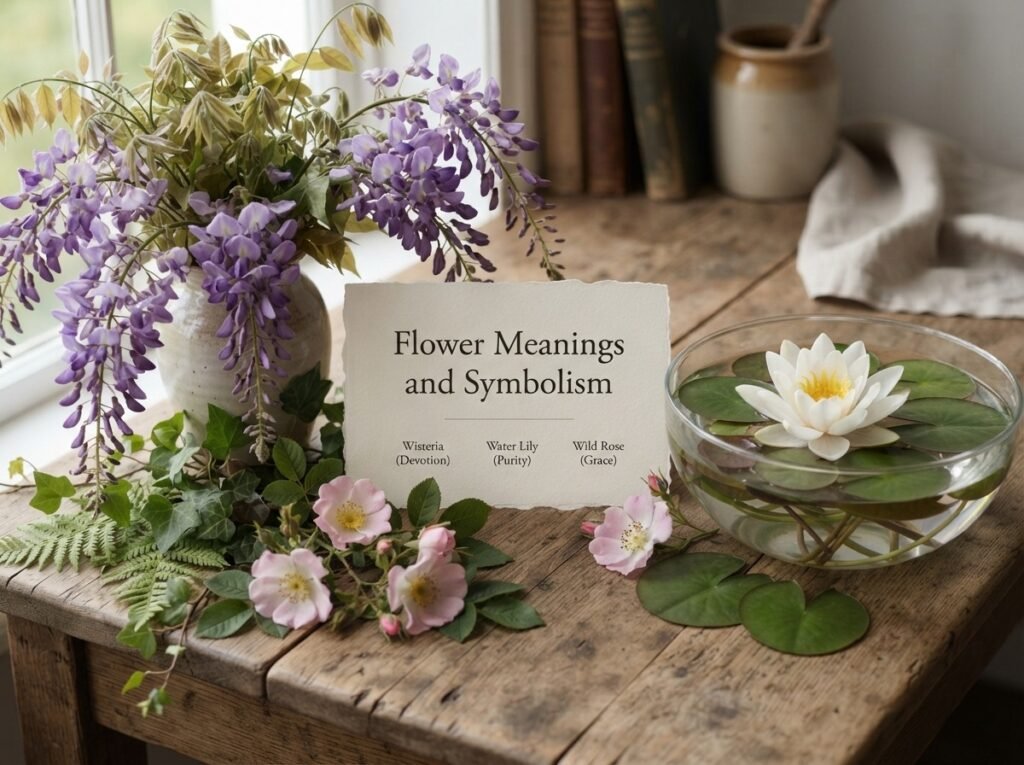
Image caption: A close-up of a single wisteria flower cluster against a clear blue sky. The water lily symbolizes purity and rebirth across several cultural traditions, partly because the flower rises fresh and clean each morning from muddy pond water below. Ancient Egyptian art featured it prominently for exactly this reason, associating the bloom with the sun’s daily rebirth. Buddhist and Hindu traditions carry a related meaning, linking the flower to spiritual awakening, rising above worldly difficulty.
Wallflower’s symbolism ties directly to its common name’s secondary meaning, representing someone who stays quietly in the background at a social gathering. Ironically, the flower itself is anything but shy, offering a strong fragrance and vivid color that stands out clearly in an early spring bed. Older flower-language traditions also linked it to faithfulness during difficulty, since it tends to bloom even in poor, rocky soil.
Wild rose symbolizes simplicity and a return to natural beauty, standing in deliberate contrast to the more elaborate symbolism attached to cultivated garden roses. Its single layer of five petals, rather than the dozens found on a modern hybrid, reinforced this reading of unpretentious charm. Some folklore traditions also tied it to enduring love, since wild rose hedges often outlive the gardeners who originally planted them.
Decision-Flow Table
Choosing the right W flower depends heavily on your space, light, and long-term goals for the bed, pond, or pot. The table below walks through common gardening scenarios and points toward a matching flower for each one. Use it as a fast reference when planning a new bed, filling a gap, or picking something for a specific spot.
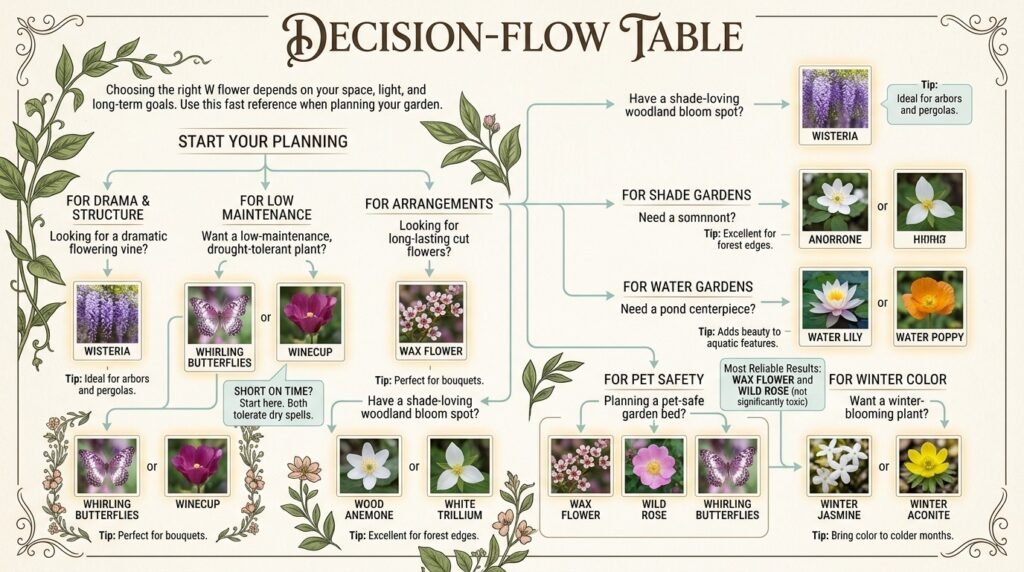
| If you want… | Choose this W flower |
| A dramatic flowering vine | Wisteria |
| A low-maintenance drought-tolerant plant | Whirling Butterflies or Winecup |
| A long-lasting cut flower | Wax Flower |
| A shade-loving woodland bloom | Wood Anemone or White Trillium |
| A pond or water garden centerpiece | Water Lily or Water Poppy |
| A pet-safe garden bed | Wax Flower, Wild Rose, or Whirling Butterflies |
| A winter-blooming plant | Winter Jasmine or Winter Aconite |
Gardeners short on time should start with whirling butterflies or winecup, since both tolerate dry spells and neglect once established. Anyone planning a pet-safe yard will get the most reliable results from wax flower and wild rose, neither of which carries significant toxicity concerns.
Conclusion
Flowers that start with W cover a real range, from the dramatic spring display of wisteria to the near-invisible bloom of Wolffia, the world’s smallest flowering plant. Water lily, wallflower, and wild rose anchor most gardens, while rarer picks like wandflower and Widow Iris reward more curious growers willing to search them out. The toxicity and life-cycle notes above should help you plant with more confidence around pets and children. Keep this list of flowers that start with W on hand as a lasting reference for your next planting season.
Frequently Asked Questions
What are some common flowers that start with W?
Wisteria, Water Lily, Wallflower, Winter Jasmine, and Wild Rose rank among the most widely grown flowers that start with W. Each suits a different garden style, from climbing vines to pond edges and early spring borders.
Are there any flowers that start with W that are toxic to pets?
Yes. Wisteria, winter aconite, white baneberry, and winter rose are all toxic if ingested by pets in meaningful amounts. Keep these away from curious cats and dogs, especially where pods or berries might attract attention.
Which W flower is best for a beginner gardener?
Whirling Butterflies is an excellent starting point. It tolerates poor soil and dry spells while blooming steadily from summer through fall with very little care.
Do any W flowers work well as houseplants?
Wax plant and wax begonia both do well indoors with bright, indirect light. Wishbone flower also adapts to a bright windowsill as long as its soil stays consistently moist.
What does a tiger lily flower symbolize?
The water lily symbolizes purity and rebirth across several cultural traditions. Its habit of rising clean from muddy water each morning has linked it to renewal since ancient times.
Is Wolffia something people can grow at home?
Technically, yes, since it thrives in still water, but its microscopic size makes it more of a scientific curiosity than a decorative water garden plant. Most home growers stick to larger, more visible aquatic flowers like water lilies instead.
Which W flowers attract the most pollinators?
Wisteria and wild indigo both draw bees heavily during their spring bloom windows. Whirling Butterflies also attract a steady stream of pollinators throughout its long summer-to-fall flowering period.
What is the difference between wisteria and wandflower?
Wisteria is a woody, climbing vine with cascading purple or white flower clusters, while wandflower is a much smaller South African bulb with thin, arching stems. The two are unrelated botanically despite both having a graceful, drooping bloom habit.
Can wisteria survive cold winters?
Yes, in most cases. Common wisteria species tolerate cold winters reasonably well, though flowering can be reduced if a hard late frost damages developing buds in early spring.
Why do some W flowers appear under both a common and a botanical name?
Nurseries often stock less common species under their botanical name only, since no widely used common name has ever developed. This is especially true for genera like Wahlenbergia, Westringia, and Wachendorfia, which stay largely unknown outside specialty growers.
Is winter rose safe to grow in a home garden?
With reasonable caution, yes. Winter rose, or hellebore, is toxic if ingested, so keeping pets and children from chewing on the leaves or roots is a sensible precaution rather than a reason to avoid the plant.
What is the best W flower for a pond or water garden?
Water lily is the strongest choice for ponds, offering reliable blooms and floating foliage that also helps shade the water and reduce algae growth. Water poppy is a smaller-scale alternative for shallower water features.