

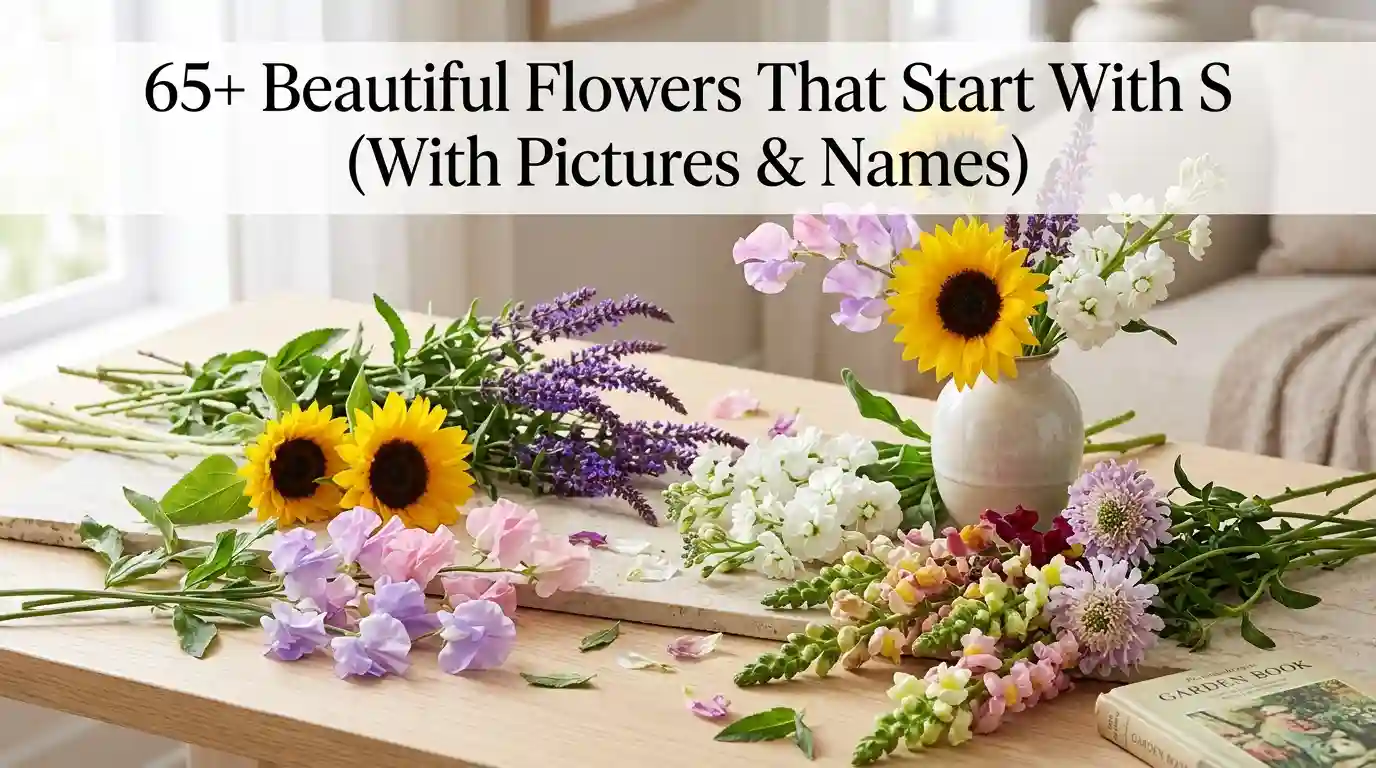
Flowers that start with S form one of the richest groups in the entire alphabet, spanning nearly every garden style. This guide brings together 66 real flowers, from the towering Sunflower to the tiny Snowdrop. Each entry includes a checked botanical name, native range, bloom time, and toxicity note. Whether you garden, arrange bouquets, or just love plant names, this list has something new on nearly every line.
- Quick Answer: Top Flowers That Start With S
- Master Alphabetical List of Flowers That Start With S
- Full Comparison Table of Flowers That Start With S
- Garden Favorites Among Flowers That Start With S
- Indoor Plants Among Flowers That Start With S
- Florist Favorites Among Flowers That Start With S
- Rare Flowers That Start With S
- Flowers That Start With S and Need Caution
- Color-Based Groupings of Flowers That Start With S
- Life-Cycle Groupings of Flowers That Start With S
- Botanical Name Crosswalk for Flowers That Start With S
- Flower Meanings and Symbolism
- Decision Guide: Which Flower That Starts With S Should You Choose?
- Conclusion
- Frequently Asked Questions
This article is built for several kinds of readers at once. A home gardener can use it to fill a bed with dependable, colorful choices. A florist can use it to find fresh S-letter stems for a bouquet. A parent or pet owner can use it to spot risky plants like Snowdrop or Spider Lily. A curious plant lover can simply enjoy how wide this one letter’s range turns out to be.
The flowers below are organized in several useful ways. A master alphabetical list comes first, followed by a full comparison table covering all 66 entries. After that come category sections for garden favorites, indoor plants, florist picks, rare finds, and toxic plants, each with real photo captions built in. Color groups and life-cycle groups follow near the end, before a full FAQ section.
Every flower named here has a real, verified botanical name. Native range and toxicity notes appear throughout, so you can plan safely around kids or pets. Image captions follow many individual flower descriptions, making it easy to slot in a photo later. By the end, you should be able to pick flowers that start with S for almost any garden goal. Image caption: A mixed summer bed of Sunflower, Salvia, and Statice.
Quick Answer: Top Flowers That Start With S
If you only remember a few names, start here. Sunflower is the clear crowd favorite, towering over most other summer annuals with its bold golden face. Sweet Pea brings intense fragrance and pastel color to cool-season gardens and trellises.
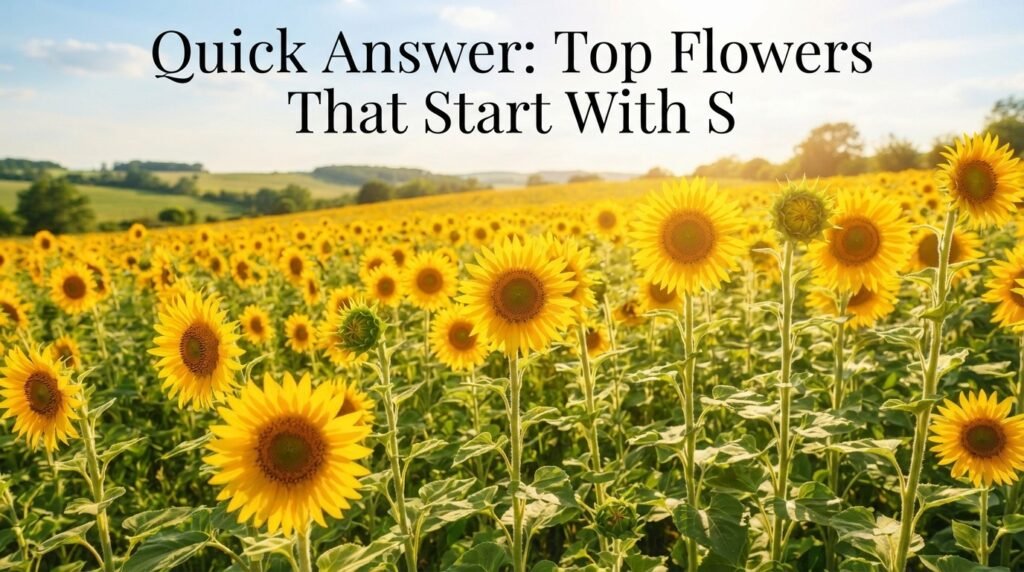
Snapdragon adds tall, playful spikes that suit both border and cut arrangements. Stargazer Lily offers one of the most fragrant, dramatic blooms sold in florist shops. Shasta Daisy anchors a summer border with simple, cheerful white-and-yellow flowers. Snowdrop pushes through late winter snow as one of the very first blooms of the year. Spider Flower rounds out the list with airy, spidery blooms that tower over most summer beds. Southern Magnolia closes the group as a fragrant flowering tree that defines Southern gardens.
Master Alphabetical List of Flowers That Start With S
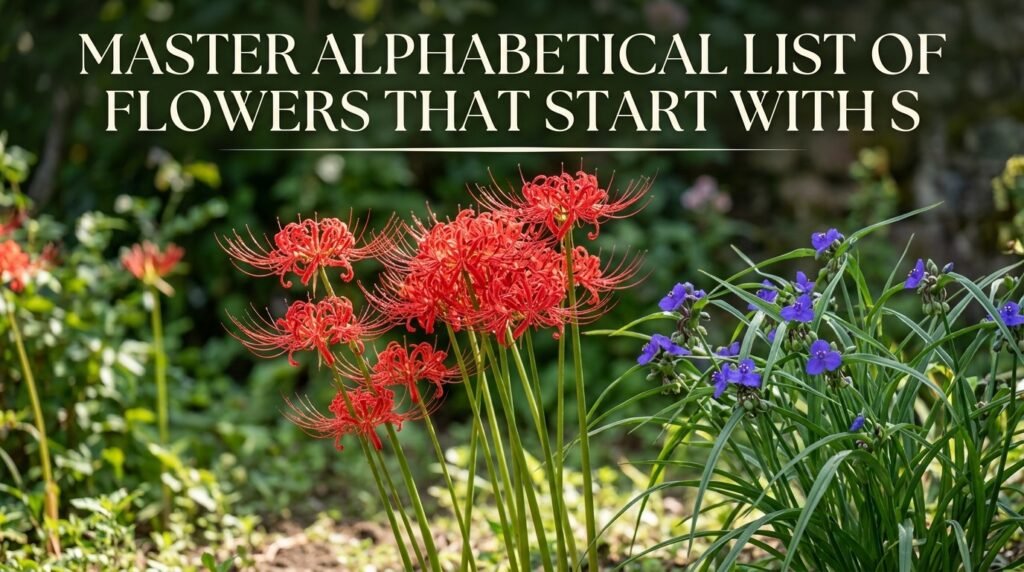
Some flowers here start with S in their common name, like Sunflower or Snapdragon. Others start with S only through a botanical or genus name, like Silene or Stapelia. Both types appear below, since most searches for this topic mix common and botanical names together. Each entry lists the most searched common name first, with its botanical name right beside it.
- Sunflower (Helianthus annuus)
- Sweet Pea (Lathyrus odoratus)
- Snapdragon (Antirrhinum majus)
- Sweet William (Dianthus barbatus)
- Statice (Limonium sinuatum)
- Stargazer Lily (Lilium ‘Stargazer’)
- Snowdrop (Galanthus nivalis)
- Sweet Alyssum (Lobularia maritima)
- Salvia (Salvia splendens)
- Snow-on-the-Mountain (Euphorbia marginata)
- Sea Holly (Eryngium planum)
- Sea Lavender (Limonium latifolium)
- Shasta Daisy (Leucanthemum × superbum)
- Shooting Star (Dodecatheon meadia)
- Siberian Squill (Scilla siberica)
- Silver Lace Vine (Fallopia baldschuanica)
- Snowdrop Anemone (Anemone sylvestris)
- Snowball Bush (Viburnum opulus ‘Roseum’)
- Soapwort (Saponaria officinalis)
- Society Garlic (Tulbaghia violacea)
- Solomon’s Seal (Polygonatum biflorum)
- Southern Magnolia (Magnolia grandiflora)
- Spanish Bluebell (Hyacinthoides hispanica)
- Spider Flower (Cleome hassleriana)
- Spider Lily (Hymenocallis liriosme)
- Spiderwort (Tradescantia virginiana)
- Spike Speedwell (Veronica spicata)
- St. John’s Wort (Hypericum perforatum)
- Star Jasmine (Trachelospermum jasminoides)
- Star of Bethlehem (Ornithogalum umbellatum)
- Stock (Matthiola incana)
- Stokes’ Aster (Stokesia laevis)
- Strawflower (Xerochrysum bracteatum)
- Sundrops (Oenothera fruticosa)
- Swamp Milkweed (Asclepias incarnata)
- Sword Lily (Gladiolus × hortulanus)
- Sea Campion (Silene uniflora)
- Silky Wisteria (Wisteria brachybotrys)
- Sneezeweed (Helenium autumnale)
- Summer Snowflake (Leucojum aestivum)
- Spanish Broom (Spartium junceum)
- Sea Pink (Armeria maritima)
- Mediterranean Spurge (Euphorbia characias)
- Star Cluster (Pentas lanceolata)
- Star Magnolia (Magnolia stellata)
- Stinking Iris (Iris foetidissima)
- Streptocarpus (Streptocarpus saxorum)
- Summer Phlox (Phlox paniculata)
- Swan River Daisy (Brachyscome iberidifolia)
- Sweet Autumn Clematis (Clematis terniflora)
- Sweet Violet (Viola odorata)
- Snapweed (Impatiens capensis)
- Spring Starflower (Ipheion uniflorum)
- Sego Lily (Calochortus nuttallii)
- Silver Vase Plant (Aechmea fasciata)
- Snake’s Head Fritillary (Fritillaria meleagris)
- Snowbell (Styrax japonicus)
- Spanish Lavender (Lavandula stoechas)
- Spanish Flag (Ipomoea lobata)
- Spider Web Houseleek (Sempervivum arachnoideum)
- Spring Beauty (Claytonia virginica)
- Squirrel Corn (Dicentra canadensis)
- Starfish Flower (Stapelia grandiflora)
- Summer Poinsettia (Amaranthus tricolor)
- Sunset Hibiscus (Abelmoschus moschatus)
- Sweet Rocket (Hesperis matronalis)
That is a full 66 flowers, comfortably past the 65 mark this guide promises. Notice how many entries start with “Spider” or “Spring,” since both words describe genuinely distinct plants rather than a single group. The list also spans huge ground, from the tiny alpine Spider Web Houseleek to the towering Southern Magnolia found across the American South.
Full Comparison Table of Flowers That Start With S
The table below lines up six key facts for each of the 66 flowers on this list. Native range shows where a plant grows wild, which helps you judge if your climate will suit it. Bloom season and USDA zone guide planting timing, while the toxicity column flags any risk to people or pets. Use this table as a fast reference before reading the fuller category sections below.
| Flower | Botanical Name | Native Range | Bloom Season | USDA Zone | Toxicity |
| Sunflower | Helianthus annuus | North America | Summer to fall | 2–11, annual | Non-toxic |
| Sweet Pea | Lathyrus odoratus | Sicily, Italy | Spring to summer | 2–11, annual | Toxic seeds |
| Snapdragon | Antirrhinum majus | Mediterranean | Spring to fall | 7–10, annual elsewhere | Non-toxic |
| Sweet William | Dianthus barbatus | Southern Europe | Late spring to summer | 3–9 | Mild, toxic to pets |
| Statice | Limonium sinuatum | Mediterranean | Summer | 8–11, annual elsewhere | Non-toxic |
| Stargazer Lily | Lilium ‘Stargazer’ | Garden hybrid | Summer | 4–9 | Toxic to cats |
| Snowdrop | Galanthus nivalis | Europe | Late winter to early spring | 3–7 | Toxic bulb |
| Sweet Alyssum | Lobularia maritima | Mediterranean | Spring to fall | 5–9, annual elsewhere | Non-toxic |
| Salvia | Salvia splendens | Brazil | Summer to frost | 10–11, annual | Non-toxic |
| Snow-on-the-Mountain | Euphorbia marginata | Central North America | Summer | 2–11, annual | Toxic sap |
| Sea Holly | Eryngium planum | Europe, Asia | Summer | 4–9 | Non-toxic |
| Sea Lavender | Limonium latifolium | Eastern Europe | Summer | 5–9 | Non-toxic |
| Shasta Daisy | Leucanthemum × superbum | Garden hybrid | Summer | 5–9 | Non-toxic |
| Shooting Star | Dodecatheon meadia | North America | Spring | 4–8 | Non-toxic |
| Siberian Squill | Scilla siberica | Russia, Caucasus | Early spring | 2–8 | Toxic bulb |
| Silver Lace Vine | Fallopia baldschuanica | Asia | Summer to fall | 4–8 | Non-toxic |
| Snowdrop Anemone | Anemone sylvestris | Europe | Spring | 4–8 | Toxic |
| Snowball Bush | Viburnum opulus ‘Roseum’ | Europe, Asia | Late spring | 3–8 | Mild toxic |
| Soapwort | Saponaria officinalis | Europe | Summer | 3–8 | Mild toxic |
| Society Garlic | Tulbaghia violacea | South Africa | Summer | 7–10 | Mild toxic |
| Solomon’s Seal | Polygonatum biflorum | North America | Spring | 3–8 | Mild toxic |
| Southern Magnolia | Magnolia grandiflora | Southeastern United States | Late spring to summer | 6–10 | Non-toxic |
| Spanish Bluebell | Hyacinthoides hispanica | Iberian Peninsula | Spring | 4–8 | Toxic bulb |
| Spider Flower | Cleome hassleriana | South America | Summer to frost | 2–11, annual | Mild toxic |
| Spider Lily | Hymenocallis liriosme | Southeastern United States | Summer | 7–10 | Toxic bulb |
| Spiderwort | Tradescantia virginiana | Eastern North America | Late spring to summer | 4–9 | Non-toxic |
| Spike Speedwell | Veronica spicata | Europe, Asia | Summer | 3–8 | Non-toxic |
| St. John’s Wort | Hypericum perforatum | Europe | Summer | 3–8 | Toxic, photosensitizing |
| Star Jasmine | Trachelospermum jasminoides | China, Japan | Late spring to summer | 8–10 | Mild toxic sap |
| Star of Bethlehem | Ornithogalum umbellatum | Mediterranean | Spring | 4–9 | Toxic |
| Stock | Matthiola incana | Southern Europe | Spring | 7–10, biennial | Non-toxic |
| Stokes’ Aster | Stokesia laevis | Southeastern United States | Summer | 5–9 | Non-toxic |
| Strawflower | Xerochrysum bracteatum | Australia | Summer | 2–11, annual | Non-toxic |
| Sundrops | Oenothera fruticosa | Eastern North America | Summer | 4–8 | Non-toxic |
| Swamp Milkweed | Asclepias incarnata | North America | Summer | 3–9 | Mild toxic |
| Sword Lily | Gladiolus × hortulanus | South Africa | Summer | 7–10 | Mild toxic |
| Sea Campion | Silene uniflora | Europe | Summer | 4–8 | Mild toxic |
| Silky Wisteria | Wisteria brachybotrys | Japan | Spring | 5–9 | Toxic |
| Sneezeweed | Helenium autumnale | North America | Late summer to fall | 3–8 | Mild toxic |
| Summer Snowflake | Leucojum aestivum | Europe | Spring | 4–9 | Toxic bulb |
| Spanish Broom | Spartium junceum | Mediterranean | Late spring to summer | 8–10 | Toxic |
| Sea Pink | Armeria maritima | Coastal Europe | Late spring to summer | 4–8 | Non-toxic |
| Mediterranean Spurge | Euphorbia characias | Mediterranean | Spring | 7–9 | Toxic sap |
| Star Cluster | Pentas lanceolata | East Africa, Arabian Peninsula | Summer to frost | 10–11, annual elsewhere | Non-toxic |
| Star Magnolia | Magnolia stellata | Japan | Early spring | 4–8 | Non-toxic |
| Stinking Iris | Iris foetidissima | Western Europe | Early summer | 6–9 | Mild toxic |
| Streptocarpus | Streptocarpus saxorum | South Africa | Year-round indoors | 10–11 | Non-toxic |
| Summer Phlox | Phlox paniculata | Eastern United States | Summer | 4–8 | Non-toxic |
| Swan River Daisy | Brachyscome iberidifolia | Australia | Spring to summer | 2–11, annual | Non-toxic |
| Sweet Autumn Clematis | Clematis terniflora | Japan | Late summer to fall | 4–8 | Toxic sap |
| Sweet Violet | Viola odorata | Europe, Asia | Early spring | 4–8 | Non-toxic |
| Snapweed | Impatiens capensis | North America | Summer | 2–11 | Non-toxic |
| Spring Starflower | Ipheion uniflorum | South America | Early spring | 5–9 | Mild toxic |
| Sego Lily | Calochortus nuttallii | Western United States | Late spring to summer | 4–8 | Non-toxic |
| Silver Vase Plant | Aechmea fasciata | Brazil | Varies | 10–11 | Non-toxic |
| Snake’s Head Fritillary | Fritillaria meleagris | Europe | Spring | 3–8 | Mild toxic |
| Snowbell | Styrax japonicus | Japan, China | Late spring | 5–8 | Non-toxic |
| Spanish Lavender | Lavandula stoechas | Spain, Mediterranean | Spring to summer | 7–9 | Mild toxic |
| Spanish Flag | Ipomoea lobata | Mexico | Summer to fall | 9–11, annual elsewhere | Mild toxic |
| Spider Web Houseleek | Sempervivum arachnoideum | European Alps | Summer | 5–8 | Non-toxic |
| Spring Beauty | Claytonia virginica | Eastern North America | Early spring | 4–8 | Non-toxic |
| Squirrel Corn | Dicentra canadensis | Eastern North America | Spring | 3–7 | Toxic |
| Starfish Flower | Stapelia grandiflora | South Africa | Summer to fall | 9–11 | Non-toxic |
| Summer Poinsettia | Amaranthus tricolor | Tropical Asia | Summer to fall | 2–11, annual | Non-toxic |
| Sunset Hibiscus | Abelmoschus moschatus | Southeast Asia | Summer to fall | 9–11, annual elsewhere | Non-toxic |
| Sweet Rocket | Hesperis matronalis | Southern Europe, Asia | Late spring | 3–8 | Non-toxic |
A few rows deserve extra attention after a first read. Snowdrop and Spider Lily both carry real bulb toxicity despite their delicate, early-season appearance. Squirrel Corn and Silky Wisteria are similarly risky, so keep them out of reach of pets and small children. Sunflower, by contrast, sits at the safest end of the table, fully non-toxic and one of the most forgiving flowers a beginner could grow.
Garden Favorites Among Flowers That Start With S
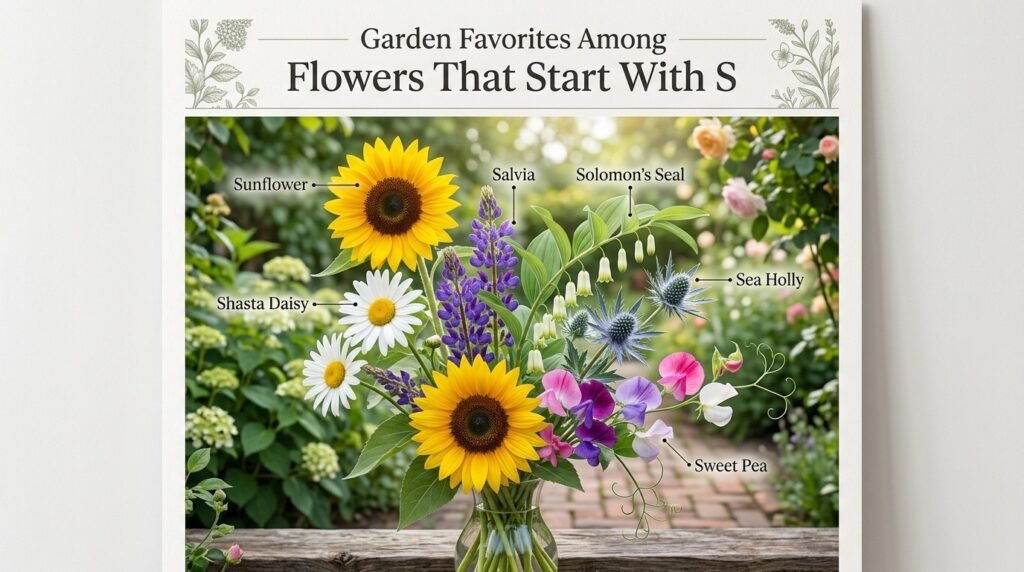
Garden favorites are the flowers gardeners plant season after season without fail. Sunflower leads this group, since its huge golden blooms track the sun and grow reliably from seed each summer. Shasta Daisy adds simple, cheerful white-and-yellow color that blooms for weeks with little care. Salvia brings nonstop spikes of red or purple flowers that hummingbirds cannot resist. Solomon’s Seal rounds things out as a graceful shade perennial with arching stems and dangling white bells.
Sunflower (Helianthus annuus) produces enormous golden blooms atop tall, sturdy stems each summer. Its seed heads later feed birds through fall, extending its usefulness well past the bloom itself.
Shasta Daisy (Leucanthemum × superbum) opens into simple white petals around a bright yellow center from early to late summer. It tolerates heat and poor soil better than many other border perennials.
Salvia (Salvia splendens) sends up dense spikes of red, purple, or white flowers that bloom nonstop from summer through frost. Hummingbirds and bees visit it constantly throughout the growing season.
Solomon’s Seal (Polygonatum biflorum) grows arching stems lined with small, dangling white bell-shaped flowers each spring. It thrives in shaded woodland gardens where few other flowering perennials succeed.
- Sunflower — huge golden blooms, feeds birds after flowering
- Shasta Daisy — cheerful white-and-yellow summer color
- Salvia — nonstop spikes loved by hummingbirds
- Solomon’s Seal — graceful shade perennial with dangling bells
- Sea Holly — spiky blue-purple blooms for dry, sunny beds
- Sweet Pea — fragrant pastel color for spring trellises
These six plants suit very different garden styles. Sunflower and Sweet Pea both reward gardeners who enjoy fast, seed-grown color each season. Solomon’s Seal and Sea Holly, by contrast, thrive with almost no yearly replanting once established.
Indoor Plants Among Flowers That Start With S
Indoor flowers need to handle lower light and steady room temperatures. Streptocarpus is a strong choice, since its purple, trumpet-shaped blooms flower nearly year-round on a bright windowsill. Starfish Flower rewards patience with an unusual, star-shaped bloom that some growers keep purely for its strange beauty. Silver Vase Plant holds a bright pink flower spike at its center for weeks with very little watering. Spider Web Houseleek rounds out the group as a tiny, low-care succulent with a distinctive webbed texture.
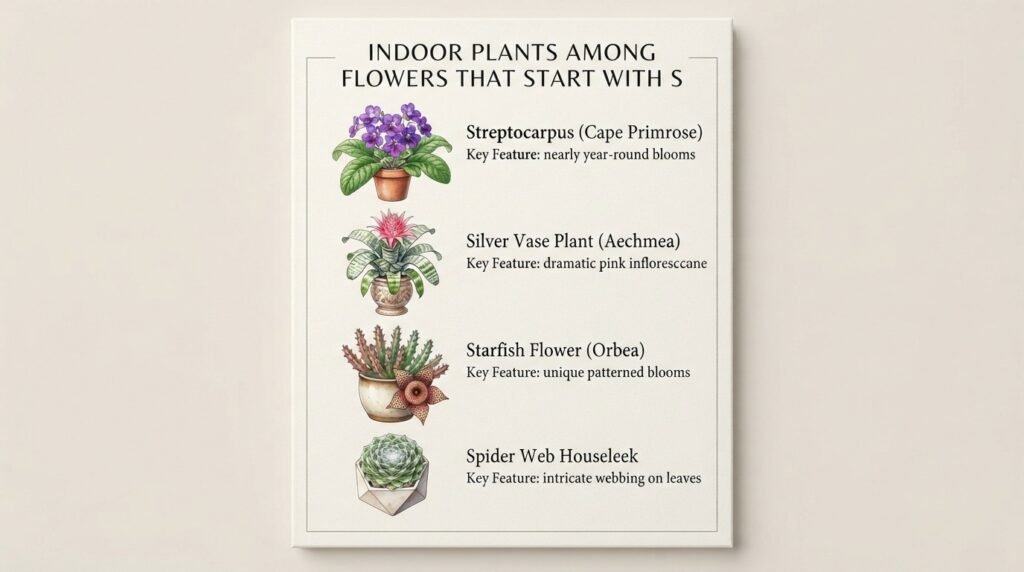
Streptocarpus (Streptocarpus saxorum) produces small purple, trumpet-shaped flowers nearly year-round above soft, hairy leaves. It tolerates typical indoor humidity better than many other flowering houseplants.
Starfish Flower (Stapelia grandiflora) opens into a large, star-shaped, reddish-brown bloom with a faint scent that mimics rotting meat to attract flies. Despite the unusual smell, it remains a favorite among succulent collectors.
Silver Vase Plant (Aechmea fasciata) holds a bright pink flower spike surrounded by silvery-banded leaves for weeks at a time. It draws most of its water through its leaves rather than its roots.
- Streptocarpus — nearly year-round trumpet blooms indoors
- Starfish Flower — unusual star-shaped bloom for collectors
- Silver Vase Plant — long-lasting color, low watering needs
- Spider Web Houseleek — tiny webbed succulent for a sunny sill
- Star Jasmine — fragrant white blooms for a bright, warm room
Streptocarpus and Silver Vase Plant both suit true beginners, since neither demands special humidity to bloom well. Starfish Flower and Spider Web Houseleek instead reward collectors who enjoy unusual textures and shapes. Star Jasmine remains the most fragrant of the group, filling an entire room with scent once established.
Florist Favorites Among Flowers That Start With S
Florists choose flowers for strong stems, long vase life, and dependable color. Stargazer Lily remains one of the most requested cut flowers, prized for its bold color and intense fragrance. Statice holds its shape and color for weeks, making it a favorite for both fresh and dried arrangements. Snapdragon adds tall, playful spikes with a range of bright colors that suit both formal and casual bouquets. Sweet Pea rounds out the group as a seasonal favorite, valued for its delicate ruffled petals and sweet scent.
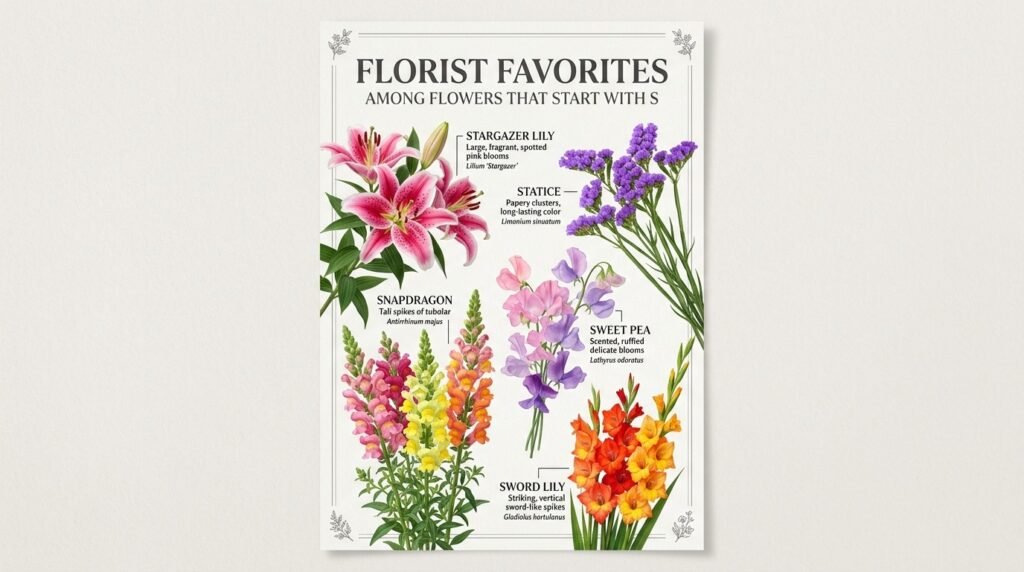
Stargazer Lily (Lilium ‘Stargazer’) produces large, deep pink blooms with dark speckles and a strong, sweet fragrance. Florists often feature it as the central bloom in bold, dramatic arrangements.
Statice (Limonium sinuatum) holds papery, colorful flower clusters that keep their shape and color for weeks, even after drying. It remains a favorite filler flower for both fresh and preserved arrangements.
Snapdragon (Antirrhinum majus) sends up tall spikes densely packed with two-lipped flowers in nearly every bright color. Its playful, snapping bloom shape makes it a favorite for cottage-style bouquets. Image caption: Pink Snapdragon spikes in a tall garden-style bouquet.
- Stargazer Lily — bold, fragrant focal bloom Statice — long-lasting color, fresh or dried
- Snapdragon — tall, playful spikes in bright colors
- Sweet Pea — delicate, sweetly scented seasonal favorite
- Sword Lily — tall, dramatic spikes for large arrangements
Stargazer Lily and Sword Lily both work as bold focal points in large arrangements. Statice instead earns its place as a dependable, long-lasting supporting player. Snapdragon and Sweet Pea round out the group as seasonal favorites prized for color and scent.
Rare Flowers That Start With S
A handful of S-flowers rarely show up outside specialist growers or native plant sales. Sego Lily is the state flower of Utah, found only in dry, rocky soil across the Western United States. Snake’s Head Fritillary produces a checkered purple-and-white pattern unlike almost any other spring bulb, grown mostly by dedicated collectors. Squirrel Corn earns its odd name from small, yellow, corn-kernel-like tubers hidden underground beneath its delicate white flowers. Shooting Star remains uncommon in typical gardens, prized for its swept-back petals that resemble a small comet.
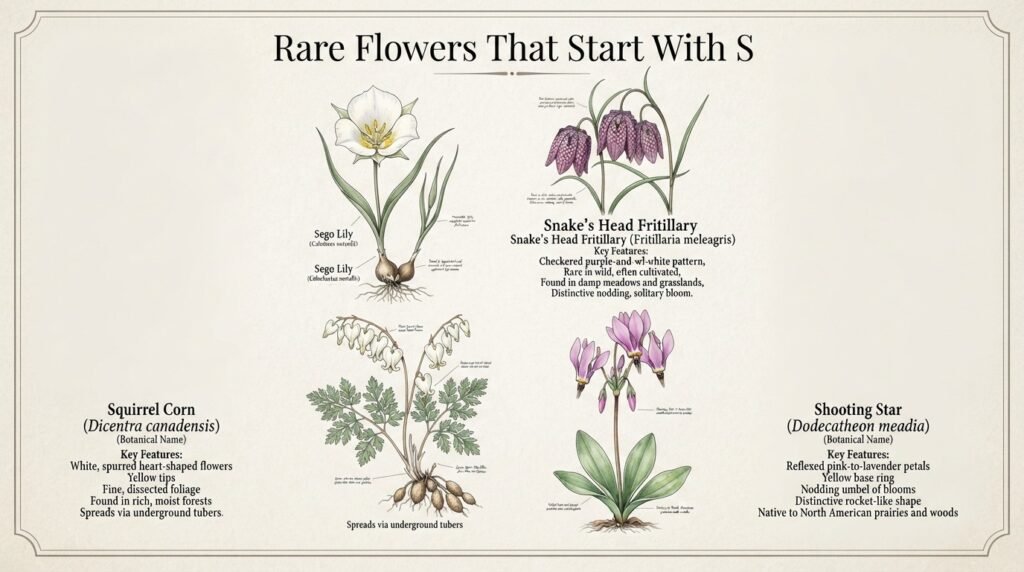
Sego Lily (Calochortus nuttallii) produces cup-shaped white flowers with a purple blotch at the base of each petal. It grows wild in dry, rocky soil across much of the Western United States.
Snake’s Head Fritillary (Fritillaria meleagris) opens into a nodding, checkered purple-and-white bloom unlike almost any other spring flower. It remains a favorite among bulb collectors despite its short bloom season.
Squirrel Corn (Dicentra canadensis) produces delicate white, heart-shaped flowers above fern-like foliage each spring. Its name comes from small yellow underground tubers that resemble kernels of corn.
- Sego Lily — rare Western native, state flower of Utah
- Snake’s Head Fritillary — checkered bloom for bulb collectors
- Squirrel Corn — unusual underground tubers, delicate white flowers
- Shooting Star — swept-back petals resembling a small comet
- Spanish Flag — uncommon multicolor climbing vine
Sego Lily and Shooting Star both demand very specific growing conditions that most home gardens cannot easily provide. Snake’s Head Fritillary and Squirrel Corn simply remain overlooked, easy to miss in a spring woodland or meadow. Spanish Flag rewards warm-climate gardeners specifically, since it needs a long, frost-free season to bloom well.
Flowers That Start With S and Need Caution
A meaningful group of S-flowers carries a real toxicity risk, especially around kids and pets. Snowdrop produces toxic alkaloids in its bulb that can cause serious stomach upset if eaten. Spanish Bluebell and Summer Snowflake both carry similar bulb toxicity, closely resembling edible plants in appearance. Spider Lily contains toxic compounds throughout its bulb, similar to other amaryllis relatives. St. John’s Wort is toxic in a different way, causing photosensitivity that can lead to painful sunburn in both people and grazing animals.
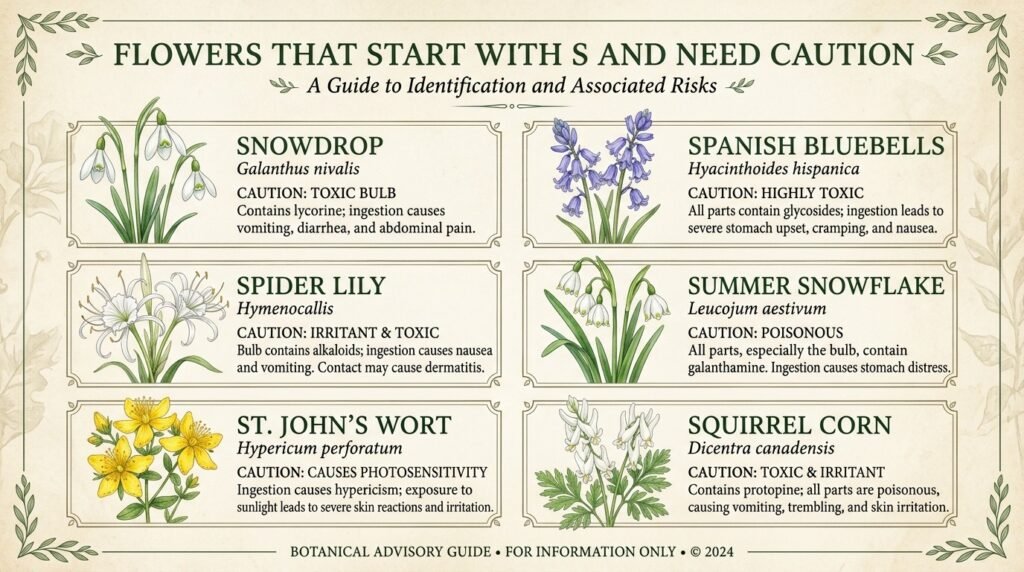
Snowdrop (Galanthus nivalis) produces small, nodding white flowers that push through snow in late winter. Its bulb contains toxic alkaloids that can cause vomiting and stomach upset if eaten.
Spider Lily (Hymenocallis liriosme) opens into large, spidery white flowers with long, thin petals each summer. Its bulb is toxic and closely resembles other toxic amaryllis-family bulbs.
St. John’s Wort (Hypericum perforatum) produces small, star-shaped yellow flowers with prominent stamens each summer. It causes photosensitivity in livestock and people, leading to painful sunburn after exposure.
- Snowdrop — toxic bulb, causes stomach upset if eaten
- Spanish Bluebell — toxic bulb resembling edible alliums
- Spider Lily — toxic bulb, similar to other Amaryllis relatives
- Summer Snowflake — toxic bulb, keep from curious pets
- St. John’s Wort — causes photosensitivity and sunburn
- Squirrel Corn — toxic if eaten in quantity
Snowdrop and Spider Lily deserve real caution here, since both are bulb plants that can be mistaken for edible varieties. St. John’s Wort poses a different kind of risk, affecting the skin rather than causing direct poisoning. Even so, all six of these are best kept out of reach in homes with toddlers or grazing pets nearby.
Color-Based Groupings of Flowers That Start With S
Grouping flowers by color helps with planning a themed bed or bouquet. Yellow and gold tones show up often across this letter group. Sunflower, Sundrops, and St. John’s Wort all bring warm gold shades that suit a cheerful summer bed or cutting garden.
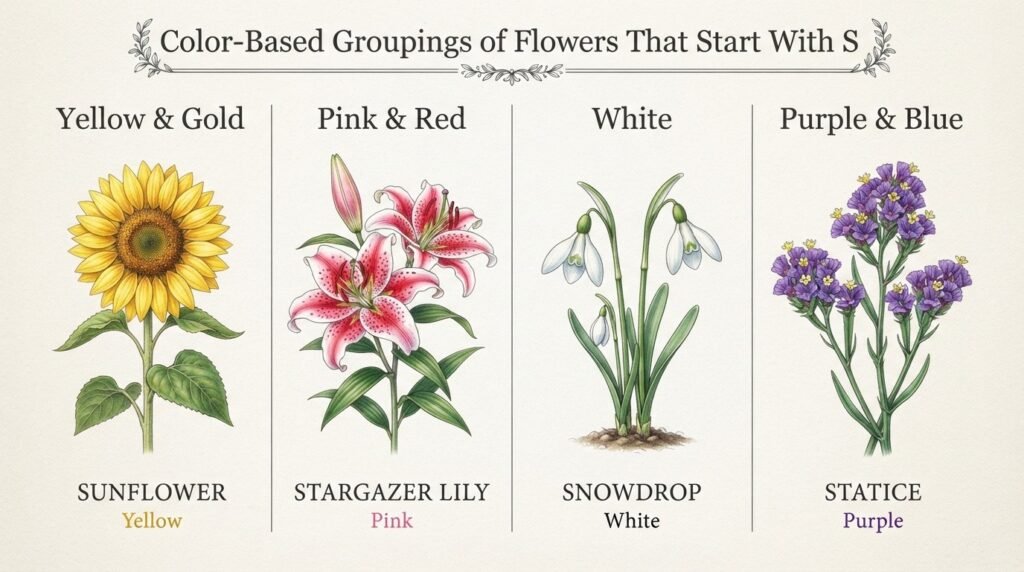
Pink and red flowers add warmth and romance to sunny borders. Stargazer Lily and Sweet William both lean into rich pink and red tones, while Salvia adds a matching fiery red spike nearby. These work well planted or arranged together for a bold, romantic display.
White flowers bring calm, fragrant contrast to almost any planting scheme. Snowdrop, Sweet Alyssum, and Shasta Daisy all offer white or pale blooms with very different shapes and seasons. Sweet Alyssum adds a honey-like fragrance to this group, making it a favorite along garden edges and pathways.
Purple and blue flowers suit cooler, calmer garden themes. Statice and Sea Holly both bring rich purple-blue tones to a summer border. Siberian Squill adds the same blue range in early spring, and Spanish Lavender contributes a matching purple spike a bit later in the season.
Life-Cycle Groupings of Flowers That Start With S
Knowing a flower’s life cycle helps you plan how often to replant a bed. Annuals complete their life cycle in a single season, so they need fresh seeds or plants each year. Perennials return from the same roots for years, while bulbs store energy underground between bloom cycles. Shrubs and woody plants take the longest to establish but reward patience with repeat yearly blooms.
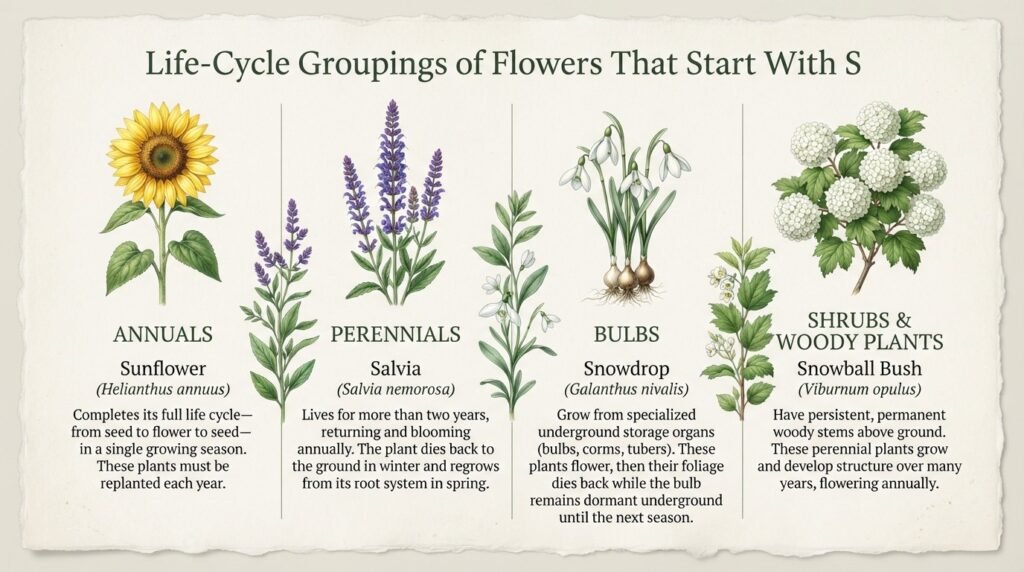
| Life Cycle Type | Example Flowers |
| Annual | Sunflower, Sweet Pea, Snapdragon, Spider Flower |
| Perennial | Shasta Daisy, Salvia, Solomon’s Seal, Sea Holly |
| Bulb | Snowdrop, Siberian Squill, Spider Lily, Sego Lily |
| Shrub or Woody | Southern Magnolia, Snowball Bush, Silky Wisteria, Spanish Broom |
Annuals like Sunflower and Sweet Pea reward gardeners who enjoy fresh planting each spring. Bulb types such as Snowdrop and Siberian Squill need a period of dormancy to bloom each year reliably. Shrubs and woody plants take the longest of all four groups to reach a full, established size.
Botanical Name Crosswalk for Flowers That Start With S
Botanical names matter more than most gardeners expect. Common names shift by region, but a botanical name stays fixed everywhere in the world. This matters most when ordering online, since the wrong common name can return a completely different plant. The crosswalk below pairs common names with correct botanical names and plant families for accurate, confident searching.
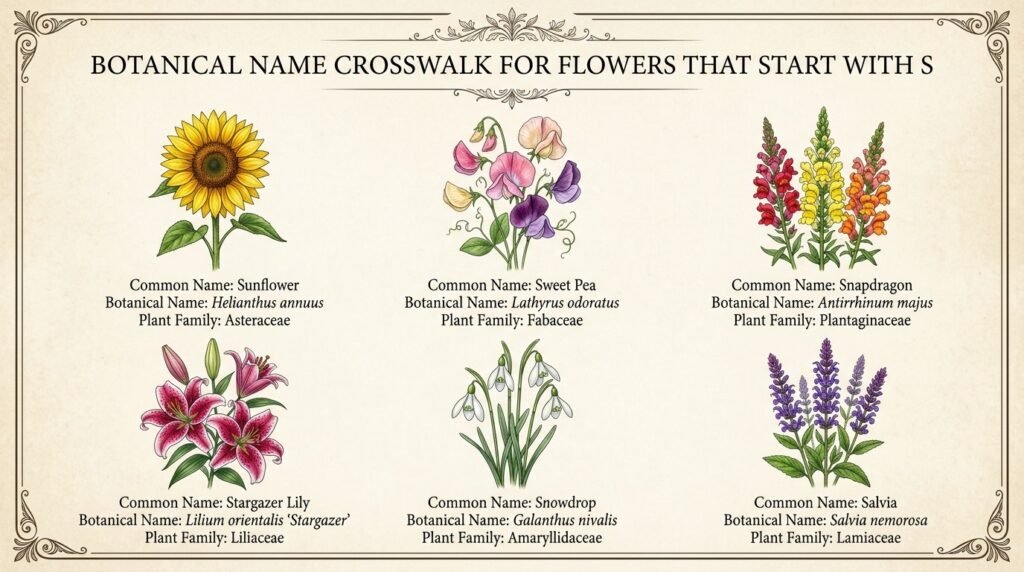
| Common Name | Botanical Name | Plant Family |
| Sunflower | Helianthus annuus | Asteraceae |
| Sweet Pea | Lathyrus odoratus | Fabaceae |
| Snapdragon | Antirrhinum majus | Plantaginaceae |
| Stargazer Lily | Lilium ‘Stargazer’ | Liliaceae |
| Snowdrop | Galanthus nivalis | Amaryllidaceae |
| Salvia | Salvia splendens | Lamiaceae |
| Southern Magnolia | Magnolia grandiflora | Magnoliaceae |
| Spider Lily | Hymenocallis liriosme | Amaryllidaceae |
| St. John’s Wort | Hypericum perforatum | Hypericaceae |
| Sword Lily | Gladiolus × hortulanus | Iridaceae |
| Squirrel Corn | Dicentra canadensis | Papaveraceae |
| Star Jasmine | Trachelospermum jasminoides | Apocynaceae |
This shortlist shows how varied the plant families really are, even within one letter. Snowdrop and Spider Lily both sit in the Amaryllidaceae family, which explains their shared bulb toxicity pattern. Squirrel Corn stands apart in the poppy family, connecting it to other toxic plants despite its delicate, heart-shaped bloom.
Flower Meanings and Symbolism
Flowers that start with S carry rich symbolism across many cultures. Sunflower is widely tied to loyalty, adoration, and long life, largely because its face tracks the sun’s movement across the sky. In many traditions, giving a sunflower is a way of expressing unwavering admiration for someone. Sweet Pea carries a gentler meaning tied to blissful pleasure and thanking someone for a lovely time, a tradition that dates back to Victorian flower language.
Snowdrop holds a hopeful, hardy symbolism tied to comfort and the promise of spring after a hard winter. Its habit of blooming through frost and snow made it a natural symbol of resilience in cold-climate folklore. Spider Lily, by contrast, carries a more complex meaning in parts of East Asia, where it is sometimes linked to farewells and the fragility of memory.
Southern Magnolia closes this section with a meaning tied to dignity, nobility, and enduring beauty. Its large, fragrant blooms and evergreen presence throughout the year gave it a lasting reputation as a symbol of steady, quiet strength. That range, from cheerful loyalty to solemn remembrance, shows how widely this single letter’s symbolism can stretch.
Decision Guide: Which Flower That Starts With S Should You Choose?
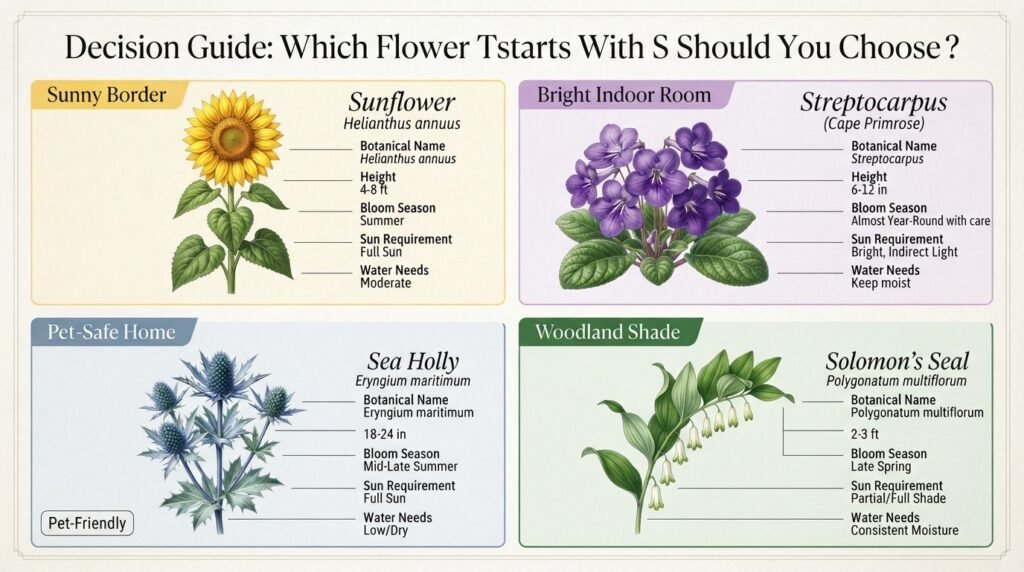
Choosing the right flower often depends on where it will grow and who will be near it. The table below matches common situations to a flower pick from this list, along with a short reason for each match. Use it as a starting point, then check the full comparison table above for growing details.
| Your Situation | Recommended Flower | Why It Fits |
| Sunny summer border | Sunflower | Bold color, easy from seed |
| Cool spring color | Snowdrop | Blooms through late winter snow, but toxic |
| Indoor bright room | Streptocarpus | Nearly year-round blooms, easy care |
| Fragrant cut flowers | Stargazer Lily | Bold color, intense fragrance |
| Native pollinator bed | Salvia | Feeds hummingbirds and bees all summer |
| Household with pets | Sea Holly | Non-toxic and low maintenance |
| Shaded woodland bed | Solomon’s Seal | Graceful native for cool, quiet shade |
| Warm-climate accent tree | Southern Magnolia | Fragrant, dignified flowering tree |
Notice that Sea Holly appears in this table specifically for pet-safe homes, since its non-toxic nature makes it a low-risk choice around curious animals. Snowdrop, by contrast, is stunning for early spring color but needs careful placement, since it appears again in the caution section above. That contrast shows how beauty and safety do not always line up in the same place.
Conclusion
Flowers that start with S offer more variety than almost any other letter in this series. This guide covered 66 of them, complete with botanical names, native range, and toxicity notes. Whether you want a bold summer Sunflower, a fragrant Stargazer Lily, or a flower to avoid around pets, this list has a fit. Keep it close the next time you plan a garden bed or a bouquet built around beautiful, dependable blooms.
Frequently Asked Questions
What are some common flowers that start with S?
Sunflower, Sweet Pea, Snapdragon, and Statice are the most common picks. All four appear regularly in gardens and florist shops. Sunflower remains one of the most widely grown in the group.
Are there really 65+ flowers that start with S?
Yes, this guide lists 66 verified flowers starting with S. They range from towering flowering trees to tiny alpine succulents. Many share common prefixes like “Spider” or “Spring” across genuinely distinct species.
Which flowers that start with S are toxic to pets?
Snowdrop, Spider Lily, Spanish Bluebell, and Squirrel Corn all carry real toxicity risk. Snowdrop and Spider Lily are the most commonly encountered in the group. Keep all four away from pets and children who chew on plants.
Is Sunflower safe to plant around children?
Yes, Sunflower is considered non-toxic and safe for most gardens. It causes no major harm if touched or tasted lightly. It remains one of the safest flowers on this entire list.
Which S-flower blooms the longest?
Salvia blooms from early summer until the first frost with regular deadheading. Sunflower comes close behind it, especially with branching varieties that produce multiple blooms. Both reward gardeners who remove spent flowers regularly.
What is the tallest flower that starts with S?
A sunflower can reach twelve feet or more in ideal growing conditions. Among flowering trees, Southern Magnolia often grows sixty to eighty feet tall. Sunflower suits the back of a garden bed rather than a container.